



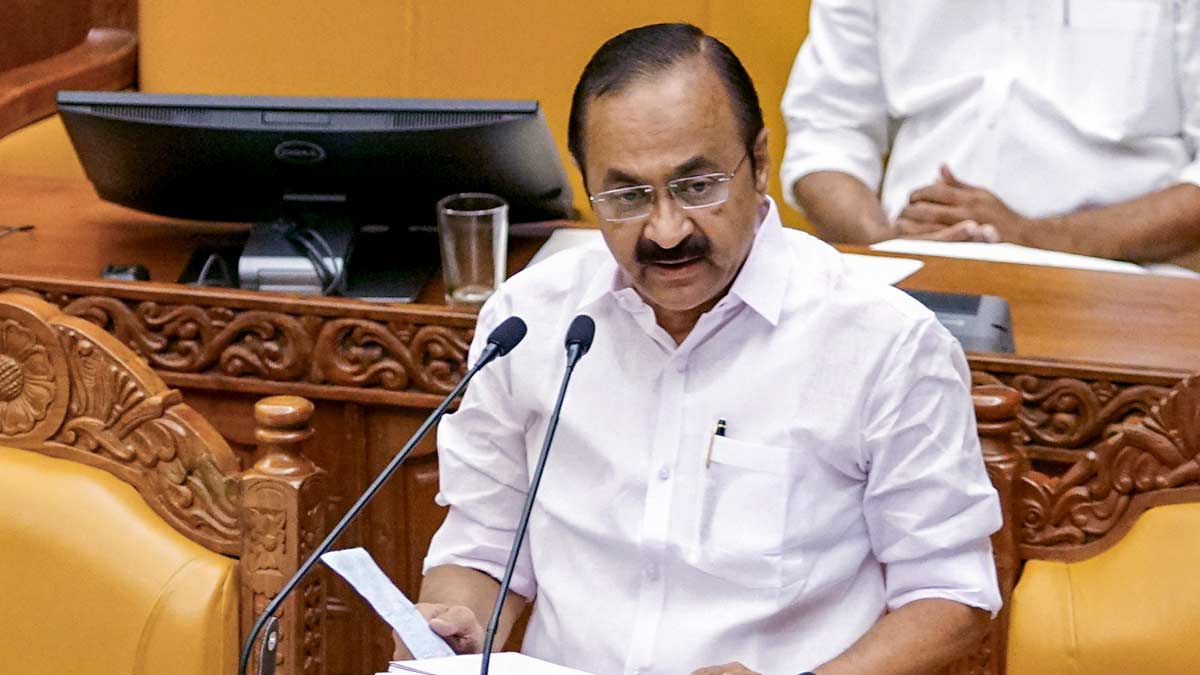
The Kerala government concluded its three-day 'Reimagining Keralam' exercise pointing to a new economic strategy for the state that seeks to convert its human capital, diaspora, research base, natural assets and traditional industries into globally competitive sources of jobs and investment.
However, most of the ideas remain at the roadmap, feasibility-study, or DPR stage.
The most revealing takeaway from Kerala’s three-day exercise is not any single project. It is the emerging idea of what the state’s next economic model should look like.
The 35 transformational projects discussed at the event range from a Global Gold Hub and a Knowledge Valley to a Global Job Watch Tower, an international maritime museum, new pilgrimage circuits, and a revamped Muziris Heritage Project.
The stated objective of the exercise was to put these projects on defined implementation pathways, including feasibility studies, master plans, DPRs and consultancy engagements.
The central problem is jobs
Employment ran through almost every discussion at this excercise.
A Global Job Watch Tower, envisaged as an intelligence layer over existing labour-market databases, is perhaps the clearest acknowledgement that Kerala's education system and labour market need to be better connected.
The proposed platform will track changing occupational demand, emerging skills, employment-driven migration and shifts in domestic and international job markets. The meeting brought together senior officials from the Higher Education as well as stakeholders from various domains including startup and skill development missions.
Notably a key discussion emerged that the system should look beyond conventional job-market data and identify occupations and opportunities unfamiliar to students and educators.
It was suggested that the Digital Workforce Management System—operated by the Kerala Development and Innovation Strategic Council (K-DISC)—could be used as the base layer for the Global Job Watch Tower while adding advanced analytical capabilities to identify where the labour market is heading.
Integration with EPFO and ESIC data was suggested to provide a more accurate picture of actual employment growth.
It was also pointed out that Kerala’s higher education system produces graduates who are more employable than graduates from other states; however, the state also records the highest educated unemployment.
DWMS currently has more than 20 lakh registered job seekers, 7,000 employers, and 54 lakh jobs aggregated from LinkedIn and Foundit, while only about 4,000 registered users are currently active job seekers. The proposal is to integrate employment data, potentially including EPFO and ESIC information, to get a clearer picture of actual job creation.
The discussion also goes beyond conventional white-collar employment.
Data centres and global capability centres, for instance, could generate demand for electricians and fitters, while international employers could provide feedback on language, cultural orientation and workplace readiness.
Building around existing strengths
Dicussions also came up around traditional economic strengths and adding value to sectors in which the state already has an ecosystem. The proposed Global Gold Hub and Jewellery Park is a good example.
Kerala wants to bring refining, recycling, manufacturing, hallmarking, testing, design, logistics and trade together in an integrated 35-acre facility, potentially through a public-private partnership. The absence of licensed gold refineries is identified as a gap that the project could address.
The proposal also seeks to formalise parts of the unorganised gold sector while introducing modern manufacturing, design and skill-development facilities.
The Thrissur-Kochi corridor has been identified as a possible location because of the concentration of jewellery manufacturing in the region.
The same principle appears in MSMEs. Rather than merely encouraging more small businesses, the discussions focused on credit, technology, intellectual property, exports, and market demand. Seafood, aquaculture, plywood, and rubber were identified as areas with potential.
The proposal for a possible ₹100-crore state credit-guarantee window is particularly significant because access to bank finance was identified as a barrier for startups and innovative MSMEs. Participants also called for better technology-transfer mechanisms to take innovations from development to commercialisation.
Knowledge base into an economic asset
Perhaps the most ambitious conceptual shift is the proposed Kerala Knowledge Valley and Research Park.
The idea is explicitly not to create another standalone institution, but to connect universities, research institutions, industry, international universities and private capital. The proposed Research Park would focus on centres of excellence, shared infrastructure, technology transfer, prototyping and deep-tech development.
The proposal recognises a familiar Kerala paradox: the state has considerable educational and research capacity, but much of that knowledge does not reach the market.
One proposal is to systematically examine postgraduate dissertations for commercially promising research, using AI as an initial screening tool followed by expert assessment.
The discussions also suggested bringing retired professors into the process and integrating Kerala's roughly 47 research institutions into the wider knowledge network.
The ambition is to produce measurable outcomes over five to 10 years.
Global connections to economic advantage
Another key outcome of the exercise is the plan to convert Kerala's global connections into an economic advantage.
The proposed Global Job Watch Tower would use the Malayali diaspora as a source of labour-market intelligence, while the Kerala-Germany nursing programme was cited as a model of structured international mobility, with training in language, geriatric care, and cultural orientation before employment abroad.
Tourism, too, is being approached through global markets.
The broader strategy is to make Kerala's international connections work in two directions: bringing capital, tourists, knowledge, and partnerships into the state while making its skilled workforce more globally employable.
Kerala currently receives around ₹2.17 lakh crore in remittances annually and holds nearly ₹3 lakh crore in non-resident deposits.
Much of this money currently goes into land and housing or loan repayment. Notably, experts at the Pravasi Partnership session said Kerala needs a credible governance mechanism to attract NRI investment. Kerala, they noted, lacks a credible and well-governed channel through which even a small share of these funds can be invested within the state.
For that to change, experts notes that Kerala needs to offer investors a credible and investible proposition—with identifiable assets, scale, professional governance, predictable execution, and a clear exit mechanism for those who may need to withdraw their investments.
The discussions also touched on connecting Kerala to India's existing global business corridors. Instead of repeatedly approaching investors with individual projects, the state needs to build a credible, professionally managed pipeline of investable projects.
Recasting heritage as an economic product
The Muziris Heritage Project in Kerala is one of the biggest conservation projects in India.
Experts suggested packaging Muziris as an international tourism product, pursuing UNESCO recognition and transforming it from an archaeological attraction into an experience involving museums, waterways, cultural performances and adventure activities. Boat and cruise connectivity from Kochi and the recreation of the Kottapuram market were among the ideas discussed.
The same approach is proposed for pilgrimage tourism. Nine circuits, including Sabarimala, Shiva, Bhagavati, Latin Catholic, Islamic heritage, and Dashavatharam circuits, have been identified. The discussions stressed integrated planning, crowd management, sustainable infrastructure and waste management.
The government expects that the International Maritime Museum and Oceanarium would take this further by combining heritage, science, biodiversity and entertainment.
Rather than two separate institutions, the proposal is for a single organisation, with the revenue-generating Oceanarium potentially supporting the museum's heritage functions.
Environment-industrial growth conundrum
The MSME discussions explicitly acknowledged a fundamental Kerala challenge: industrial expansion has to coexist with the Western Ghats, water bodies, and biodiversity.
This is particularly important because some of the proposed growth areas—aquaculture, seafood, coastal development, tourism and maritime infrastructure—depend directly on the state's ecological assets.
The valedictory session also highlighted the economic potential of Kerala's more than 500-km coastline and the possibility of leveraging its cooperative sector, whose contribution to the state's GDP was put at 8-9 per cent during the discussions.
Kerala is a state that now faces major issues in handling its power demands. As part of the multi-pronged strategy to address Kerala’s power demands in the longer run, the state government is looking into the feasibility of floating solar projects and pump storage facilities.
Expert noted that the state has the capacity to produce 2000 MW of power through floating solar facilities, and that the government should formulate a single window clearance approach for the timely implementation of such energy projects.
The conference also deliberated on how solar photovoltaic, small and medium wind, small hydropower, biomass and waste-to-energy can be integrated into a common Energy Management System.
The conference also discussed how Battery Energy Storage Systems can be demonstrated at utility, community, institutional and residential scale.
Biggest test
For all its ambition, Reimagining Keralam is still largely a pipeline of ideas.
The exercise brought together ministers, bureaucrats, regulators, industry, investors, researchers, funding agencies and other stakeholders to define ownership, institutional arrangements, resources and implementation strategies.
Several proposals now require feasibility studies, master plans or DPRs. The Maritime Museum-Oceanarium, for example, still requires its economic model and DPR to be finalised.
The Knowledge Valley is targeting measurable outcomes over 5-10 years. The Gold Hub requires land, infrastructure and regulatory changes. The Job Watch Tower requires integration of multiple data sources.
That makes implementation capacity the common denominator.
The exercise therefore offers a potentially important shift in Kerala's development vocabulary—from announcing schemes to designing ecosystems.
For instance, Tourism is linked to heritage, transport and global marketing. Employment is linked to education, migration and real-time labour-market intelligence.
The question now is whether these interconnected ideas can survive the transition from round-table discussions to land acquisition, financing, regulation, DPRs, institutional ownership and measurable outcomes. That, ultimately, is the real test.
