



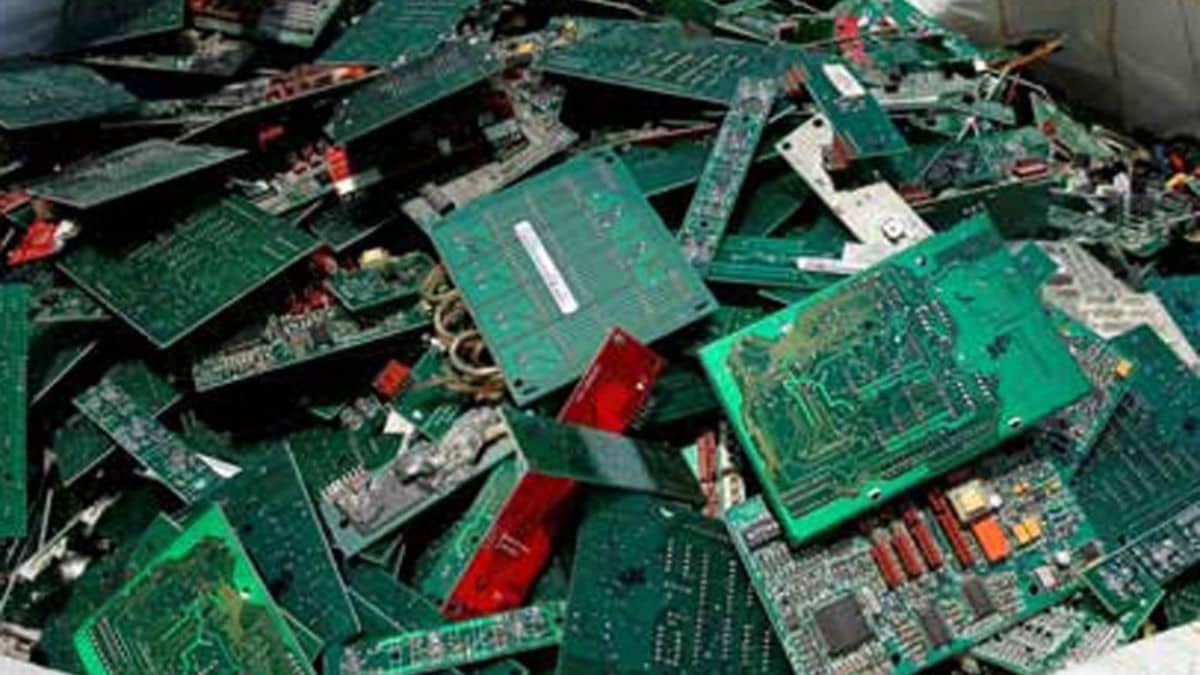
Tucked inside smartphones, laptops, and batteries that Indians discard every year lies a fortune in lithium, cobalt, and rare earths. India generates the world's third-largest volume of e-waste, yet much of it passes through informal recycling networks that recover only a fraction of its minerals. State governments must take up the mandate to convert these networks into a formal recycling ecosystem. By transforming urban waste into mineral sources, states will become pivotal to India's mineral security strategy.
Today, China dominates the global reserves for critical minerals. Recycling e-waste can cut reliance on first-use minerals by 25 to 40 percent, per the International Energy Agency. Recognising this, the Trump administration restricted e-waste exports to boost domestic recycling and counter China's dominance.
India has also attempted to augment its formal recycling capacity by earmarking $157 million (₹1,500 crore) under the National Critical Minerals Mission (NCMM). Recently, India signed a Joint Declaration with Japan, a pioneer of urban mining on Economic Security Cooperation, committing to build an e-waste recycling ecosystem. But success hinges on sufficient e-waste feedstock reaching formal recyclers — the biggest bottleneck.
India’s formal recycling ecosystem relies on the 'Polluter Pays Principle'. It enforces Extended Producer Responsibility (EPR), tasking producers of electronic goods to recycle end-of-life electronic products through 509 formal entities registered with the Central Pollution Control Board (CPCB). In the past decade, EPR regulations have tightened to prevent leakages to informal recyclers. Yet, the current systems of formal recyclers capture just 22 percent of the e-waste processed. The informal sector, 500,000 workers strong, handles the remaining 78 per cent and runs a complete value chain spanning doorstep collection, scrap yards, acid leaching, open burning, and mechanical dismantling to extract valuable metals, outside any regulated market.
Why states matter
State governments in India are best placed to institutionalise this informal network into a resilient domestic supply chain. India cannot augment its recycling capacity to meet mineral security without formalising its informal sector. They enforce policies, allocate land, regulate labour laws, and can ease regulatory bottlenecks.
Common facility centers for e-waste at the state-level
India’s Ministry of Electronics and Information Technology (MeitY) launched an accelerator called the Cluster Development Program (CDP) to train 15,000 informal operators. NITI Aayog also advocated this model for both e-waste and lithium-ion batteries.
For policymakers, cluster-based models are a way to bring informal sectors into formal folds. But for it to work, states need to solve three distinct problems, not sequentially, but simultaneously: where the clusters sit, why informal operators would join them, and how they would stay compliant once they do. The pathway to achieve it is clear:
Land and siting
Commercial land prices are the first obstacle: no state offers free or long-term-lease land, and relocating operators away from existing collection centers in cities hampers buyer networks and cash flows. States should treat land as equity in critical mineral recovery and create a dedicated land-allocation window similar to Special Economic Zone (SEZ) mechanisms, providing recycling clusters with long-term concessional leases and expedited clearances. The clusters should be sited near existing urban collection networks rather than the cheapest available plot.
Weak return on investment relative to the informal model
Informal recycling pays out immediately; formal entry demands upfront spending on registration, cluster deposits, and compliance months before revenue comes in. It is a financing-design problem rather than a subsidy problem.
Three policy interventions can reduce the gap. Deferred-fee structures allowing costs to be recovered from future earnings, rather than upfront payment, and low-interest, quick-disbursal credit lines administered through the cluster itself rather than a general bank application that directly addresses the cash-timing mismatch. Pairing this with procedural speed matters as much as the money, since the informal model's real advantage is turnaround time, not just cost.
EPR portal compliance capacity
CPCB's EPR portal requires GST or customs data and e-invoicing, which is a capacity barrier for small operators trying to formalise through clusters. Clusters need a phased or lighter-weight reporting tier for cluster-based small operators with simplified data entry; batched rather than pre-transaction invoicing. This must be paired with active handholding: state industry departments and CPCB running onboarding support directly at the cluster, not just publishing simplified rules and expecting operators to self-navigate.
India's critical mineral strategy is increasingly global, and its challenges are local. Urban land allocation, industrial cluster development, environmental clearances, worker formalisation, and small business support all fall largely within the domain of state governments. India's mineral ambitions will keep outrunning its recycling reality until this gap closes. Intent has failed before. States need to become central actors in the critical minerals agenda.
(Shashwat Kumar is a fellow, and Iram Siddique is a research intern, Chair on India and Emerging Asia Economics at the Center for Strategic and International Studies)
The opinions expressed in this article are those of the author and do not purport to reflect the opinions or views of THE WEEK.
