



Japanese Prime Minister Sanae Takaichi's first official visit to India, from July 1 to 3, 2026, is being framed as a summit about semiconductors and supply chains rather than submarines, as Tokyo seeks to lock India in as a trusted economic-security partner amid mounting global uncertainty.
The 16th India-Japan Annual Summit, held on July 2 in New Delhi, builds on last year's Joint Vision for the Next Decade, under which Japan has already committed to a target of ¥10 trillion, roughly $68 billion, in private-sector investment into India over ten years.
Tokyo is expected to raise this commitment further still and push bilateral trade beyond the current $27.5 billion.
The economic core of the visit lies in a joint declaration on economic security, expected to cover resilient supply chains in semiconductors, critical minerals, information technology, clean energy and pharmaceuticals, alongside a separate statement on artificial intelligence cooperation.
Energy security features prominently as well, with a proposed task force on liquefied natural gas stockpiling and continued progress on the Green Ammonia Project in Odisha, both aimed at reducing India's exposure to volatile Middle East energy markets.
Union Minister Piyush Goyal, at another event today, disclosed that India has raised regulatory concerns with Japan to help widen Indian exports, a rare acknowledgement of friction within an otherwise upbeat bilateral relationship.
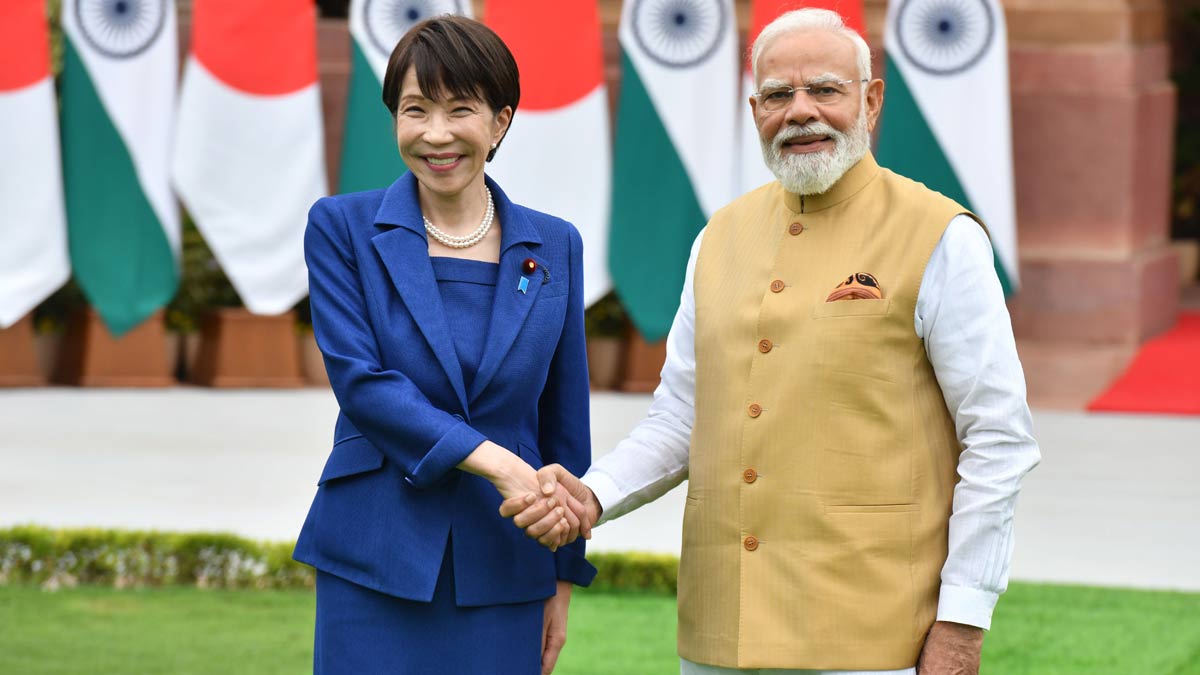
The symbolism of Takaichi's visit also factors in. The Japanese leader received a ceremonial welcome at Rashtrapati Bhavan on Thursday morning, with Prime Minister Narendra Modi by her side as service contingents performed a guard of honour. The two leaders subsequently held bilateral talks at Hyderabad House covering trade, investment, defence and other sectors.
While defence cooperation, including a proposed agreement on stealth-boosting radar antenna technology for Indian warships, will also be discussed, officials on both sides have been at pains to stress that economics, not security, is driving this particular chapter of the relationship.
With around ten memoranda of understanding expected to be signed by the end of the visit, the summit signals Tokyo's intent to deepen its economic footprint in India well beyond the traditional domains of infrastructure and defence that have long anchored the partnership.
