



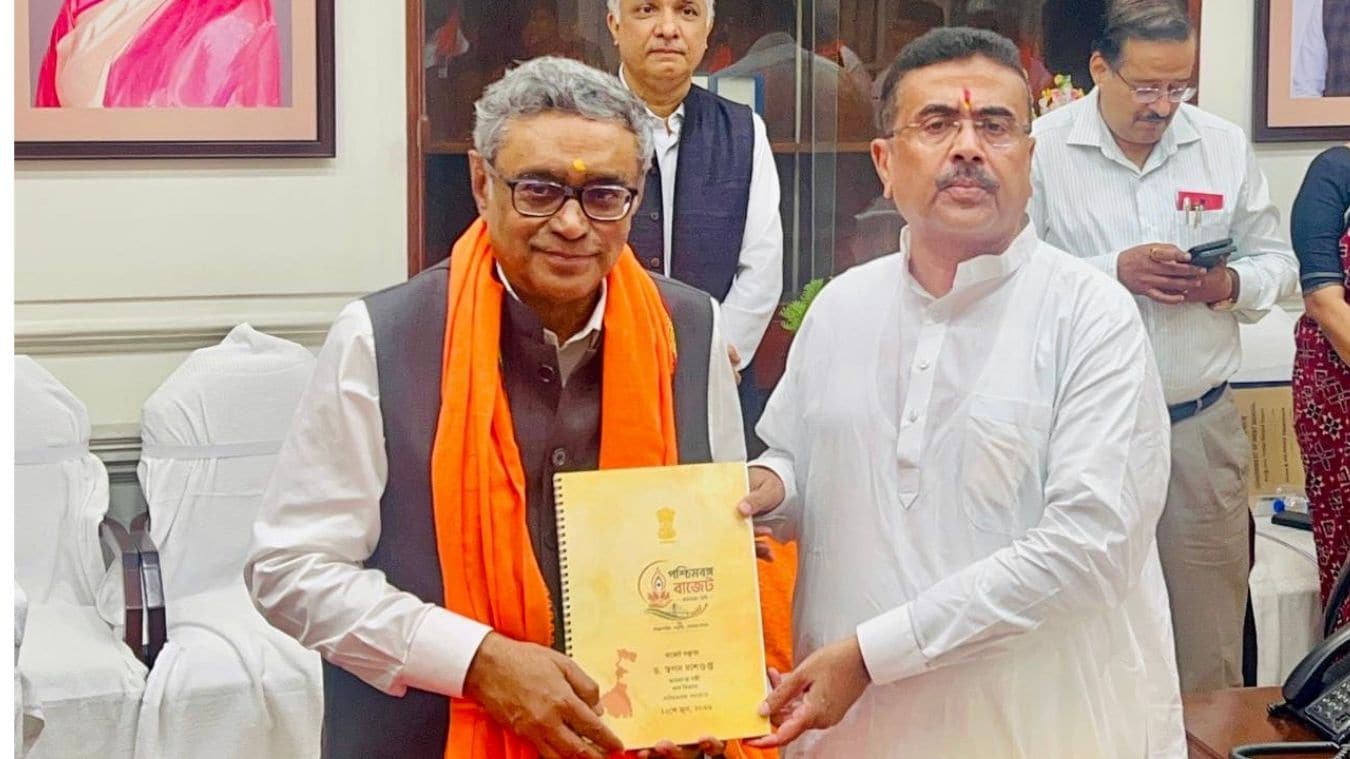
The Suvendu Adhikari-led Bharatiya Janata Party (BJP) government on Monday presented the West Bengal budget for the next eight months, giving fillip to attract big-ticket investments and create a sustainable employment destination hub, which the state has been lacking for decades. The budget allotment for the fiscal year of 2026-27 is ₹4,38,775.29.
As he began his one-and-a-half hour speech, Finance Minister Swapan Dasgupta’s revealed that West Bengal has a debt of 8.15,951 crore. The budget is laden with subsidies and incentives designed to revitalise the state's industrial sector, including a single-window clearance system to streamline the process for new businesses.
“The mission is to take Bengal towards a new shape and a Vikshit Bharat, Vikshit Bangla for the future,” said Dasgupta.
The BJP government looks to re-examine the Urban Land Ceiling Act 1976, introduce a law to abolish extortion and syndicate raj and improve the law and order situation leading to a prospective investment destination for investors.
“To attract investments, we have to improve the law and order situation, stop 'cut money', extortion and syndicate raj, to facilitate industry through a single window system, to create a conducive environment, to have roads, airports and water transport and importance to procure raw material,” said Chief Minister Suvendu Adhikari.
The focus was also on building airports, ports and roads to improve infrastructure and connectivity. A bridge has been proposed to connect the Chief Minister's erstwhile constituency of Nandigram with the industrial port of Haldia, which is an hour-and-a-half away in East Midnapore district. A plan to develop Falta in South 24 Parganas into a model industrial hub was also announced.
The push for a 50,000 square feet industrial park in Siliguri in North Bengal, focus on creating an Artificial Intelligence (AI) and semiconductor hub in the state, a special licence for keeping offices, shops and restaurants open 24x7 to attract big industries to invest in the state has been welcomed by industry experts. MSMEs, especially food processing, logistics and warehousing facilities, eco-friendly and solar energy initiatives, reducing compliance and raising professional tax slabs from ₹10,000 to ₹20,000 were also highlighted. Experts were looking for a direction towards a development-focused budget as opposed to a welfare economics budget laden primarily with social welfare schemes for the poor and this budget gave them some fillip.
Bengal Chamber of Commerce (BCC) termed it a populist budget and a miniature Union budget. They opined that job creations will be in the AI sector to keep employed youth in Bengal and viable opportunities on that scale of lakhs is available in the AI sector, which is the experience of overseas companies. Hence, they feel Bengal is heading in the right direction. “With the double engine government working, in the next six months, this budget will sow the seeds of positive investments,” said Vivek Jalan, Chairperson National Taxation Committee of BCC.
“The new incubation fund for startups and trying all probable steps to bring industry to state, whether labour or IT will provide a boost to the state GDP,” said S. Radhakrishnan, former president of BCC.
Industry experts also applauded efforts to revive the deteriorating state of Calcutta Stock Exchange. Public Sector Units (PSU) will go towards listing, which will work towards revival of the state’s economy, they added.
Confederation Of Indian Industry (CII) looked at the budget as a positive step as the government will re-examine the Urban Land Ceiling Act, 1976. “It has been a demand of the industry for a long time. Big industries were unable to come here as it was a hurdle. The new BJP government is like a breath of fresh air, they will re look the policy. Big industries in West Bengal, India and overseas will get a positive message. We are very hopeful it will be lifted,” said Sumit Goyal, Chairman International Trade Committee, CII.
Other budget pointers to cheer about
The budget focused on women empowerment, health and welfare of the poor including farmers, apart from job creation and industry development. Rural clusters look to get a push with airports, roads and ports while North Bengal will get an IIT and IIM to boost education. Darjeeling will be a eco-adventure hub, however to safeguard the ecological balance, tea tourism budget has been cut down from 30 per cent to 15 per cent.
Dearness Allowance (DA) for government employees increased from 18 per cent to an additional 20 per cent, taking it to 36 per cent. This has been a bone of contention in the previous Trinamool Congress (TMC) regime.
Social welfare schemes implemented by the government soon after taking charge in the state were also announced again, including health insurance cards as part of the Centre’s Ayushman Bharat scheme.
What Mamata's TMC said?
Responding to the budget, Kunal Ghosh, TMC MLA and spokesperson for the Mamata-Abhishek Banerjee faction, said, “The new government has just come in, we want to give them some time and reflect on announcements made in the budget, see whether these can be implemented. If something is not in accordance with the budget, we will oppose it then.”
“The initiative to make Bengal an employment destination was started by Mamata Banerjee. We are supporting the increase in budget allocation but Mamata Banerjee had already done that. Since the finance minister said it is a double engine government, the reference to the central government, that we wondered whether we are listening to the state budget or the Union budget. Mamata Banerjee’s budget was self reliant, the Centre did not give funds,” added Ghosh.
