



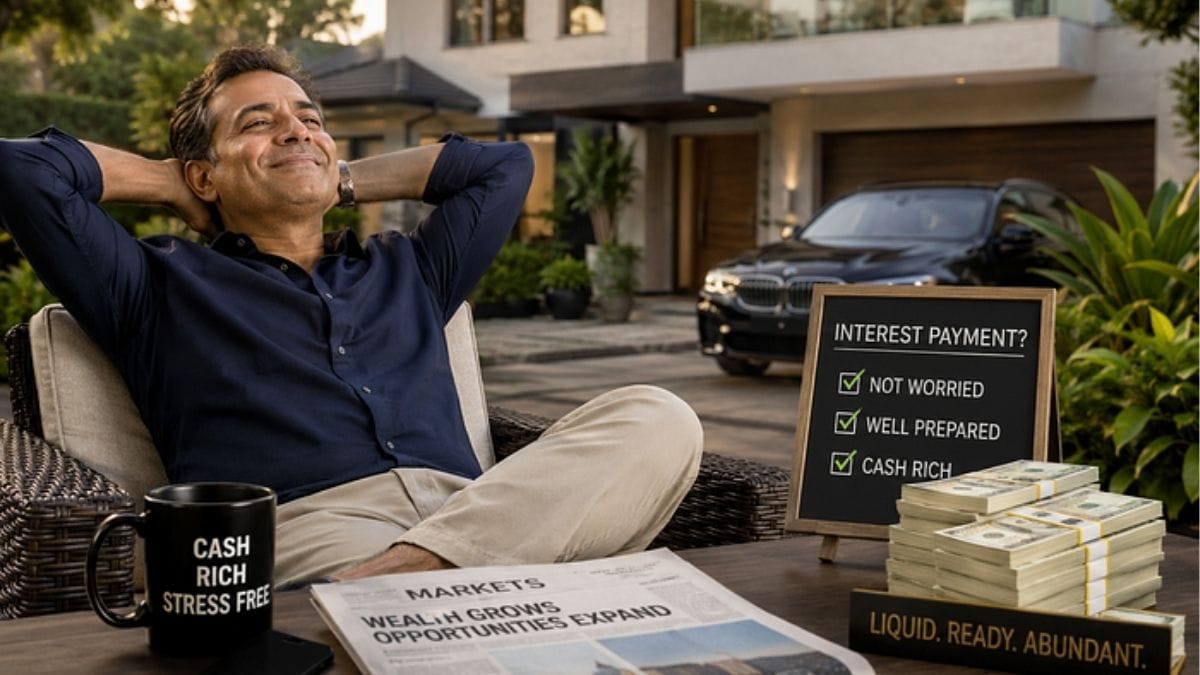
The good thing about buying a house is that you can fund it via debt, i.e., take a housing loan for a tenure of 20 years or above. This means that even if you do not have adequate funds, you can convert it into easy monthly instalments and pay it off.
The bad thing is that debt eats into your savings and puts a lot of strain on your income for a long time. This means the pressure to pay the EMI lasts a long time, and if your income stops unexpectedly, the loan payments could default.
When you take a home loan, you are entitled to pay back the principal as well as the cost of the principal (interest) to the lender. Most homeowners still think a single house is an asset, but they do not realise what they are actually missing.
The fact is: Your housing loan is an asset to the bank, as it earns income, and a liability to you, as you incur expenses.
When you buy a house with a ₹1 crore loan at an 8 per cent interest rate for the next 20 years, the numbers look like this.
Your monthly EMI would be ₹83,090 for 20 years, i.e. 20x12 = 240 months. The total amount you would have paid back would be 83,090.07 x 240 = 1,99,41,616.8 ~ ₹2 crore. But you had only borrowed ₹1 crore in capital in the first place. This means the remaining ₹1 crore is the cost of acquisition, or the interest you pay to the bank.
Most investors do not take this cost of capital into account in their return-on-investment calculations. Instead of buying the house, if you had invested ₹83,090 in an instrument that generates 12 per cent annual returns for 20 years, your final corpus would have been a whopping ₹8.3 crore.
So, for our homeowner to really benefit from an asset-appreciation perspective, they should be able to sell the house for ₹10 crore or more after the 20th year to generate surplus capital gains.
What are the real chances that the house, which was worth ₹1 crore, will be worth 10x in 20 years? Sounds like a real trouble for me.
Every time I throw these numbers at a group of people, I am not well received. They always say the house has an emotional appeal; there is always a value much higher than what money can buy.
If you are in this category of people, then I have a different equation for you. What if I tell you there is a means to recover the ₹1 crore paid out as the interest component?
You might remember from the early example that for a housing loan of ₹1 crore, at 8 per cent interest for 20 years, you end up paying ₹1 crore in interest as well. Our idea is to recover this ₹1 crore by starting an SIP of ₹10,010 in an instrument that returns 12% annually for 20 years.
This also means that your monthly outgo would be ₹83,090 (EMI) + ₹10,010 (SIP) = ₹93,100. The ₹10,010 SIP is just to recover the ₹1 crore amount given away due to interest payments.
It is interesting to note that a monthly investment of ₹10,010 is just 12 per cent of ₹83,090, but over a long horizon of 20 years, it is fully capable of recovering the cost of capital that is paid out.
The next time you take a loan, use these calculations so that you are converting your EMIs to no-cost EMIs.
The writer is a SEBI Registered Investment Adviser (INA000021757), SEBI Registered Research Analyst (INH000025045), and author of ‘How to join the top 1% options traders club’.
DISCLAIMER: Investments in the securities market are subject to market risks, including the potential loss of principal. Past performance does not guarantee future results. Information provided is for educational purposes only and should not be considered financial advice. Investors should read all related documents carefully and consult a certified advisor before investing. Registration granted by SEBI and Enlistment with RAASB/BSE and certification from NISM in no way guarantee the performance of the intermediary or provide any assurance of returns to investors. The investor is requested to take into consideration all the risk factors before actually trading in stocks or derivatives.
The opinions expressed in this article are those of the author and do not purport to reflect the opinions or views of THE WEEK.
