



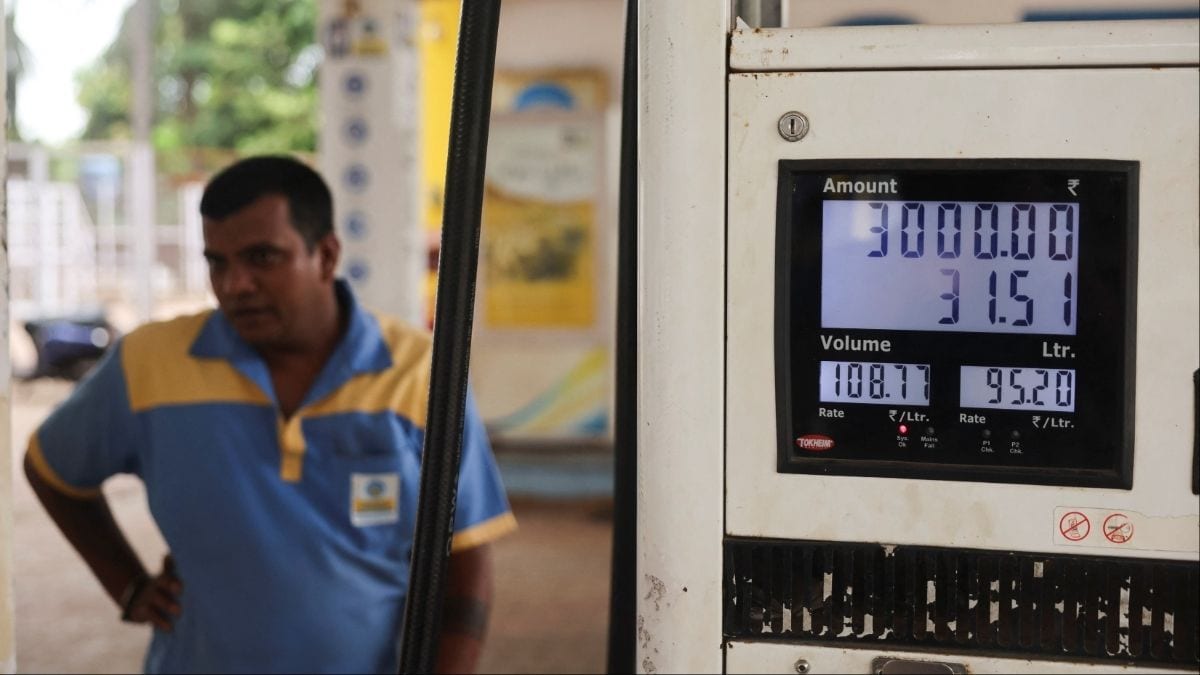
For the past 49 months, petrol and diesel prices at Indian fuel pumps not moved up. On Friday, May 15, 2026, that record freeze ended. State-owned oil companies Indian Oil Corporation (IOC), Bharat Petroleum (BPCL) and Hindustan Petroleum (HPCL), which together control over 90 per cent of the country's 1 lakh-plus fuel stations, raised petrol and diesel prices by ₹3 per litre each. This was the first such hike in more than four years.
In Delhi, petrol now costs ₹97.77 per litre (up from ₹94.77) and diesel ₹90.67 (up from ₹87.67). Mumbai petrol is ₹106.68, Kolkata ₹108.74, and Chennai ₹103.67, with differences driven by state-level taxes.
The increase, at 3.2–3.4 per cent, might sound shocking to the common man, but many industry sources say that it is only one-tenth of the correction actually needed to account for the full surge in global crude since the West Asia war began. In fact, analysts at Kotak Institutional Equities had, last month, estimated the required correction at ₹25–28 per litre.
India's crude oil import basket averaged $69 per barrel in February 2026, before the war. It averaged $113–114 per barrel in the weeks that followed. That was a surge of over 50 per cent.
Last month, officials from the oil ministry reportedly stated that retailers were losing ₹100 per litre on diesel and ₹20 per litre on petrol at prevailing prices, as per Reuters. The three PSU oil companies absorbed these losses for close to 11 weeks before the hike became financially unavoidable.
The hike also came exactly 16 days after assembly elections concluded in Assam, Kerala, Tamil Nadu and West Bengal, in which the BJP won two of four states. Fuel prices had been held steady through the entire polling period despite soaring international crude rates.
Monetary Policy Committee member Ram Singh had explicitly forecast post-election fuel price hikes even before the polls ended, and private refiner Nayara Energy had already raised pump prices in late March to stem its own losses, leaving the PSUs as the last holdouts.
The inflationary consequence of even a ₹3 hike, on top of an already stressed economy, is not a joke. The direct impact on Consumer Price Index (CPI) inflation is estimated at around 15 basis points but the indirect effect via transport costs, logistics, food prices and manufacturing inputs could be more pronounced.
Just a day ago, official data revealed that the Wholesale Price Index (WPI) hit a 42-month high of 8.3 per cent in April, driven by a 24.71 per cent surge in fuel and power prices at the wholesale level. Petrol WPI inflation was 32.4 per cent and diesel 25.19 per cent in April.
Congress leader Jairam Ramesh, in a post on X, called the hike inevitable but politically timed, saying "this is bound to lead to further inflation that is now projected to be close to 6 per cent for this financial year. Growth estimates will be lowered considerably."
According to an RBI study (Pattnaik et al.), fuel price shocks in India have significant second-round inflationary effects through input costs in agriculture and manufacturing, with transport cost pass-through typically completing within two to three months of the initial price change. This meant the ₹3 hike today will be felt not just at the petrol pump but across household expenses, freight rates and factory prices through July and August 2026.
