



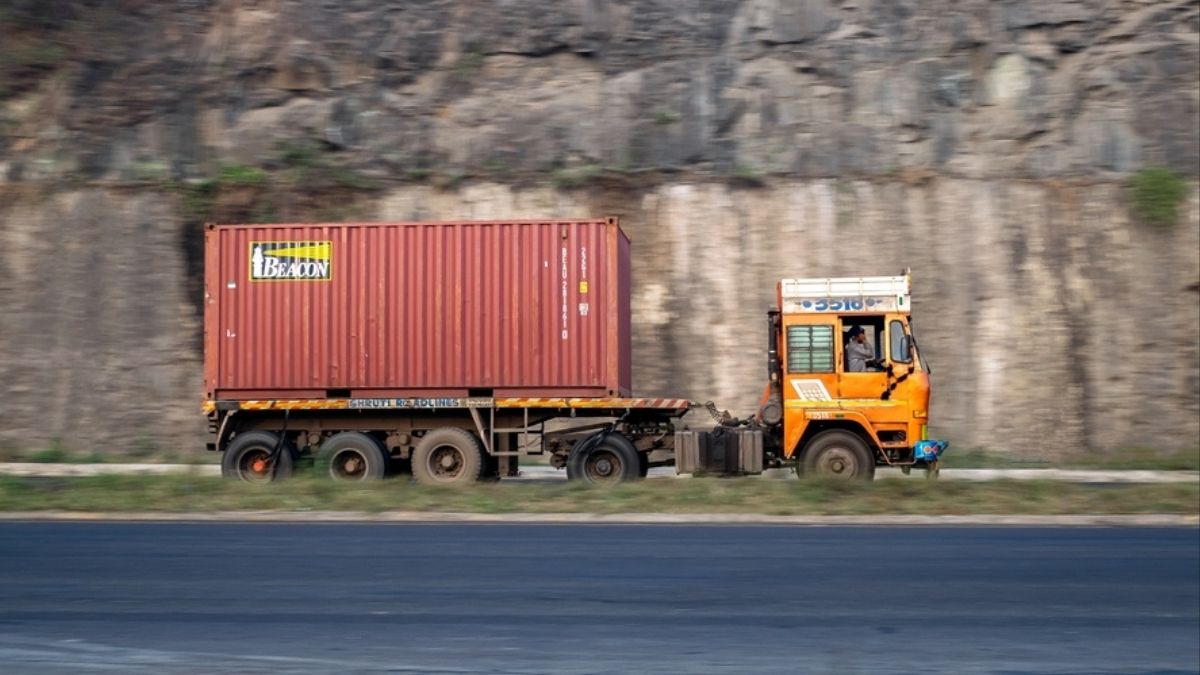
Every day, millions of commercial trucks, railway wagons, maritime vessels, and delivery motorcycles move staggering quantities of goods between India’s cities, towns, and villages.
From produce arriving at an urban farmer’s market before dawn to an online order landing at your doorstep within three hours, the economy runs on this ceaseless motion.
Yet behind every seamless delivery lies an infrastructure layer that, until recently, was held together by spreadsheets, phone calls, and sheer human grit. That is changing fast, and a new generation of logistics startups is leading the charge, not by copying global playbooks but by building solutions engineered for the unique complexity of moving goods across India.
The $150 billion inefficiency
India’s ambition to become a $5 trillion economy by 2030 is well-documented. What is less discussed is that this target is structurally impossible without a radical overhaul of how goods move across the country. India’s logistics costs amount to approximately 7.8–8 per cent of GDP according to recent government estimates, a figure that still translates to over $150 billion in annual friction embedded across fragmented supply chains.
That gap is not merely a cost problem. It is a competitiveness problem. An Indian MSME manufacturing textiles in Tirupur is, by default, at a disadvantage against a competitor in Vietnam or Bangladesh, not because of product quality but because of the cost and unreliability of moving that product to its end customer.
A convergence of tailwinds
Several forces are making this the most opportune moment for logistics innovation in India’s history. The National Logistics Policy, the PM Gati Shakti masterplan, and GST-driven formalisation have created an enabling environment that did not exist five years ago. The construction of dedicated freight corridors, new multi-modal logistics parks, highway modernisation, and port upgrades is alleviating infrastructure bottlenecks that have plagued the industry for decades.
Crucially, the increased policy attention has also resulted in logistics being recognised as a strategic industry, unlocking institutional capital and long-term investment. Meanwhile, e-commerce has rapidly expanded beyond metros into Tier 2 and Tier 3 cities, small manufacturers are selling nationally for the first time, and MSMEs are utilising direct-to-market distribution. India’s e-commerce market is projected to cross $200 billion by 2030, and the fulfilment infrastructure to support that scale does not yet exist.
The Missing Middle
The most compelling growth story lies with India’s 63 million MSMEs, the backbone of the economy, contributing nearly 30 per cent of GDP, who have historically been locked out of efficient supply chain infrastructure. A brand doing ₹20–500 crore in annual revenue is too large to rely on ad hoc logistics, yet too small to command the customisation a Flipkart or Reliance receives from third-party providers. This “missing middle” is not a niche problem; it is a systemic bottleneck constraining the growth trajectory of the very businesses India’s economic planners are counting on to drive employment and exports.
What makes the current generation of startups fundamentally different is the application of intelligence at every node. Digital freight platforms are matching shippers and carriers in real time, slashing empty truck trips. Route optimisation software saves fuel and hours. Warehouse management systems track inventory across multiple locations with precision, once exclusive to large corporations. AI-native platforms dynamically allocate inventory based on real-time demand signals, predict returns before they happen, and orchestrate multi-modal transportation across wildly uneven infrastructure. The warehousing landscape illustrates this vividly. India has roughly 300 million square feet of Grade A warehousing, but will need three to four times that within the decade. Static storage is giving way to intelligent fulfilment centres that function as dynamic nodes in a responsive network. What makes all of this truly powerful is accessibility: tools once reserved for the largest enterprises are now within reach of online sellers and regional distributors. This is a category shift, from logistics as a service to supply chain as an operating system.
Democratising market access
India’s next hundred million online shoppers will come from Tier 2, 3, and 4 towns where logistics infrastructure is thinnest. When a startup enables a brand in Jaipur to serve customers in Siliguri with the same speed as in Delhi, it is democratising market access.
Equally significant is job creation. While many digital businesses concentrated employment in metro tech hubs, logistics creates work across the country, including drivers, warehouse staff, operational managers, and delivery partners.
Startups are formalising historically informal work through digital payments, route transparency, and performance tracking, giving workers more consistent income and clearer advancement paths. The logistics industry is both an economic growth engine and a social change agent.
Logistics and supply chain technology attracted over $2 billion in venture funding in India between 2021 and 2024. The government’s recognition of logistics as a strategic industry has unlocked institutional capital and signalled long-term policy commitment.
But the real opportunity is not in building another aggregator or asset-heavy fleet. The defensible, venture-scale prize lies in intelligent orchestration layers, platforms that coordinate across fragmented infrastructure and deliver enterprise-grade capability to businesses that could never build it themselves. Just as UPI and fintech unlocked banking for millions of underserved Indians, supply chain startups are unlocking operational capability for millions of constrained businesses.
Movement as mission
India does not lack entrepreneurs building great products or consumers eager to buy them. What India has is a movement problem, a gap between where goods are made and where they need to be. The next wave of growth will be driven not by producing more, but by moving what we produce more intelligently.
The logistics startups closing this gap may not command centre stage, but they are building the invisible infrastructure upon which India’s economic future will rest. As the country grows in connectivity, ambition, and global scale, the business of movement may well be the most consequential business of all.
The author is the Co-founder and CEO of Edgistify.
The opinions expressed in this article are those of the author and do not purport to reflect the opinions or views of THE WEEK.
