



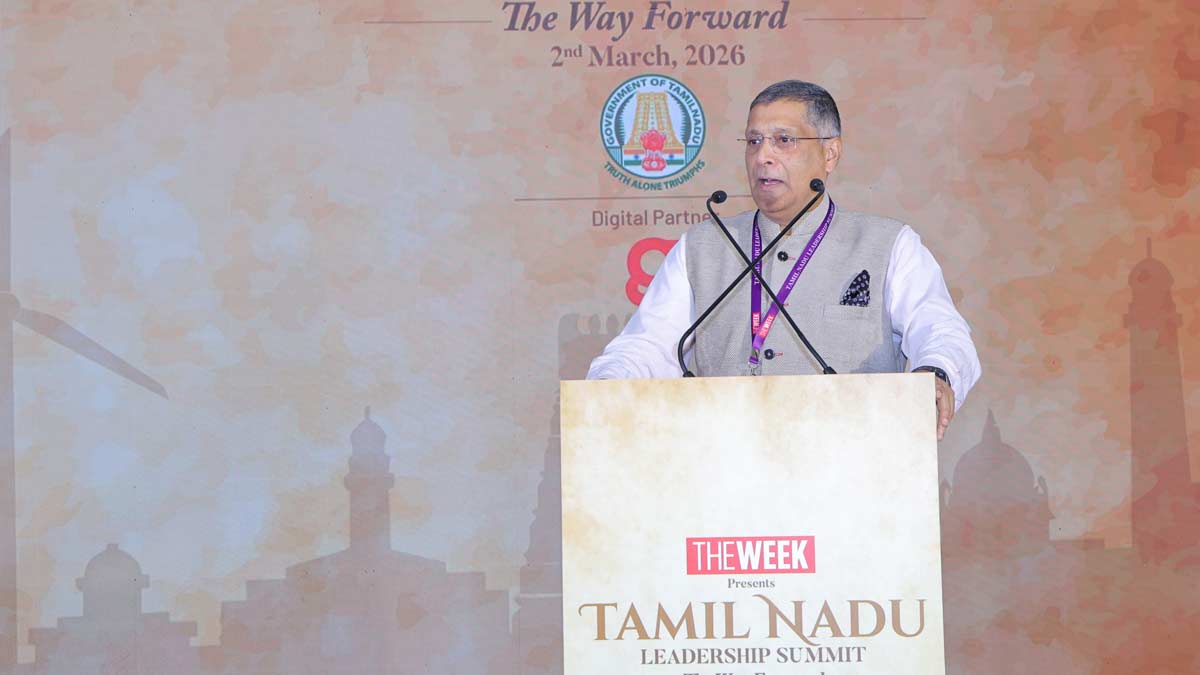
India’s federal structure is under growing strain, driven not just by politics but by deep economic divergence between states, former Chief Economic Adviser Arvind Subramanian said at THE WEEK Tamil Nadu Leadership Summit in Chennai.
Subramanian said the spirit of cooperative federalism envisioned at Independence is now being tested. “From an amicable union, we risk moving towards a distrustful one,” he observed, pointing to intensifying debates around fiscal transfers and representation.
He argued that two structural forces are behind the current tensions: increasing political centralisation and rapid but highly asymmetric economic growth across states.
On centralisation, he noted the expansion of centrally sponsored schemes since the early 2000s and the growing reliance on cesses, which are not shareable with states. While these trends began under earlier governments, they have continued in recent years, he said. The cumulative effect has been an erosion of trust between the Centre and states.
However, the deeper driver, he argued, was divergence in economic performance.
In the decades following economic liberalisation, some states—particularly in the south and west—grew at rates comparable to East Asian economies. Others, especially in parts of the Hindi heartland, lagged behind. This divergence has had cascading consequences for fiscal federalism.
As richer states generated more tax revenue, transfers to poorer states rose steadily. While redistribution is intrinsic to federal systems, Subramanian warned that persistently widening gaps could make transfers politically contentious. “If better-performing states feel they are being penalised for success, and underperforming states continue to receive rising transfers, tensions will inevitably grow,” he said.
The issue becomes sharper in the context of delimitation. Parliamentary representation has been frozen based on the 1971 Census. If representation were adjusted strictly according to current population, southern states that have successfully lowered fertility rates could lose seats relative to faster-growing northern states. This has fuelled anxiety about a potential “double disadvantage”—higher fiscal transfers combined with reduced political voice.
Subramanian cautioned against alarmism but acknowledged that these concerns are politically real. He credited recent Finance Commission deliberations for recognising the need to consider states’ contribution to the tax base in determining devolution formulas, calling it a step towards balancing equity and efficiency.
Turning to solutions, he urged states to focus on strengthening their own fundamentals rather than relying solely on negotiations with the Centre. For Tamil Nadu, he flagged power sector reforms, fiscal discipline, and urban governance as priority areas. He also criticised states for replicating centralising tendencies at the local level, arguing that urban local bodies remain fiscally weak compared to their global counterparts.
Ultimately, he said, the sustainability of India’s Union depends on narrowing performance gaps. “It is in the interest of richer states that poorer states grow faster,” he noted, suggesting that investment flows must increasingly reach lagging regions.
India does not need new federal institutions, he concluded. What it needs is improved practice—and convergence in growth. Without that, fiscal federalism will face mounting and perhaps unmanageable pressure.
