



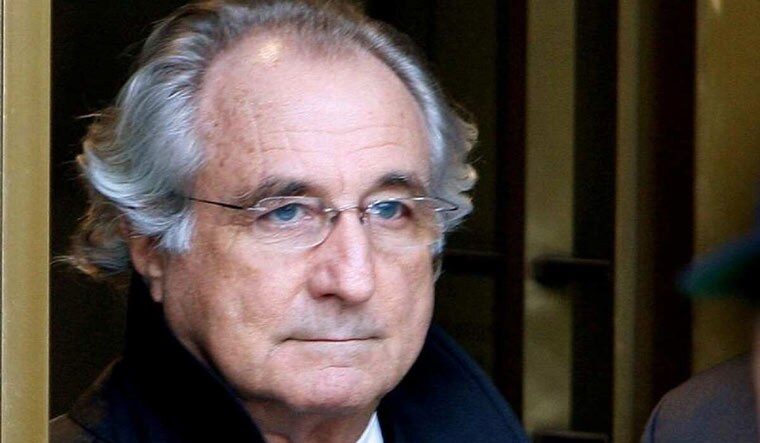
Ponzi schemes have cropped up in different formats during these years. The largest of them, which may be termed the mother of these schemes is the one started by Bernie Madoff.
However, such schemes are named after Charles Ponzi and so he may be considered the father of such investment schemes.
Charles Ponzi and his modus operandi
Charles Ponzi, a 21-year-old Italian migrant, landed on American soil in 1903. He drifted from one job to another and one day he came across a mail from Spain attached with it an ‘International Reply Coupon’. Ponzi immediately pounced on it as a business opportunity. Ponzi formed a company named Securities Exchange Company in 1920. Promissory notes of the company were issued at $ 10 and up at 50 per cent in 45 days which worked up to 400 per cent p.a. On 12 August 1920, the government auditor after examining his book of accounts came to the conclusion that he is in the red by $ 3m later revised to $ 7m. Ponzi was arrested and initially sentenced to five year imprisonment, which was later extended to 14 years.
Along with the scheme, five other banks fell in addition to Hanover Trust Bank. The investors were paid a final payment of around 30 per cent and in all they lost $20m in 1920 (valued around $240 m in 2020). Most intriguing is the fact that he had invested only $3 in International Reply Coupon, the means he claimed to make his returns. In fact he was revolving the money around for these seven months. The earlier investors were paid out of the later investors. This deposit scheme is termed as 'Borrowing from Peter to pay Paul' and is now branded as Ponzi scheme.
Ponzi schemes evergreen
US federal government, to protect the investors, passed Securities Exchange Act in 1934 and set up the agency in the very same year named Securities Exchange Commission. Similar Acts were passed and commissions made operational in many countries across the globe. The latest Act was passed in India on July 31, 2019 entitled The Banning of Unregulated Deposit Schemes Act 2019. In spite of these laws, we see Ponzi schemes emerging every now and then from different parts of the world.
Bernie Madoff: Mr Wall Street
The largest and the longest so far of the Ponzi schemes is the one operated by Bernie Madoff. It lasted nearly two decades. Bernie Madoff’s father, a Jewish descendant, went out of the sporting goods business due to steel shortages during the Korean War and so he was determined to succeed which his father hadn't.
Madoff started Bernard L. Madoff Investment Securities LLC, in 1960, at age 22. At first, he traded penny stocks with $5,000 and by the late 1980s, Madoff was making around $100 million a year.
He created a front of respectability, gained trust of the Investors by offering his returns which were high but not unusual and he claimed to use a legitimate strategy. Madoff was a pioneer in electronic trading and was chairman of the NASDAQ in 1990, 1991 and 1993. Being a fund manager for more than 50 years, Bernie Madoff was renowned on Wall Street. He was at one time called Mr Wall Street.
Securities Exchange Commission received the first complaint against Madoff in 2000, but the regulator ignored it.
Madoff simply deposited client funds into a single bank account that he used to pay existing clients by attracting new investors. He was unable to continue during the financial crisis in late 2008. He confessed on December 10, 2008 to his sons, Mark and Andrew, who were in the trading operations of his firm, that his business was a lie and that it was a Ponzi scheme. Madoff claims that his sons were not aware of it. The sons turned him in to the authorities the next day.
In 2009, at age 71, Madoff pleaded guilty. He was sentenced to 150 years in prison. Madoff's scheme cost his investors about $ 65 billion, the largest so far.
His elder son Mark, who was 46, committed suicide in 2010, and Andrew, the other son, died of lymphoma at age 48 in 2014.
A number of articles, books (one of them by the widow of his son Mark), documentaries, T V serials, movie and a biopic on Bernie Madoff have been released.
Features of a Ponzi scheme
Ponzi schemes reappear in different format but have the following features
Attractive facade: If it was the International Reply Coupon in the original scheme, in the latest, cryptocurrency was projected as means to multiply the money. They included god’s money, pigeon race, ants, milk, boy band, hotel rooms, and so on. Their operation is opaque and mystifies the scheme to a certain extend.
Offer tempting returns: The return offered on the scheme is tantalizingly attractive. They promise a return far above the normal prevailing in the market. Exception might be that of Madoff who gave only reasonable return, but he made it steady for over a long period which is quite abnormal in the stock market.
Fund operator is over confident: The scheme operator will be overflowing with confidence and has the ability to gain the trust of the prospective investors.
Does not generate any revenue from the fund: This is the single distinguishing feature and can be made out only internally. An objective and exhaustive examination of books of accounts will be revealing it. The earlier investors are duly paid out of the new investors.
Question Mark
Often we refer to the test of time. A cooling time used to test the real worth of investment. Bernie Madoff scheme raises a question on the period of time to be used to test an investment scheme.
Why they succeed
In spite of repeated failures of schemes and laws and regulators on the watch out, Ponzi schemes crop up every now and then. How do they succeed, even if for a short while?
The reason lies within us human beings, in our psychosis. Charles Ponzi claimed, “I knew human nature”. He wrote: “Because we are all gamblers. We all crave easy money. And plenty of it. If we didn't, no get-rich-quick-scheme could be successful. … Each satisfied customer became a self-appointed salesman. It was their combined salesmanship, and not my own, that put the thing over. I admit that I started a small snow ball downhill. But it developed into an avalanche by itself.”
Madoff had this to say: "Everybody was greedy, everybody wanted to go on and I just went along with it.”
No laws, no regulators can put a stop to such schemes. Unless and until we, human beings, curb our greed that fosters the get-rich-quick mentality, Ponzi schemes will continue to emerge and disappear with the investments.
Dr Stephen Mathews is the former principal at St Berchmans College, Changanacherry, Kerala and the former Director at XIME, Bengaluru
