



Tarluvada, Andhra Pradesh
A row of low-income houses is being renovated at the foot of a hillock in Tarluvada village in Andhra Pradesh, around 35 kilometres from Visakhapatnam. New floors are being added and walls painted. More than 50 dalit families live here, many of them happy after recently receiving compensation of Rs40 lakh per acre.
Between the hill and these homes lies a neatly marked stretch of their former farmland, road-rolled by heavy machinery. In a few years, a gigantic 1GW data-centre complex will rise on this 266-acre slope.
For now, fewer than 50 people are working on levelling the land. In a few months, the workforce will grow to hundreds and then thousands as construction gathers pace. Villagers believe that once construction is complete, they may find permanent employment at the facility. “We may be the first ones to get the jobs,” says Chandala Pentayya, 70.
But Pentayya has little idea what kind of employment will actually be available. According to studies reviewed by THE WEEK, a 1GW data centre may create around 1,000 permanent jobs—possibly fewer. These facilities are built around automation and a highly skilled workforce.
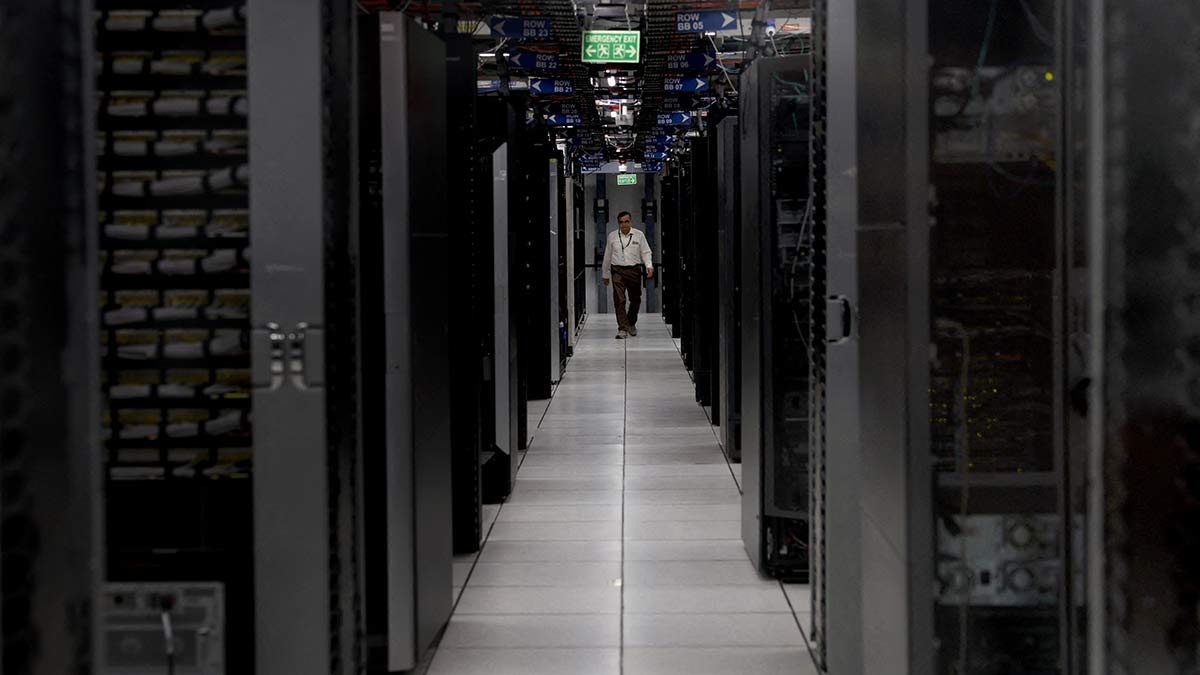
Data centres, therefore, are not expected to drive employment generation. India is building them because it wants to become an AI-ready digital economy. Currently, even though it produces 20 per cent of global data, it hosts only 2 per cent of it. To bridge this gap, the government is driving investment in digital infrastructure.
Much of this new capacity is coming up in Chennai, Hyderabad, Mumbai, Bengaluru, Delhi-NCR and Andhra Pradesh—locations that have efficient grid connectivity and reliable power. But unlike the previous generation of data centres, which were largely designed to store data and host cloud services, the new facilities are being built to handle AI workloads.

More than 80 facilities are under construction across the country—that is, nearly 10 per cent of the world’s data centres currently being built. Over the coming decade, India will position itself alongside the US, China and the European Union, which together account for nearly 85 per cent of global data-centre infrastructure now.
“Data centres will be one of the most important pieces of India’s infrastructure of the 21st century,” says Dr Hemachandran Kannan, director, AI Research Centre, Woxsen University.
As hubs for the digital world, data centres need round-the-clock power supply and cooling. It raises a fundamental question: if India can access data centres anywhere in the world, why host them at such a large scale, with huge investments of capital, land, energy and water?
Data sovereignty is a major part of the argument. Sensitive data need to remain within India because physical control makes it easier to protect it. “Much of the data and documentation we use today is hosted in the US,” says Nishita Baliarsingh, CEO of energy startup Nexus Power. “If it remains outside, it can potentially be breached from there. To have physical control over critical data, we need to host it here. The laws India is bringing in also show that the country wants greater control over its data.”
Unlike China, the US and the European Union, which have developed their own AI models, research ecosystems and technology stacks, India is still largely building the digital-economy infrastructure. It is trying to shift large parts of its economy onto an AI-powered digital platform—a process similar to creating its own smartphone ecosystem and integrating applications into it. The objective is to build domestic capacity to process, regulate and train digital systems, giving the country greater control over infrastructure.
“It will be the engine which will run every digital thing under the sun—digital payments, e-commerce, health care, education and government platforms,” says Jaspreet Bindra, an expert on digital transformation and emerging technologies. “They will also enable digital businesses and support technological innovation.”
According to Cushman & Wakefield, India’s data-centre pipeline has already reached 3.1GW, while operational capacity stands at around 1.6GW. Beyond this, more than 10.5GW is reportedly at the land-acquisition stage. Building hyperscale data centres was traditionally considered beyond the reach of energy-deficient developing economies because of the massive capital requirements and their dependence on reliable power.
India’s current data-centre capacity can host only a fraction of the data it generates. The country would need to reach roughly 16GW of capacity if it wanted to host a much larger share of its own digital economy domestically.
But not everyone is convinced by this race for capacity. Some analysts argue that the current wave of data-centre announcements aligns more with political ambition than physical necessity. A video uploaded from Mumbai can be stored in Singapore, processed elsewhere and viewed back in Mumbai with minimal friction. India does not necessarily need to store 20 per cent of the world’s data simply because it generates it. Environmentalists warn that rapid expansion could deepen pressure on resources.
AI data centres operate on an entirely different energy scale from the earliest computing machines. ENIAC, one of the world’s first general-purpose electronic computers, consumed about 150kW of electricity. A 1GW data centre, by comparison, would require more than 6,600 times as much power.
A study by the Council on Energy, Environment and Water shows that 57 per cent of Indian districts face high to very high risks from extreme heat. Many emerging data-centre hubs are located in these districts. If data centres rely heavily on groundwater or municipal supplies, they could end up competing with households and agriculture. The same districts are also vulnerable to extreme climate events, raising concerns about outages, data losses and financial risks at a time when AI is becoming central to economic activity.
“India, which is still developing, with large sections of its population struggling with poverty as well as water and energy shortages, may not need such heavy investments in data centres,” says V.S. Krishna of the NGO Human Rights Forum, which is campaigning against the ecological impact of data centres.
The debate becomes sharper when viewed through the lens of employment. According to a Food & Water Watch survey, data centres in Virginia—which hosts nearly one-third of America’s data-centre capacity—created just one direct permanent job for every $54 million invested between 2020 and 2025. That was 168 times more expensive than creating a permanent job in non-data-centre sectors. By the same calculation, if a 1GW data centre in India creates around 1,000 permanent jobs, an equivalent investment elsewhere could potentially create more than 1.68 lakh jobs.
Dilip Chenoy, former secretary general of the Federation of Indian Chambers of Commerce & Industry (FICCI), has a different view. “Although employment generation remains a priority, it is important to understand that this cannot be an either-or choice. You cannot choose one set of sectors over another; the focus has to be on both—data centres as well as employment generation,” he says.
According to him, China has become so critical to the world because it controls between 35 and 75 per cent of several critical resources and components required by industries globally. “At the same time, it has built its own data sovereignty, cloud sovereignty and technological ecosystem. China is investing in data centres, while also investing in other sectors of the economy,” he says.
But, even if India succeeds in building data sovereignty, can it achieve digital sovereignty?
Ayushi Parashar, a data privacy, AI and energy regulatory adviser at HSBC, thinks just because a data centre is built in India does not mean India owns it or controls its business decisions. “India can make sure foreign-owned data centres operating on Indian soil follow Indian laws, but it cannot automatically convert those data centres into instruments of Indian digital sovereignty,” she says.
She points to what she calls a “digital sovereignty gap”. India can regulate foreign AI companies and foreign-owned data centres and impose compliance requirements. But it still lacks a comprehensive legal framework addressing dependence on foreign AI models, cloud platforms, operating systems and cybersecurity technologies. “India has rules for how AI operates, but it does not yet have a complete strategy in law for who ultimately controls the AI ecosystem on which India may come to depend,” she says.
Then comes the question of energy.
India’s challenge may no longer be simply building data centres. It is powering them—and, increasingly, powering them with renewable energy to reduce the initial dependence on coal. “Solar generates power for six to eight hours a day while AI data centres run round the clock,” says Mayank Garg, CEO of Aroma Solar. “Battery storage is the direct solution.”
The second challenge is transmission. More than 50GW of renewable-energy capacity remains stranded because of transmission bottlenecks. Power generated in Rajasthan cannot always reach a data centre in Karnataka, Telangana, Maharashtra or Andhra Pradesh.
“We are confident the wind energy sector will achieve 100GW of wind installations by 2030 and 155GW by 2035,” Pralhad Joshi, Union minister of new and renewable energy tells THE WEEK. “Initiatives like WT-MARUT (Wind Turbine Manufacturing Assessment, Registration, Utilisation and Traceability) will strengthen supply-chain visibility, boost domestic manufacturing and enhance India’s competitiveness in global markets.”
The third challenge is grid stability. “States such as Rajasthan, Gujarat and Tamil Nadu are already reporting renewable-energy curtailment because transmission infrastructure has not kept pace,” says Garg.
For its part, China has attempted to solve many of the problems associated with data centres. Under its “Eastern Data, Western Computing” strategy, data generated in cities such as Beijing is transmitted to large computing hubs in less-populated western regions such as Inner Mongolia. These regions have cooler climates and are closer to major solar and wind-energy sources. High-capacity fibre network connects these regions to major population centres, reducing pressure on urban power grids.
India, too, is expected to produce abundant renewable energy in the coming years. But there is uncertainty over whether sufficient transmission lines can be built to carry power to data centres.
India is spending billions on data centres that may create only a few permanent jobs. The larger wager is on sovereignty and a place in the next technological order. Whether that wager succeeds will depend on who controls the technology—and whether the country can find enough power and water to sustain it.
