



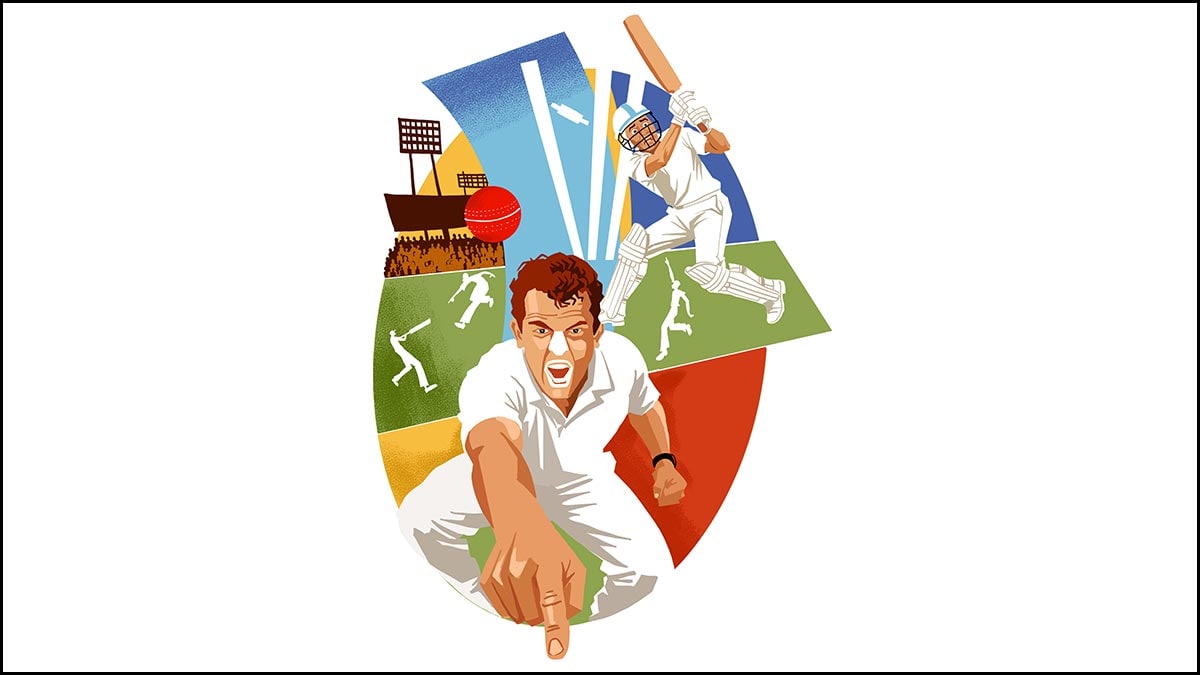
Ask any cricket fan about his relationship with the game, and ten to one he’ll tell you, “I am done with cricket.”
“I am done with cricket,” says the honourable insomniac with a history of waking up at 3:30am to catch the toss at the Basin Reserve. “I am done with cricket,” says the semi-retired fanatic, struggling to fit into his 1992 World Cup jersey, now a shade of fading Oxford blue. “We are all done with cricket,” says the fastidious stats-keeper, speaking as if for his band of purists. “It’s the jammed calendar,” says the one-time bookmaker, blaming his fatigue on the unceasing clamour of leagues and allegiances.
This is a mysterious quality of cricket: its truest fans are always breaking up with the sport, even while being wedded to it on some psychosomatic level.
The passion for cricket is often bequeathed from fathers to sons and so it was with me, though these days I see my father splayed out in front of the TV, pounding his chest and broadcasting his annoyance in parallel with the frenzied commentary: “This is what I hate… these tense chases.” He, too, is evidently done with cricket.
Bear in mind, we are not discussing those unfortunate souls who claim to have stopped watching at the height of the match-fixing controversies of 2000—such dropouts were never cricket fans to begin with. I am talking about fans like me, who find their necks craning involuntarily at traffic signals, peering through a slightly open window at some clip from an obscure match, and then remarking ruefully as the light changes to green, “I am so behind the game now, I don’t know who this player is or what that one’s nationality is.”
And yet, a true cricket fan never stops responding to the bend in a batter’s stance, the trot and jiggle of a bowler’s run-up, and even when at a bar over a round of drinks and pleasant chitchat, he can detect from the corner of his eye the opening rites of execution, an umpire getting ready to raise his time-stopping finger. A fan like that is conditioned to discover cricketing avenues at the queerest of places. Growing up in cramped homes (where cooking and fornication took turns and made space for each other), I’ve had visions of fiercely fought cricket matches happening at half-empty parking lots, rubber plantations, salt pans, even graveyards.
Cricket is the concentrate of stellar athleticism, capitalist greed, the spectacle of media and private mythology; and better than most modern forms of entertainment, it makes of the keen watcher a sensitive yet detached anthropologist.

I am in my early 40s now, and every time I wish to recapture that sense of national humility we have since lost, I look back to India’s hapless 1991 tour of Australia. The feeling comes rushing back when I evoke with a quick shudder the image of Craig McDermott charging up to the popping crease, his face and lips artfully daubed with zinc oxide. The whiteness of McDermott, reinforced by the whiteness of the cream, has crystallised into the purest symbol of athletic superiority and aggression that I know of. Even in this post-post-colonial age, the cream-daubed face remains my go-to image for such notions as cricket-as-birthright and a cricketer’s natural communion with the sport, so much so that when Captain Andrew Russell and his team took the field in Lagaan, I half-expected them to appear glistening with zinc oxide.
Cricket to me is therefore personal and political and commercial and subliminal all at once. I cannot help but see visceral connections where others see plain facts.
Doordarshan’s habit of transitioning from Raveena Tandon in mid-jingle dancing with a ball-point pen to Manoj Prabhakar in mid-jump about to deliver the second ball of his over has persisted in my mind as the aesthetic choice that most clearly announced the dawn of liberalisation. The one ball readily sacrificed at the altar of brand-building could now be viewed as just reparation for 44 years of Nehruvian socialism.
I mention such examples merely to show that a true cricket fan is by nature idiosyncratic. Cricket is a team sport expected to be enjoyed communally; and yet, a cricket fan does his ‘fan work’ mostly within himself. It is no surprise then that he remembers cricketing events of global magnitude by way of little details from his own parochial life.
For instance, I remember March 13, 1996, as the day when I kept delaying my mother’s request to play errand boy until Sachin had been freakishly stumped by Kaluwitharana with the score at 98/1. As I stepped out, Tony Greig was wondering with a wink, “Is this the beginning of the slide?” I still remember the brand of bread I bought that day (Wibs), the brand of milk that the shopkeeper put out for me (Mahanand), and I remember the penguin on his Kelvinator eyeing me suspiciously. When I sprinted back home, I could feel gloom touching our rented ink-blue walls and the bamboo-mat picture of a Kerala elephant looking decked up but lugubrious. India had slumped to 115/6, and my father was slumped over in his plastic chair, massaging his chest. An angioplasty in 2004, followed by a bypass in 2008, told us that his actions were more than just ‘grief, properly dramatised’. He was, however, luckier than actor Shafi Inamdar, who, on that dreadful, dreadful night, had collapsed with his team, never to see March 14, 1996.
Had my bond with cricket been based on such willed recreations alone, I might have quit watching long ago. But, as it happens, memories of cricket often arise in me out of the blue, precipitated by a shift in weather or a change in the mood-temperature of my immediate surroundings. Before I know it, a trapdoor has opened under my feet and I find myself free-associating.
To this day, many blue moons and many cycles of religious paranoia later, Ganeshotsav still makes me think of the Sahara Cup, of pretty colony girls in salwars practising their ‘group dance’, of that extra nip in the air helping everyone from open-chested Mohanty to close-chested Ganguly, of Azhar pleading with a needlessly rushing Afridi, “Thoda time deke daal na bade bhai.” Azhar’s weakness for watches was near-legendary, and even when he bantered, it was in the language of his greatest temptation.
Since cricket derives its spiritual sustenance from the individualism of the dedicated fan, a diaspora of close cricket watchers is doomed to be a strange community. This is a tribe that cherishes a good heartbreak, a tribe whose fears and irritations and morbidities have all been shaped by cricket, an anarchic tribe that unites over unexpected points of agreement.
When you are a part of this diaspora, you don’t feel threatened by the elegies of those who believe that cricket has progressively lost its elegance. In fact, in such instances, you feel the need to listen to the mourning poet, and through his verses to bridge time.
Like a monocled archivist, I jot down the lineaments of an age when cricketers believed in masking their disappointments and when they were almost apologetic for their achievements. My eyes widen and I mentally supply the drama missing in an old newsreel of Freddie Trueman castling a batter, waiting three seconds, and then silently walking back to his bowling mark, or a video, now scratchy and disintegrating at the corners, of Rohan Kanhai celebrating his century with a shy raise of his bat. (Back then, only the most flamboyant ones took off their caps).
I have a theory that celebrations on the cricket field became more animated after the camera grew into an omniscient, voracious presence and the commentary came to be punctuated with the vocabulary of sadism: ‘spanked’, ‘whacked’, ‘smacked’, ‘thwacked’. As a friend put it rather shrewdly, “When our schools decided to ban corporal punishment, we started to seek its substitution in cricket.”
But whatever the truth may be, almost all of my elementary responses have their origins not just in cricket, but in the way cricket was packaged and beamed into my home.
I belong to that generation of cricket watchers whose conception of the absurd, its hunch that the world was random and chaotic and meaningless, was formed on that murky evening when a rain-break caused the digital scorecard at the SCG to flit like the ticker at a stock exchange: ‘22 needed off 13 balls’, ‘22 needed off 7 balls’, ‘22 needed off 1 ball’. It was as though the weather gods and the maths gods and the gods of transmission were jointly conspiring to put us into a state of stupor and the South African team into a state of wry smile, a smile that became its preferred wearable for the next decade.
Come to think of it now, the queasy sensation I used to feel whenever Sachin was on strike owed so much to the tightly composed framing of the cricket pitch that cameramen perfected in the 1990s. I don’t know how to describe the phenomenon except that the whole stadium, complete with the players and the crowd and the advertising signboards, seemed lodged in my stomach, even as McGrath or Donald or Ambrose marched toward Sachin, who rose to meet the challenge. I would picture the worst while hoping for the best, and I used to think of this as ‘my weird little sensation’. So imagine my surprise when I found out that other members of the diaspora also grew up feeling that same queasiness. Suddenly, it was like sharing someone else’s intimate dream—or was it a nightmare?
The English aristocracy who gave cricket the title of the ‘Gentleman’s Game’ could hardly have anticipated us crazies, we who depend on cricket for the tingle in our spine and the blots on our psyche. We are a set of people helpless before cricket, a set frequently given to outbursts, a vulgar set, an unruly set. And yet, we remain gentlemen in one crucial sense: we came to cricket as children, and the game has supplied some of our earliest intimations of being out in the world.
A cricket-crazy kid learns before long that he may not be good enough to comment on world leaders and their politics but he can still have strong opinions about international cricketers. As a timid 12-year-old, when I worked it out that Heath Streak’s reputation as a big-hitter was based largely on his physique and never quite fulfilled on the ground, it was my first experience of resisting the party-line: I had caught something that none of the grand experts had. On the other hand, I could see that somebody like a Mark Waugh thrived on creating a low opinion of himself: a big part of Waugh’s charm was based on playing the divine loafer, and then pulling the rug from under the opposition’s relaxed feet.
It must also be mentioned that cricket, by the geometry of its playing field and the relentless nature of its coverage, is perfectly suited to instruct an impressionable mind in the many dimensions of the wider world, its miracles as well as its harsh ironies.
For instance, when you watch a batter swivel and pull a bouncer into the stands at Kingsmead, you begin with an appreciation of his preternatural reflexes, and then, as the ball travels against an alternating backdrop of greenery and tall buildings, receive a swift, shocking lesson in how an arboreal republic becomes a concrete jungle.
A boy growing up in the Karachi ghettos of the 1980s notices in the newspaper Bob Willis’s bowling arm brushing against a giant lattice structure. It’s the gasholders at The Oval! Oh, the tribal rites of cricket nicely mixed with this ultimate emblem of urban convenience: Willis’s wiggly dance and the promise of sufficient fuel to bring all the kettles of South London to a boil. As he sips his morning tea, the boy thinks about his mother, down at the ration shop, queuing up for kerosene.
You could make a case that a sickness for cricket is almost always forged in deprivation. For every child blessed with a synthetic turf in his backyard, there are hundreds of slenderly built ones making the daily trip from Palghar or Vasai or Uran to good old Shivaji Park, with heavy kits slung over their shoulders and impossible dreams in their eyes. These are the travelling princes of the city, and on their journeys they regularly whizz past the humble dwellings of box-cricket kings. But unlike the princes, the kings do not believe in formal coaching—they have evolved their own technique, their own range of shots, and they have done so by accommodating their boundless passion for the game within the narrow lanes of their chawls. Call it my backdoor philosophy, but I think cricket loses something when devotion to the game does not issue from a state of lack, from that touch of longing. I have never been able to recreate on a paid cable subscription the happiness I used to feel when my television aerial would fortuitously slide close to a neighbour’s dish antenna and bring to my sad, grey TV set a live signal from Barbados or Perth or Sharjah. A simple act of freeloading, it had all the afflatus of transcending my station in life.
Funnily enough, cricket’s kinship with the deprived is a legacy of empire—a story of how Britain’s favourite pastime came to be embraced by the colonies as a matter of life and death. Seen this way, there’s justice in England having had to stand by and watch all her major cricket-playing ‘subjects’ win the World Cup before she got a chance to lift the trophy herself. The civilisational music that runs through cricket is impossible to ignore, the echoes of old tyrannies and old uprisings. On the ground, little asides often end up annotating key chapters from history: in the subcontinent’s crowd-funded orchestra of cymbals and bongos and conches, you can hear the ecstasy of freedom hard-won; in the ridiculous costumes of the Barmy Army, there’s the conceit of former imperialists now posing as chivalric knights. As for an evocation of the hardy attitude that shines through displaced convicts, look no further than the seagulls at the MCG, who continue to peck for worms even as a cover drive hurtles toward them at flock-shattering speed.
To the congenital fan, all cricketing images would seem suspended in a larger context. To a fan like that, even cricket in repose is cricket in action: doom-scrolling on social media, he might stop for such inanities as Mahanama blowing into the top of his bat handle before every delivery or Jayasuriya feeling his armorial get-up before every round of combat. If he has more patience than the casual onlooker, it’s because he understands that the intoxication of cricket is precisely that it keeps changing pace, keeps going slow, keeps growing dull, and then it produces something that you had never seen before, thereby perking you up and putting you in company with great numbers of people who care about this odd game the way you do.
As much as results and winners and high-points, cricket to him is greatness in limbo: Dravid watching the ball all the way to the keeper; Jonty watching Dravid; Akram or Bumrah or Warne plotting a downfall a good three overs in advance; Hrishikesh Kanitkar’s eyes melting into the Dhaka smog as he gathers himself for the biggest swing of his life. Imagine a mass of the citizenry getting its kicks this way—what is it but the perfect prescription to incubate a nation of slackers?
Yet, when I was little, I was surrounded by just such fans, silent preachers of ‘the faith’. There was this particular zealot whose pet dialogue now strikes me as the voice of legions. The boys in the colony called him David Boon after his short, stocky build and his walrus moustache. In truth, he worked for the Life Insurance Corporation, and his obsession with cricket could be summed up in the following quip, a real spit in the face of ambition and careerism. “So I took a loss of pay today to watch the match,” he would say.
The thrust of the administrators, especially in the past few years, has been to make cricket more and more inclusive. The oft-quoted refrain was, of course, “It’s a wonderful sport, but it takes up too much of my time”. Accordingly, cricket has been sped up and miniaturised. Today, it offers sufficient elbow room for the practical-minded, the man who puts a premium on his hours. It adjusts itself to suit the in-and-out timings of the dutiful professional and curtsies before the businessman looking for some distraction after a tough day at the negotiation table. But these people do not cut it as fans for me, not really. Perhaps, my loyalties still lie with those heroic wastrels from my childhood, those Hogarthian figures who could organise their entire lives around the toss and the presentation ceremony.
By the same token, cricket today is available for consumption anytime, anywhere. Yet my mind harks back fondly to when I would see huge crowds in front of television showrooms, trying to catch a quick peek of the score, presumably between work and home. There’s clearly something the matter with me. I raise an eyebrow when dates for marquee clashes are drawn by lot and when without exception they get scheduled for Sundays—I am then compelled to ask myself if the hand of providence is working a bit too hard to put the squeeze on the family audience.
I understand that this attitude of mine sets me up for obsolescence. I feel like an early 20th-century reactionary who, upon seeing his street filled with cars, sits down to write a tract about the romance of the horse carriage.
However, this much is certain: cricket may be more inclusive today, but because it asks so little of the fan, it is also more impersonal. Once, you were expected to give yourself over to cricket—and then its glories singed, and then were its tragedies magnificent. In an age of cricket-on-tap, not only do victories seem fleeting and illusory, but there’s seldom any time to properly grieve a stinging defeat or time enough to let your crystal of grief be formed. Consequently, more than ever before, cricket feels divorced from ache.
Ah, that ache, that lingering ache—can anything in sports compare with it? If the commerce of cricket is predicated on plans coming to fruition, then an aching heart is the game’s enduring capital, the thing that binds a lifelong fan to a self-aware cricketer.
There was a line in Ajinkya Rahane’s recent retirement speech that I found rather touching. “While my name translates to unbeatable,” said Ajinkya, “as a cricketer, I have failed more than I have succeeded.”
Too much cricket has meant that we no longer possess a clear narrative sense of a cricketer’s career: these days, the best ones seem to pass from neophyte to legend in a haze. As a corollary to this, we have stopped paying attention to cricketers who do not make good on their promise, or worse, we tend to dismiss them off-hand as cautionary tales. Yet, they are vital characters in the theatre of cricket, its Horatios, its Falstaffs, its King Duncans, and in their unrequited love for the game, a crazy fan is apt to discover a fellow traveller.
I have a special place in my heart for such names as Sadagoppan Ramesh, Amay Khurasiya and Vijay Bharadwaj, cricketers who did not cash their cheques on the big stage; for the pomp and regalia that had accompanied the selections of Sujith Somasunder, Jacob Martin and Vikram Rathour; as well as for those who frittered away their God-given talents through indiscipline or indecision; and then for the plain star-crossed—for Amol Muzumdar, the greatest No. 3 never to play for India, or Pandurang Salgaoncar, the fastest bowler never to bowl for India. A big part of the lore of cricket has long been that things don’t always end happily for those involved: not all cricketing arcs reveal an inspirational edge, and many of them carry just that hint of fatalism. Imagine seeing in The Times of India a photograph of Rashid Patel charging at Raman Lamba with a stump and Lamba’s confession in the caption below, “I thought I was about to get killed”, and then seven years later, reading in the same publication that Raman Lamba had copped a pull shot on his temple and passed into the realm of memorials and black armbands. Yes, cricket is where anxieties and forebodings come true even when goals and aspirations remain unfulfilled.
This then is a tribute to those ‘has-beens’, those ‘might’ve-beens’, those ‘never-wills’. This is for those lucky-unlucky ones who have been repeatedly stung by cricket and who go back to cricket to resolve the itch. I recall the time when my middle-class parents decreed that I could not attend cricket coaching lest I miss my Marathi tuition. So what did I do? I headed to Thane’s Central Maidan to watch Sangram Bagul bat, hoping to find my shelved career incarnated in another schoolboy.
Bagul was a star of the Thane cricketing circuit in the late 1990s, and on that particular afternoon, ample demonstrations of his growing celebrity were in order: silken off-drives that must have felt like beautiful death to the tenderfoots trying to pitch it up to him. He made 62 of his team’s total of 70, before misjudging a single and being run out. Such local dominance in an era of Tendulkar’s national dominance had already fixed him in our minds as the Next Tendulkar. I saw him leave the ground that day: a bucktoothed boy cursing the heavens, then reining himself in to offer a swift prayer, his momentary disappointment replaced by a gesture of gratitude.
A permanent scribe of the game, I have been tracking his progress ever since: centuries in the Vijay Merchant Trophy, the Cooch Behar Trophy, the Kanga League, and a fleeting place among Mumbai’s Ranji probables. While composing this piece, I stopped to check his current status on his social media page. He is now a performance nutritionist. “There are times when I still dream that I am making my Ranji debut. Then I wake up, and it’s back to reality,” he told me over the phone recently. “But no regrets whatsoever.” Listening to him, I pictured his bucktoothed boy face radiating the same expression I saw on that hot afternoon at Central Maidan: caught short of the crease yet overall grateful, grateful for a chance to be associated with cricket. As indifference threatens to settle over the game, a tale like Sangram Bagul’s gives me hope. It somehow fills me with joy. He is sick, but I am sicker.
The writer is a columnist, predictor of cultural trends and anatomiser of sweet sadnesses.
