



Thirty-two years ago, the US hosted arguably the greatest football tournament ever. It was the first World Cup to be decided on penalties. It also had the epic quarterfinal clash between eventual champions Brazil and the Netherlands. Romania, inspired by Gheorghe Hagi, beat Argentina to reach the quarterfinals for the first and only time in their history. Bulgaria’s golden generation, headlined by the likes of Hristo Stoichkov, stunned reigning champions Germany to reach their first and only semifinals.
But, the more impressive aspect was perhaps off the pitch: 35,87,538 spectators saw the 52 matches at the 24-team tournament, with an average of 68,991 spectators per game. Both records stand to this day. Both could well be broken this time. But, what that represents has morphed into something else entirely. In 1994, the US packed its stadiums with people from every continent, and charged them as low as $25 a ticket—roughly equivalent to $56 today.
In 2026, the US is co-hosting the biggest World Cup ever, following the expansion to 48 teams (104 matches). According to FIFA, there were 50 crore ticket requests—10 times the combined demand for the 2018 and 2022 editions. The world governing body’s revenue from this tournament is projected to be $10.9 billion (more than Rs1 lakh crore, at current exchange rates), a 56 per cent increase from the record $7 billion of Qatar 2022 (about Rs58,000 crore then). What there is less of, for most of the world, is a realistic way in.
When the US, Canada and Mexico were awarded the tournament in 2018, the bid—United 2026—spoke of hundreds of thousands of $21 tickets across the group stage. But, the cheapest openly available group stage ticket in the first sale phase was $120. The cheapest final ticket on official primary sales was $1,490, before FIFA’s 15 per cent service fee. Premium final tickets opened at $6,730, but stood at $32,970 as of early May. This is not simply inflation or demand. It is a structural choice.
FIFA had trialled dynamic pricing at the rebooted and expanded 2025 Club World Cup in the US—it was seen as a dress rehearsal for the World Cup. Ahead of this trial, Lionel Messi’s Inter Miami was seemingly parachuted into the tournament. FIFA president Gianni Infantino also publicly encouraged participating clubs to temporarily sign Cristiano Ronaldo (his club, Al Nassr, had not qualified). In Messi’s case, FIFA didn’t need help. It awarded the host nation spot, usually reserved for the champions, to Miami for winning the Supporters’ Shield (the regular-season title)—the MLS Cup is the top trophy in American soccer. Though this reportedly overrode the wishes of the MLS, it is, admittedly, how champions are decided in other leagues. (Even India has now got rid of the play-offs at the end, though the US persists with them.) Having thus ensured the participation of at least one of the two icons, FIFA proceeded with dynamic pricing—or price-gouging, as it is traditionally known.

The mechanism of dynamic pricing is borrowed from the American entertainment industry, where the Super Bowl, the NBA finals and concerts have long operated on the principle that a seat is worth whatever someone will pay. For the opening game between Miami and Egypt’s Al Ahly, the cheapest tickets were at $349. This fell to $230 because of low interest and eventually plummeted to $55. Imagine paying $349 for a ticket and sitting beside those who paid only $55. Similarly, the ticket price for the Chelsea versus Fluminense semifinal collapsed from around $500 to $13 in a matter of days. This, in theory, is how dynamic pricing can work out well for (some) fans.
FIFA learnt its lessons and instituted a base price of $60 while introducing dynamic pricing at the World Cup. Towards the end of May, there was finally some price correction, but the World Cup’s higher pull compared with the Club World Cup is likely to prevent a major dip in prices.
FIFA’s strategic shift was also evident in its resale platform. In the past, it had capped resale prices. This time, the caps were removed for matches in the US and Canada. Sellers could list any price they chose and FIFA would charge both the seller and the buyer a 15 per cent commission on every transaction. On the official resale marketplace, final tickets were listed at up to $2.3 million each—about Rs20 crore—towards the end of April. The cheapest resale listing for the final was around $11,000 (Rs9.4 lakh).
Then there are FIFA’s right to buy tokens sold through its blockchain platform. They do not confer a ticket, but grant holders a priority window to buy one if their team qualifies for a given round. Tokens for the final were priced between $299 for lower-ranked teams and $1,499 for world No. 1 France. Perhaps the part where the team has to qualify for the round in question was not clear to the five Uzbekistan fans or the three New Zealand fans who bought them for $299.
The New York Times said in November that the tokens were sold without disclosed ticket prices, gave holders a deadline to commit or forfeit their money, and restricted most tokens to the priciest ticket categories. They initially carried a no-refund clause—reversed only after a Swiss gambling authority filed a criminal complaint against the right-to-final tokens for unlicensed gambling. So, thankfully for the eight overenthusiastic fans mentioned above, there should be no permanent damage—FIFA should be offering a full refund if Uzbekistan or New Zealand do not reach the final.
FIFA’s stated rationale is managing excess demand—comparable to paying to reserve a table at a sought-after restaurant. The mechanism has some logic. But even fans who navigated the process without loss paid hundreds of dollars for the chance to pay thousands more.
Football Supporters Europe, an umbrella body for fans, filed a complaint with the European Commission in March, alleging that FIFA had abused its monopoly. It said that FIFA had imposed “conditions on fans that would never be acceptable in a competitive market”.
FIFA’s one concession, made after a wave of global backlash, was a “supporter entry tier”—the $60 tickets referenced earlier, given to the federations of qualified teams to be distributed among their most loyal travelling fans. A gesture that acknowledges the problem while doing almost nothing about it.
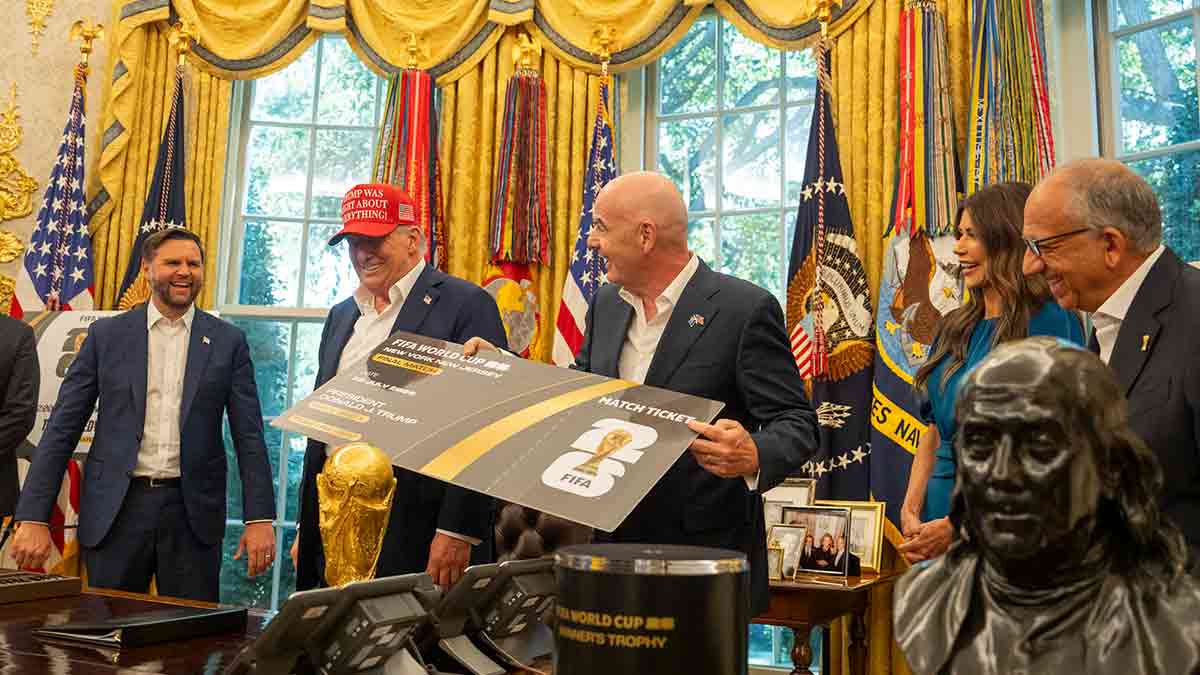
While the financial barrier is the most visible, it is not the only one. For many fans, the question is not whether they can afford to go. It is whether they are allowed to. This is thanks to Infantino’s new best friend, US President Donald Trump. When the ‘liars’ and ‘crooks’ (to borrow two words favoured by the leader of the free world) who decide the Nobel prizes turned a blind eye to Trump’s contributions to world peace, Infantino—dubbed ‘Sychofantino’ by some fans—stepped up. FIFA bestowed the newly created FIFA Peace Prize on Trump. But, the illusion of peace shattered in more ways than one.
Apart from the well-documented recent developments, the Trump administration had introduced a visa bond pilot programme last year. As of April, it requires certain people from 50 countries—predominantly in Africa, the Caribbean, the Middle East and parts of Asia—to post a refundable deposit (returned if the traveller departs on schedule) of $5,000-$15,000 while applying for a US visa. That seems reasonable enough as a deterrent to prevent illegal immigration. But, for fans from the five World Cup-qualified nations caught in the programme—Algeria, Cape Verde, Ivory Coast, Senegal and Tunisia, all African—this meant fronting a sum that, in most cases, exceeded or approached their country’s average annual per capita income.
After months of gentle nudging from FIFA and pressure from host city officials, the State Department announced on May 13 that ticket holders from these nations would be exempt from the bond. For Haiti and Iran, the suspension is total: all tourist visas are frozen. Their fans cannot travel to watch their teams play on US soil.
If fans find a way to afford a ticket, are lucky enough to get it and then a visa and go to New Jersey—the MetLife Stadium in East Rutherford is hosting eight matches, including the final—they may find that things do not get any easier from there. The stadium, like all American sporting infrastructure, is world-class—it is an NFL arena, designed for fans who drive in, surrounded on all sides by highways and parking lots, with no pedestrian access. Walking along the surrounding roadways is prohibited. So, international football fans, for whom walking to a ground is a ritual, will encounter officials telling them not to. One local official called the idea of walking “about the most unsafe thing I can think of”.
The answer, then, is public transport. NJ Transit announced in April that a round-trip train ticket from Penn Station in Manhattan to MetLife—a journey of about fifteen minutes—would cost $150. The regular fare for the same journey is $12.90. After considerable public anger, the price was reduced first to $105, then to $98. Bus tickets, initially $80, were cut to $20 following intervention by the governors of New York and New Jersey. NJ Transit’s justification was that FIFA had contributed nothing while minting money. However, the argument lands badly when fans absorb the cost.
Notably, the World Cup is not easily affordable even to those settled in the US. Shenny Chacko, an Indian enterprise architect who has lived in Dallas for 19 years, says that even with a US salary, the full expense—tickets, travel, hotels, parking and food—add up quickly for an average family. Among immigrant communities in Dallas, which hosts more matches than any other venue, the World Cup arriving on their doorstep has been a long-awaited moment. Chacko and his 16-year-old son Ryan—a winger who has come up through the FC Dallas youth system and now plays for Dallas Texans—will attend the Japan versus Netherlands match at the AT&T Stadium on June 14. He hopes the tournament does for Ryan’s generation what 1994 did for a previous one.
The broader geography is its own problem. The 2026 World Cup spans about 10 million square kilometres across the three host countries. For fans following their team through the group stage, the distances between matches can exceed 1,900km.
The US Immigration and Customs Enforcement, aka ICE, was another question that hung over the tournament. In December 2025, at a news conference held two days before the draw, Andrew Giuliani—the White House task force chief for the 2026 World Cup—was asked by a Sky News reporter whether the Trump administration would rule out ICE operations at stadiums. “The president does not rule out anything that will help make American citizens safer,” Giuliani replied.
Most of this is not, individually, unprecedented. Tickets to major sporting events have always been expensive at the top end. Visa difficulties are a fact of life for travellers from many parts of the world. American stadiums have long been car-centric and the transport prices go up during big events.
What is different about 2026 is the accumulation and the direction of travel. Previous World Cup hosts had gone out of their way to create entry points for the world. The 2026 World Cup’s primary host seems to be saying don’t bother turning up.
Critics have drawn an uncomfortable parallel with the Super Bowl—an event that has become a corporate hospitality showcase where the sport’s most devoted followers are largely priced out of the building. The fear is that the World Cup final at MetLife is heading the same way: a spectacle designed for television and the ultra-wealthy, not for the people who loyally fill the lower leagues and the away ends.
The bottom line is, it does not really affect FIFA’s earning potential. The World Cup has a captive audience and fans would rather claw out their eyes, at least hypothetically, than boycott the beautiful game. So, those who cannot attend will just watch from afar and FIFA will earn its billions regardless.
