


 Add as a preferred source on Google

A Kathak performance opened a conversation about health, but the message that emerged through the day went far beyond physical fitness. From food safety and preventive health care to artificial intelligence, organ health and the rising incidence of cancer among young Indians, THE WEEK Health Summit 2026 examined the challenges confronting India’s health care system and the innovations that could help address them.

Held in New Delhi on November 22 under the theme ‘India Heals, India Innovates’, the summit opened with a performance by Kathak exponents Richa Srivastava and Divya Verma. Through graceful movements, rhythmic footwork and expressive gestures, the dancers demonstrated how classical dance could contribute to physical activity and overall wellbeing.
Taking advanced medical care beyond metropolitan hospitals was the focus of the first special address by Dr Nikhil Tandon, director of AIIMS, New Delhi. He said India’s health care achievements should not be measured merely by the number of hospitals, sophisticated equipment or clinical breakthroughs. “Our real test is whether patients, irrespective of their geographical location or economic background, could access quality treatment in time.” Tandon underlined the need to reduce out-of-pocket expenditure through affordable diagnostics, generic medicines and standardised treatment protocols. Technology, he said, should give doctors more time to interact with patients rather than become a barrier between them.
The conversation then moved from access to treatment to another fundamental aspect of public health: food safety. Sharad Aggarwal, director of the Food Safety and Standards Authority of India (FSSAI), said ensuring safe food was a shared responsibility involving the government, food businesses and consumers. “Safe food is a right that must reach every child, every home, every school, every office and every hospital,” he said.
Access to health care takes on an even greater urgency in conflict zones, where medical infrastructure and supply chains are frequently disrupted. Dr Andrey Kozik, deputy head of the regional delegation of the International Committee of the Red Cross (ICRC) in New Delhi, spoke about the challenges of delivering medical assistance during humanitarian emergencies. “Conflicts can damage hospitals, interrupt medical supply chains and force health care workers to leave. Yet, the everyday medical needs of people do not disappear. Children still need vaccinations, while patients with diabetes and heart conditions require continuous treatment,” he said. Saving a life, he added, was only the beginning; it had to be followed by continued care.
The discussion subsequently turned to the challenge of ensuring consistent health care delivery across regions. In a session on Tamil Nadu’s health care priorities, Dr K.G. Arunraj, the state’s minister for health, medical education and family welfare, outlined his government’s ambition to improve services and ensure uniform standards across districts. “The goal before our government is not merely primary health care, but accountable primary health care,” he said. While Tamil Nadu already had health care centres across its districts, the next phase would focus on improving service quality and ensuring that patients received the same standard of care wherever they sought medical assistance.
Dr Iyappan Ponnuswamy, medical director of Kauvery Hospital, Chennai, emphasised the complementary roles of government and private health care providers in strengthening service delivery, with preventive care emerging as a major priority. Dr Rajesh Isiah of Christian Medical College, Vellore, highlighted the institution’s use of artificial intelligence to improve health care processes.
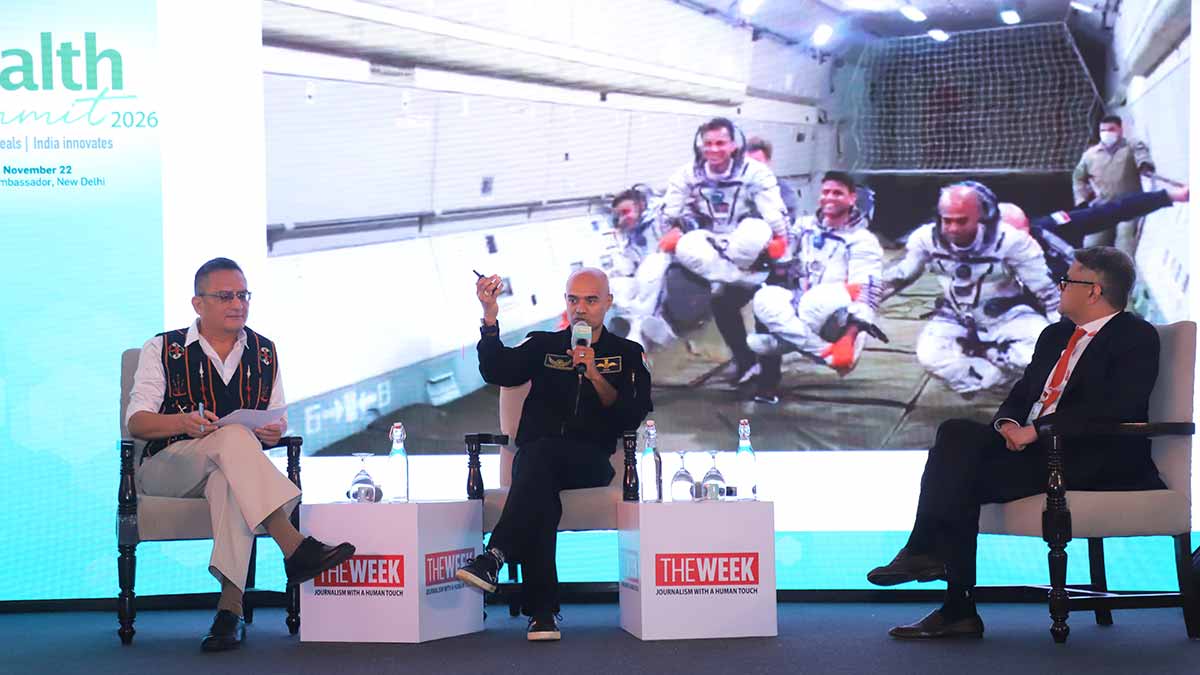
The importance of physical fitness received a different perspective during a session featuring astronaut-designate Air Commodore Prasanth Nair, one of the candidates selected for India’s Gaganyaan mission. Nair spoke about the demanding physical and psychological preparation required of astronaut candidates. He urged people to move beyond merely looking at the absence of disease and focus instead on optimising their health.
The summit then turned to chronic kidney disease, a condition that often progresses without obvious symptoms. Dr Sanjiv Jasuja, senior nephrologist at Apollo Hospitals, said around seven out of every 100 people could be vulnerable to kidney disease, underlining the importance of regular screening. Diabetes and hypertension were major contributors, but many patients remained unaware of kidney damage because symptoms often did not appear in the early stages. Dr Narin Sehgal of Neo Hospital reinforced the need for routine health checks, particularly among people with diabetes and hypertension. He also cautioned against the regular and unsupervised use of painkillers.
Preventive health care took centre stage in the address by the day’s chief guest, Dr Jitendra Singh, Union minister of state (independent charge), science and technology; earth sciences; minister of state in the prime minister’s office; personnel, public grievances and pensions; atomic energy; space. Speaking about the Union government’s initiatives, he emphasised the importance of prevention in India’s long-term health strategy. “Preventive health care is essential and it is our mission for 2047,” he said.
Pointing to the growing incidence of diabetes, Singh said it had become a pan-India concern. Even hill states, where the disease was earlier not considered a major health challenge, were witnessing a change in its prevalence.
He also spoke about India’s progress in vaccine development and the growing attention being given to rare diseases. Government intervention alone, however, would not be sufficient. “Unless society gets involved, we won’t be able to do it,” he said, calling for greater public participation in addressing rare diseases and other health care concerns.
The role of technology and institutional investment in expanding access to treatment came up in the address by Dr Santosh Shetty, CEO of Kokilaben Dhirubhai Ambani Hospital. He spoke about the hospital’s health care delivery model and investments in technology, saying it treated around 40,000 patients every day, many of them beneficiaries of Ayushman Bharat, and had invested approximately Rs50 crore in technology.
The discussion returned to lifestyle-related conditions during a panel on medical advancements in 2026. Dr Saptarishi Bhattacharya, senior endocrinologist at Apollo Hospitals, argued that diabetes management needed to go beyond controlling blood sugar levels. “Diabetes is not about treating numbers but ensuring that a person can stay healthy in every possible way,” he said. Early screening, he added, was essential to identify the disease and prevent complications.
Dr Rakesh Garg of AIIMS, New Delhi, highlighted the need for greater investment in research and development to introduce new treatments. Developing medical products required substantial resources, rigorous testing and government support, he said. He also cautioned against spurious medicines and pointed to changing lifestyles, reduced physical activity and unhealthy food habits as contributors to the growing disease burden.
Adding a gender-specific dimension to the discussion, Dr Jyoti Yadav of Kamla Hospital spoke about preventive health care and the need to monitor changes in women’s health. Medical advancements were helping reduce the time required for diagnosis and treatment, she said, while affordability remained an important priority.
Another panel of Dr Shrish Dutt Mishra, Apollo Hospitals; Dr Rajeev Verma, Manipal Hospital; Dr Rajesh Kumar Verma, Shalby Hospital; Dr J.P. Manocha, Sitaram Bhartia Hospital; Dr Suraj Prakash, Apollo Spectra; and Dr Rakesh Mahajan, BLK-Max Super Speciality Hospital, examined bone health, with a particular focus on osteoporosis, which often remains undetected until a fracture occurs. The panellists stressed that bone strength is built during childhood, adolescence and early adulthood, with peak bone mass generally achieved by around 30 years of age. The discussion highlighted the importance of early attention to bone health rather than waiting for symptoms or fractures to appear.
The summit also featured a session by Dr Deepak Khandelwal on the possibilities of semaglutide. “Almost one-third of us are obese. One-third of us, or maybe more, are dying of cardiovascular disease. And now we have another pandemic—fatty liver disease,” he said. The new drugs on offer could revolutionise treatments. This was followed by a discussion on medical innovation featuring Mohammed Galeeb, founder of IDMedico.
One of the most pressing conversations of the day addressed the rising incidence of cancer among young Indians. The panel brought together Dr Ajay Gogia, medical oncologist at AIIMS, New Delhi; Dr Ankur Bahl, principal director and head of oncology at Fortis Gurugram; Dr Murali Krishna Voonna, MD and chief surgical oncologist at Mahatma Gandhi Cancer Hospital and Research Institute, Visakhapatnam; and Dr Ankit Jain, medical oncologist at Apollo Hospitals.
Gogia said young adults accounted for around 40-45 per cent of India’s approximately 15 lakh cancer cases. Breast cancer was emerging as a major concern, with its incidence doubling over recent years. Bahl said doctors were increasingly treating patients in their 30s, well before they would ordinarily be eligible for routine age-based screening. He pointed to air pollution, particularly in cities such as Delhi, as an environmental concern, while stressing the need to examine genetic and other factors behind the trend.
Voonna drew attention to lifestyle-related risk factors, including tobacco and alcohol consumption, obesity, physical inactivity and poor nutrition. Jain, meanwhile, highlighted the difficulties of diagnosing cancer in younger patients.
India’s health care ambitions will ultimately be measured not only by the breakthroughs it achieves but also by how many lives those breakthroughs can reach.
An astronaut’s guide to fitness
By Abhinav Singh
“MAKE SPACE FOR FITNESS,” said Air Commodore Prasanth Balakrishnan Nair, astronaut-designate for ISRO’s Gaganyaan mission, at THE WEEK Health Summit, highlighting how astronaut training transforms both physical and mental fitness.
In a conversation with Riyad Mathew, Chief Associate Editor and Director of THE WEEK, and Sanjib Kr Baruah, Senior Assistant Editor, Nair spoke about the demanding training regimen that has made him fitter and more agile, while also changing his eating habits and improving his gut health.
“The body must learn how to fight against forces it was never designed to experience,” he said, explaining how astronauts train in specialised breathing techniques and muscle movements to maintain blood circulation in space.
In the absence of gravity, the heart does not work as hard as it does on Earth. Prolonged exposure to microgravity can affect the cardiovascular system, making even walking difficult upon returning to Earth. Astronauts therefore undergo rehabilitation involving treadmills, swimming and specialised exercises.
But physical fitness is only part of the challenge. “An astronaut must possess strong mental strength,” Nair emphasised, describing survival exercises in deserts, forests and freezing conditions. Teamwork, composure and resilience, he noted, are equally essential when working in confined spaces under extreme conditions.
