



AHMEDABAD
On September 25, the ministry of ports, shipping and waterways published an extraordinary gazette notification under the newly established Indian Ports Act, elevating four major maritime gateways—Deendayal Port (Kandla), Jawaharlal Nehru Port (Nhava Sheva), Paradip Port and the privately-owned Mundra Port—as Mega Ports of India.

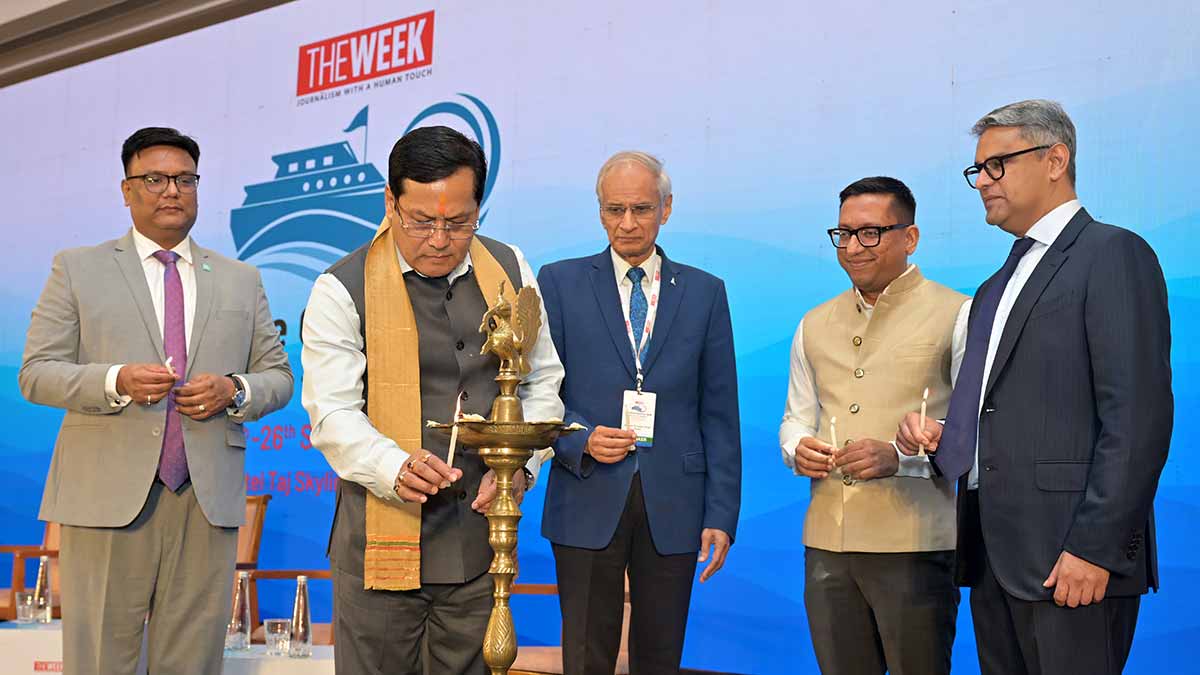
On the same day, in Ahmedabad, Union Minister of Ports, Shipping and Waterways Sarbananda Sonowal delivered an electrifying speech before admirals, port chairmen, logistics titans and maritime cadets at the third edition of THE WEEK Maritime Conclave. “In all the sectors, if we could demonstrate our power of excellence and power of performance, then the global society will accept us as a world leader,” he said. “We cannot move slow; we have to go faster than a bullet train!”
Sonowal backed his call to action by reminding the sea of port stakeholders, mariners and cadets about some key operational statistics: India’s major port handling capacity had expanded to 1,728 million metric tonnes (MMT) in FY2026 from 873MMT in FY2015. The mechanisation and digitalisation drive by the Sagarmala project had brought in dividends, with average vessel turnaround times across major ports dropping from 96 hours to 48 hours, slashing EXIM trade logistics costs. Cargo movement along national inland waterways surged to 216MMT from 18MMT in FY2014, placing seven Indian ports on the World Bank’s Container Port Performance Index 2025–26.
Voices of the future
While policymakers and industry giants presented macroeconomic data and projections on stage, the true spirit of the two-day summit emerged from the floor, where maritime cadets and university students directly engaged with Sonowal after his speech.
Namitha K. Sethu, an LLM student in Maritime Law at Rashtriya Raksha University in Gandhinagar, spoke to the minister about the importance of ministry internships. “If we want to pursue further in our realms, we need hands-on experience with what is happening inside the ministry,” she said. The minister assured on the spot that if students demanded more positions, the government would give them.
Abhilasha Mukherjee, studying global governance at Rashtriya Raksha University, raised the critical issue of gender representation in naval and coast guard services. The minister assured her that policy changes were actively being pushed for gender equality.
Security at the seas
While the future holds bright, India’s woes now stem from the geopolitically fuelled energy turbulence and its overarching influence on maritime security.
The first panel of the conclave, chaired by former chief of the Naval Staff Admiral Karambir Singh (retd), looked to address these geostrategic headwinds threatening India’s $30 trillion GDP target set for 2047. “There is a vital distinction between energy security and the security of energy,” Singh observed, and he suggested a holistic national security strategy, warning that today’s “corrosive geopolitics” weaponises trade, technology, currencies and energy corridors.
While Vice Admiral R.B. Pandit (retd), former commander-in-chief of Strategic Forces Command, flagged how low-cost drones and precision vectors exposed coastal assets, captain Ashutosh Sharma, chief general manager at IFSCA, GIFT City, offered some sobering reality check: in 2026, more than 95 per cent of India’s EXIM trade was carried on foreign-flagged, foreign-owned vessels. “Whoever controls the financial plumbing controls the world today,” he cautioned.
What India has in abundance is human capital. In the maritime sector, that also calls for human security. Captain Ajit Sunil Topno, nautical surveyor and deputy director general (tech) of shipping, pushed for international adoption of IMO Resolution 7.112 guidelines to protect seafarers against arbitrary criminalisation. Additional director general A.K. Harbola (retd), former Coast Guard commander (Western Seaboard), called for protecting India’s 20-nautical-mile shallow creek bands, where deep-draft naval and Coast Guard vessels cannot operate but non-state actors, smugglers, and illegal infiltrators could easily navigate.
After an elaborate discussion on coastal security, the conversation quickly moved to India’s maritime champions, its ports.
Co-host Deendayal Port Authority’s deputy chairperson Nilabhra Dasgupta outlined Kandla’s roadmap to add 100MMT of capacity by 2030 via a new container terminal at Tuna Tekra, 2,000 acres allocated for shipbuilding and repair, and a 150-tonne-per-year e-methanol plant. “A modern port is a comprehensive economic ecosystem. Cargo creates trade. Trade creates industry. Industry creates investment. Investment generates employment. And employment brings prosperity. Therefore, the question is no longer only how much cargo a port can handle. The question is how much prosperity can a port bring,” said Dasgupta.
S.K. Purohit, chairman and managing director of V.O. Chidambaranar Port (VOCPT) and Paradip Port, detailed how Thoothukudi became India’s first 100 per cent renewable-powered port, while establishing pilot green hydrogen bunkering facilities. “We recently received our Scope 2 carbon-free certificate—our entire port operation is run by renewable energy, generating 8MW of solar and wind power, and we are adding another 17MW to target Scope 3,” he said.
With great ports comes the demand for a fluidic supply chain, and this was what a panel moderated by Gaurav Dayal, chairman of JNPA, discussed. Lauding the “national ambition” to do well in the maritime sector, he asked: “What will it take to convert this ambition into a globally competitive supply chain?”
Technology and tax rationalisation provide a part of the answer. Vice Admiral B. Kannan (retd), former CEO of L&T Shipbuilding, recommended predictive AI tools while Price Waterhouse & Co Partner Suresh Swamy urged the Centre to resolve the inverted GST structure. Imported marine components now carry 18 per cent GST while finished commercial vessels attract just 5 per cent.
The shipbuilding dilemma
As India looks to file the edges in the supply chain, it also needs to answer a pertinent question: ‘Why are we not building enough ships, and why are we not building them fast enough?’ L&T vice president Kamal Kannagat highlighted how India moved from ‘should India build ships?’ to this very question.
Almost as an answer to this, Sanjiv Walia, CEO of the Shipyards Association of India, said that while the East Asia bloc (China-Japan-South Korea) controls 95 per cent of global commercial shipbuilding, India accounts for less than 1 per cent, despite ranking 15th globally. The reason, Walia said, was that Indian shipbuilders faced a cumulative 24 per cent cost disadvantage, which worked out to be around $8 million when building a standard $33.5 million bulk carrier.
It is to build these gaps that the Rs24,736 crore Shipbuilding Financial Assistance Scheme, the Rs20,000-crore Maritime Development Fund and the Rs5,000-crore Interest Incentivisation Fund have been formed. The recently established India Ship Technology Centre (ISTC) adds to this.
With these schemes in place, India could build ships for the world. And that requires discipline and high productivity. “By executing series orders of multipurpose commercial vessels for international clients, Indian yards build baseline process efficiency, strict delivery timelines and global quality assurance,” said Commodore Vinith Aerat (retd.), executive director of Garden Reach Shipbuilders & Engineers (GRSE).
However, Prasad Sawant, founder-CEO of Buoyancy, cautioned against forcing standardised vessel templates on commercial shipowners. He even proposed that government agencies like the ISTC could operate as shared “hardware banks” by providing private designers access to high-performance AI computing and GPU modelling infrastructure.
A green future for the mariner
As India looks to make ships for the world, it is already the global leader in ship recycling. Indian yards command around 35 per cent of the global market share. Speaking in a discussion on the circular lifecycle of ships chaired by Indian Maritime Centre CEO Tushar Pradhan, Dr Anand Hiremath, CEO of Sustainable Ship and Offshore Recycling Programme, and Rohit Agarwal, director & COO of Bansal Shipbreakers, revealed how 95 per cent of active recycling plots at Alang are Hong Kong Convention (HKC) compliant in 2026.
Dr Hiremath noted that direct re-rolling of ship steel plate into TMT construction bars slashed energy consumption by 16 per cent and cut carbon emissions by 58 per cent when compared to virgin ore smelting.
From 1982 to 2026, Alang has recycled more than 8,600 vessels, recovering 70 million tonnes of steel—equivalent to the steel required to construct 7,000 Statues of Unity.
According to Gujarat Maritime Board (GMB) data, ship recycling directly employs 18,000 yard workers while supporting five lakh indirect jobs across 800 secondary market shops surrounding Alang.
So how do we keep India in the lead? Through standardising material as well as human labour. Dr Hiremath and Sawant advocated for formal Bureau of Indian Standards (BIS) accreditation for re-rolled ship steel.
Vidyadhar Vasudeo Rane, general secretary of the Alang Sosiya Ship Recycling Workers Association, and Pallavi Mansingh, national project coordinator at International Labour Organization, explained how Supreme Court mandates from 2007 and 2013, Factories Act enforcement, PF pensions, and ESIC health care elevated migrant labourers into certified industrial professionals.
With all this in place, the only thing left was getting the workforce up to the mark. In the concluding session, Commodore R.S. Vasan (retd), Professor Jitesh J. Thakkar, dean at Gati Shakti Vishwavidyalaya, and Amit Oza, CEO of Astramar, talked about India’s roadmap to train one crore maritime professionals by 2047, bridging an anticipated sector deficit of 20,000 skilled shipbuilding technicians in 2026.
The conclave made one thing clear: India’s maritime ambitions will be judged not by the scale of its plans, but by the speed and quality of their execution. From modernising ports and strengthening coastal security to building ships, developing green maritime infrastructure and creating a skilled workforce, the next phase calls for coordinated action across government and industry. As India seeks to become a global maritime power by 2047, the challenge is to turn its considerable potential into competitive capacity. And, in the process, make the maritime sector a larger engine of trade, jobs and national prosperity.
