



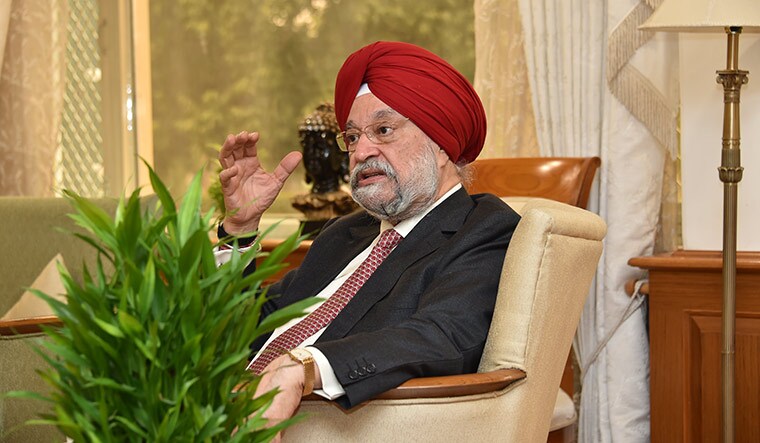
UNION MINISTER for urban development Hardeep Singh Puri has a reputation for speaking his mind. “I am too old to get into trouble,’’ he says, with a laugh. In his new book, Delusional Politics, Puri uses his skills as a diplomat to analyse a post-truth world where false narratives prevail. He writes about a failing UN, multilateralism and, of course, US President Donald Trump. Puri pulls no punches as he reflects on Trump’s fate—he is likely to be indicted, he says—or Iran, which cannot be underestimated even in its “potential for destabilising”. The book was written before he became minister and is his personal opinion, Puri insists. Excerpts from an interview:
In your book, you list five possibilities for what could happen to Trump.
Out of the five, what is likely to happen is that he is going to be indicted for his acts prior to becoming president. He has immunity now. Secondly, he is definitely going to be indicted for obstruction of justice. But having said that, I also maintain that his support base among people who elected him is not [weakening].
You have been blunt about many foreign-related matters, more than the ministry of external affairs.
This book was written before I became a minister. In a career spanning 39 years in the foreign service, I was always known for speaking bluntly.
You talk about Sri Lanka’s Hambantota port and airport, calling it delusional.
To have a white elephant that will cause the exacerbation of your debt, which, ultimately, will slice away your sovereignty... is totally delusional.
Then, why would India invest in the world’s emptiest airport?
In our case, it is a strategic investment. We are a $2.7 trillion economy. We grow 7.5 per cent [every year]. I think it is a small price to pay. It is not on the same plane. In Sri Lanka, somewhere along the way, some of the political class misread the situation. I think Rajiv Gandhi’s 1987 India-Sri Lanka Accord, where [we] went out of the way to assist them, was done literally. Not because we wanted any strategic inroads there. Rajiv Gandhi paid for it with his life.
You have been very frank about Trump pulling out of Iran.
I speak in my personal capacity. [The Iran deal] was a much better deal with all other members of the Security Council building the safeguards you required. You had international agencies also helping out. Compare that with what he (Trump) has got with North Korea. Where is the comparison?
I am very clear in my mind. If you do not want to deal with Iran for a variety of reasons, then it is different. There is an Israeli factor, a Saudi factor. I think all this is delusional.
You think it was not prudent of America to pull out of the Iran deal?
I feel these deals are very difficult to work out. Once you are in there it is better [to continue]. I am on the side of engagement.... Don’t underestimate Iran as a country. Don’t underestimate Iran’s potential to engage them.
Potential to?
Destablise, too. It is very clear. It is a strong country. It has reach. There is much more merit in engaging them and utilising the multilateral instruments available. That would be in everyone’s interest.
India could soon be talking with the Taliban. If the Afghans want to talk to the Taliban and want peace, should we not help?
I wrote this book before I became minister, so I want to qualify that the scenario in Afghanistan will play out as it has been envisaged. Because this presupposes a certain transitioning and maturity of the Taliban from wielding the gun to peace time democracy. These are early days yet. But India, under Prime Minister Modi and the kind of security establishment we have now, is more than capable of looking after itself.
You have said that the UN is not fulfilling its role at all.
It is not being allowed to. When you say the UN, I ask which one? There are three UNs; the member states, the secretariat and the civil society, [which is] more visible and an active part. My worry is that incoming secretaries-general have [only] one or two choices. They misread the proximity of New York and Washington. In other words, they transcribe in that functioning. I think the kind of problems the world is facing today are so serious, and so huge, that are beyond the capability of the most powerful states. Multilateralism has been rendered ineffective because you have the same dominant powerplay, which is delusional politics.
The PM has tried to deal with Pakistan. You went to Kartarpur. What did you think?
I was asked to go [at the] last minute. As a devotee and as a Sikh, I can say with all humility that it was a moving experience. Now, with the passage of time, I am very clear that the nature of the deep state in Pakistan has not changed. The nature of the deep state is encouraging characters who want to destabilise India. [But] they do not stand a chance like the 2020 referendum [demand for the creation of Khalistan].
Are you saying that the demand for the 2020 referendum is sponsored by Pakistan?
It is an ISI project, make no mistake. That is why it is not taking off, because even the diaspora can see through it. People say that the newly elected prime minister [of Pakistan] wants to work on peace. Is he able to? That is a question that has always been asked. People say that the chief of the army staff General Bajwa has a more open mind. I have known Bajwa from my UN days. You (India) should keep your options open. The Kartarpur corridor is good, but we have to build in safeguards to ensure it is not used for other purposes.
