



Although its first summit was 17 years ago, BRICS has not quite decided what it wants to be: a bloc, a bargaining chip or merely a waiting room for a multipolar world that has not yet arrived. That question will be repeated with unusual urgency when the group meets in New Delhi on September 12-13 for its 18th annual summit. It comes at a moment when Donald Trump’s trigger-happy diplomacy has left some of the BRICS members bruised and the bloc’s founding premise—strength in numbers against western unilateralism—under its sharpest test yet.
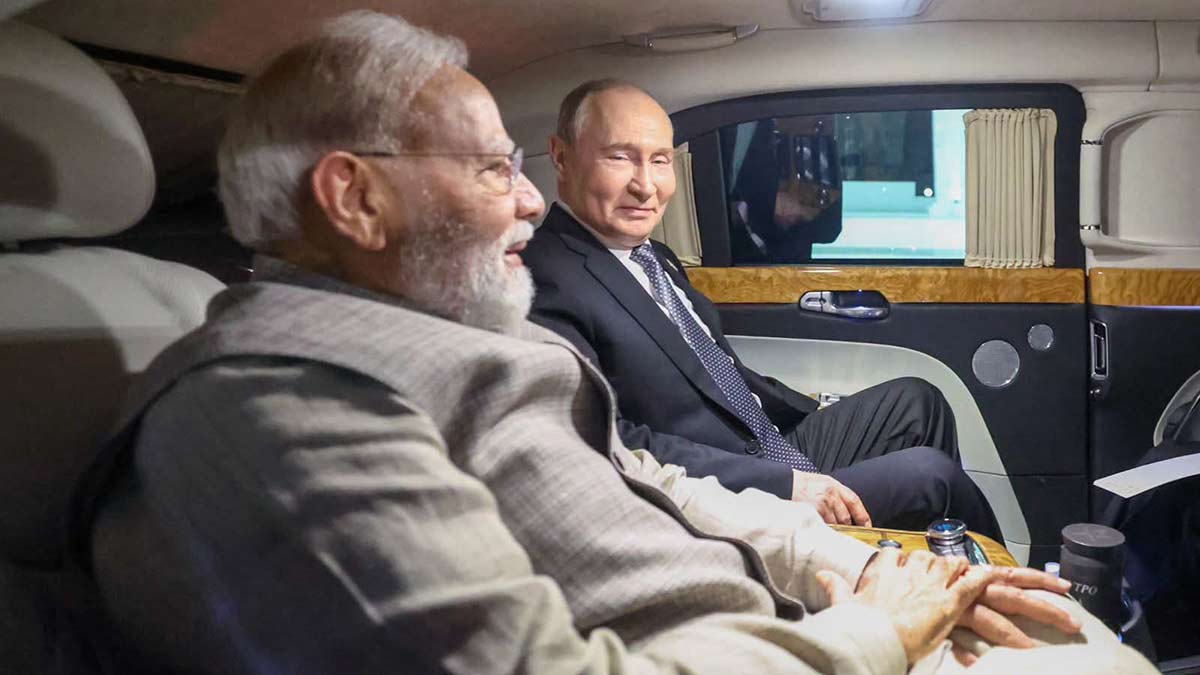
India is certainly treating the summit as more than a hosting duty. Facing a difficult diplomatic environment amid the wars in the Middle East and Europe, New Delhi has mounted a spirited outreach in the weeks before the summit. External Affairs Minister S. Jaishankar carried a personal message from Prime Minister Narendra Modi to President Vladimir Putin at the Kremlin on August 24. National Security Adviser Ajit Doval met Chinese Foreign Minister Wang Yi in Beijing the following day. On August 31, Modi met Putin in Bishkek, Kyrgyzstan, on the sidelines of the Shanghai Cooperation Organisation summit. He also held talks with Iranian President Masoud Pezeshkian, whose presence underscored the continued functioning of Iran’s political leadership despite US claims to the contrary.
The diplomatic activity reflects a deeper anxiety. BRICS has been hamstrung since its inception by friction between members whose interests rarely align. India and China have always had competing strategic interests, and several members remain uncomfortable with Beijing’s economic dominance. Kumar Sanjay Singh, who teaches history at a Delhi University college, traces the turning point to 2022, when western sanctions on Russia over Ukraine exposed how vulnerable the bloc’s members were to a financial system they did not control. “Imposition of sanctions on a peer power underscored the necessity of developing alternative trade routes and banking systems beyond the control of the US,” he says.
Yet the bloc’s centre of gravity has stayed firmly economic and technical rather than political. Meera Shankar, who served as Indian ambassador to the United States, expects the emphasis on trade, finance and sustainability to continue. Iran, meanwhile, wants BRICS to formally condemn the American military action against it, a demand that divides members. “We have to wait and see if the Delhi summit could agree on a basic formulation calling for a complete cessation of hostilities, resolution of differences through negotiations and reopening of the Strait of Hormuz,” says Shankar.
India’s problems are manifold. Having built its foreign policy around strategic autonomy, New Delhi now has to defend its standing within an increasingly assertive bloc without being seen as diluting it, a balancing act that is becoming harder to sustain. Singh points to a worrying precedent: “Brazil vetoed Venezuela’s inclusion as a partner state at the 16th BRICS summit in Kazan in October 2024 despite Russian backing. The subsequent attack on Venezuela and the capture of president Nicolas Maduro underscore the urgency to constitute BRICS as a strategic alliance against western unilateralism.” He clearly sees a repetition of that pattern in the US attack on Iran and feels there is enough evidence of a hardening Russia-China-Iran axis within the bloc. “Most certainly this summit will test India’s traditional aversion to de-dollarisation, a common BRICS currency and its own ties with Israel and the west.”
However, not everyone expects the Delhi summit to resolve any of this. Former national security adviser M.K. Narayanan says expectations from the summit are unduly optimistic. “I do not expect any significant outcome,” he says. “Much of the expectation in India derives from the fact that the meeting is being held here. There is thus a tendency to overemphasise its importance.” In his assessment, BRICS is no longer positioned to adopt a clear or definitive stance on global affairs, even as its members try to keep alive the spirit that built the group in the first place. Individually, several members, including India, carry more global weight than they once did. Collectively, Narayanan argues, they carry rather less, a paradox he believes will not be resolved at the summit. “Our options are limited, but the summit being held in India provides us with an opportunity to try and give the organisation a fresh lease of life.”

The scale of the bloc makes that underachievement all the more striking. Founded in 2009 by Brazil, Russia, India and China, followed by South Africa in 2011, the group now also features Egypt, Ethiopia, Indonesia, Iran, Saudi Arabia and the United Arab Emirates. The bloc accounts for close to half the world’s population and, by most estimates, around 40 per cent of the global GDP on a purchasing power parity basis. But this heft has not translated into relevance, and the interest generated by this year’s summit in India is not matched by comparable enthusiasm among the bloc’s other members.
Nirupama Rao, former foreign secretary, frames the real test for the bloc differently: can an enlarged BRICS translate the language of multipolarity into practical cooperation. “India will want to keep the focus on reform of global governance, development, technology and greater representation for the Global South, rather than allow BRICS to be defined simply as an anti-western platform,” she says. There is a genuinely stronger Global South voice today, though not yet a unified one, and what unites these countries is less ideology than a demand for agency in institutions that no longer reflect the world as it actually is. “The watershed is that countries which were once largely rule-takers now increasingly expect to participate in making the rules. BRICS can help amplify that voice, provided it does not simply replace one form of bloc politics with another,” says Rao.
India will face mounting pressure to pick a side as rivalries sharpen, but Rao resists calling its position fence-sitting. Strategic autonomy, she says, is itself a position, and India’s advantage lies precisely in working with different partners on different issues without being annexed to either camp.
Singh’s assessment of the run-up to Delhi lends that caution some weight. Since the BRICS summit in Brazil in July 2025, international diplomacy has been shaken twice by American gunboat tactics: first by the attack on Venezuela in January and then by the joint US-Israeli strike on Iran at the end of February, both widely read as attempts to choke fuel supplies to China. That belligerence has placed BRICS under a strain it was never quite built to withstand. As geopolitical rivalries harden, the case for BRICS as a major economic and strategic formation is fast eroding. New Delhi, unfortunately, might not have much time to prove otherwise.
