



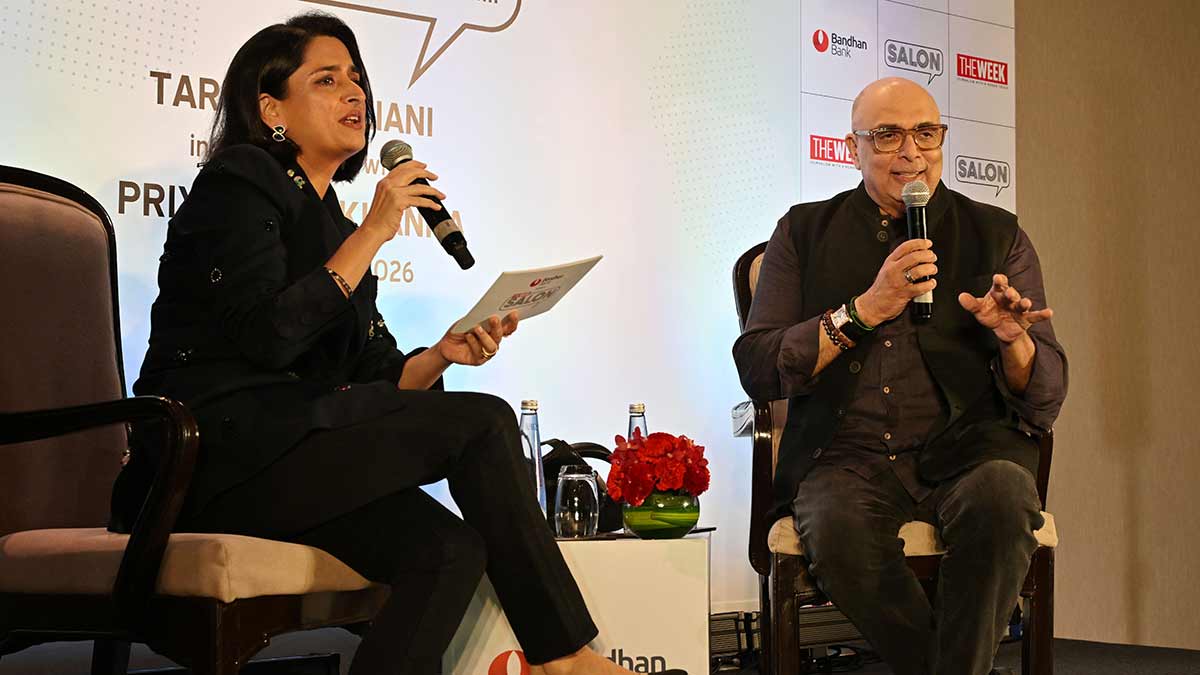
Tarun Tahiliani isn’t one to mince words. And when he sat down at THE WEEK Salon, presented by Bandhan Bank, he spoke with the candour of someone who has spent 30 years in the industry.
Indian fashion has transformed over these decades—it has gone from a time when neighbourhood tailors were the first and last resort for getting clothes made to an era of extravagant weddings, social-media-driven trends and global luxury. Tahiliani has not only had a front-row seat to these changes, but he has also had a hand in ushering in many of them.
Yet, through all this transformation, one thing has remained constant in his work: the drape.
“Indians have always draped fabrics. And we do it in a way nobody else in the world does,” he said. “The sari is draped, the dhoti is draped, the Kerala lungi, or mundu, is beautifully draped,” he said. That understanding of the drape became the foundation of his structured drape—a technique he pioneered, alongside his work with the concept sari. “Hindus draped the textiles, Mughals brought embroidery, and the British gave us tailoring,” he said.
And then, of course, there are his lehengas. As the host, author Priyanka R. Khanna, put it: “When, in my book, the protagonist had to buy a bridal lehenga, it had to be a Tarun Tahiliani lehenga.”
Oil-field and Ensemble
Born to a Navy Admiral father and an engineer mother, Tahiliani’s first job was not in fashion but selling oil-field equipment. “There were no design schools or communities. When I told my father, he was like, ‘I can’t believe you’re becoming a tailor’,” he quipped.

Nevertheless, at 25, he opened Ensemble, India’s first multi-designer retail store, with wife Sailaja in 1987. “The idea for Ensemble came because of two reasons,” he said. One was a 1987 news magazine article on a new fashion movement in India, which featured the likes of Ritu Kumar. “We were kind of on a cusp of something,” he said. “Second, my wife had moved here from the US and would look at things abroad and see all these beautiful Indian things being made there, while the availability here was so limited. Why were we still shopping at Fashion Street? So, we decided to do Ensemble.”
He went on to study fashion at New York’s Fashion Institute of Technology, and started his label in 1995.
Two years ago, he launched his luxury pret-a-porter line OTT—a bridge between couture and everyday clothing. The same year, he sold 51 per cent of his label to Aditya Birla Fashion and Retail, which he said was “great”. “For a while, I was kind of chasing my tail because I just didn’t have the wherewithal to organise production,” he said. “We showed in Milan in 2003, and it was a sensation. We came back to India and we fell flat on our face because we made one basic sample. We had no production team. We had an order for 400 amazing chikankari pieces. We were a mess. From that high of the show, I stopped showing for the season. Now, with OTT, everything is made in proper factories. We only do the sampling in-house.”
OTT is now set for a Milan showcase, he added.
East or west? Both
Throughout the conversation, Tahiliani returned to how, growing up in South Bombay, there was a pervasive tendency to look towards the west.
“If anyone had told me, at that point, that I might be in a village outside Lucknow doing block printing, or go to the kumbh mela, I would have taken a wager for anything in my life,” he said.
Yet, over the years, he went on to work extensively with structured drapes, Indian handlooms and traditional embroideries. That confluence came through beautifully in his 30th-anniversary showcase earlier this year in Hyderabad.
The idea, he explained, was inspired in part by White Mughals, William Dalrymple’s account of James Achilles Kirkpatrick, an Englishman who fell in love with Khair-un-Nissa, a Shia noblewoman, and received the Nizam’s permission to marry her.
Kirkpatrick, Tahiliani noted, lived a dual existence: by day, he was the quintessential Englishman; by night, he dressed in Indian attire and lived with his wife at the mahal next door.
“And, you know, this sort of started happening,” he said. “And I thought, what a perfect space, because it talked about a transcendence from one culture to another. Now, there is not such a difference from a kid growing up in Bombay or Delhi or Portugal.”
The Gen Z bride
Along with globalisation, that gap has also been bridged by social media. “It’s a great way to tell a brand’s story,” he said. The new-age bride and groom, who are Gen Zs, he said, “just want to have fun at their wedding”.
“Thirty years back, the bride and the groom would come meekly and would say, ‘Mummy, Papa said I have to wear this.’ It’s all gone,” he said.
It all boils down to individuality, he said. “I remember Raghu’s (designer Raghavendra Rathore) wedding. All the Rajput women were dressed in identical poshaks in different colours. It was a vision I can’t forget,” he said.
Fashion, after all, is individualistic.
And if there was one unexpected takeaway from the conversation, it was this: washing your sari in reetha (Indian soapberry) makes it soft.
