



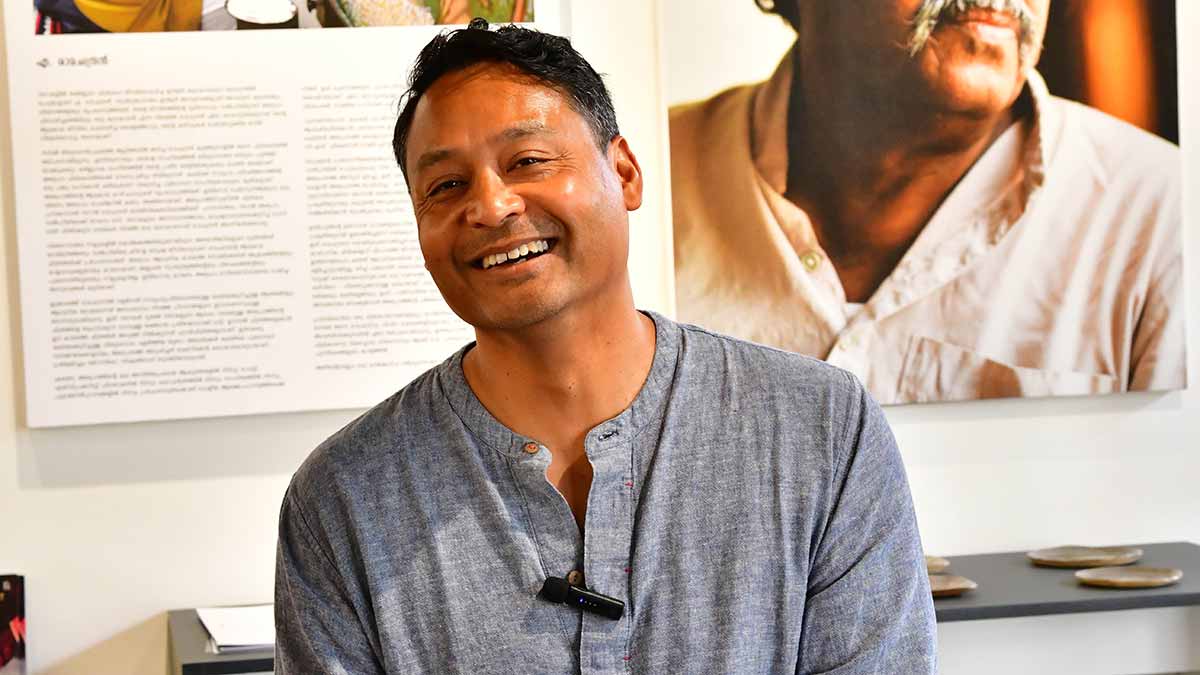
What happens when a NASA scientist steps out of his methodical, process-driven world to travel to an unfamiliar land and take on the fluid, unpredictable task of building an art museum from scratch?
For Rahul Ramachandran, who leads a team of earth-science researchers at NASA’s Marshall Space Flight Center, Alabama, this museum project was more than an adventure. It was a deeply personal mission.
Rahul is the son of A. Ramachandran, the renowned painter, sculptor and art scholar from Attingal, Kerala, regarded as one of the titans of the Indian art world. Wanting to establish a museum of his life’s work in Kerala, Ramachandran had donated a large collection of his works to the state government. But before he could realise his vision, his health failed, and he died at his home in Delhi in 2024.

“The museum was my father’s dream,” Rahul said. “After he passed away, it became my responsibility.”
THE WEEK met Rahul at the monument he helped build in memory of his father—the A. Ramachandran Museum at Asramam, Kollam. On display at this state-of-the-art facility, an hour’s drive from his father’s birthplace, is a comprehensive range of his works spanning decades and mediums: sculptures and paintings, including the large-scale lotus pond series that has acquired iconic status; drawings and sketches; and ceramics and bronzes.
Well-lit spaces and carefully mounted walls showcase the life’s work of a modern master, while dehumidifiers, security devices and unobtrusive conservation systems protect a sprawling collection estimated to be worth around Rs450 crore.
The museum opened last year, and plans for an expansion are already under way—a testament to Rahul’s successful navigation of the intersection of art, technology and personal memory.
Did he find the project as difficult as his work at NASA? He paused before answering.
“It was harder,” he said. “It was harder in a lot of ways.”
The museum is housed in a 1,00,000sqft cultural complex near the historic Asramam ground in Kollam. A 72-acre open field in the middle of Kerala’s oldest port town, Asramam may be worlds away from the NASA facility in Alabama, but there is one similarity: it, too, has a connection to takeoffs and flights.
The ground served as the region’s only civil aerodrome nearly a century ago. VIPs travelling to Thiruvananthapuram, then capital of the Kingdom of Travancore, deplaned at Asramam before continuing on by road. On the way lay Attingal, the town where Ramachandran was born, also home to a storied palace where many of the Travancore kings grew up.
The year Ramachandran was born, in 1935, a new airport in Thiruvananthapuram made the Asramam aerodrome obsolete. In Ramachandran’s teens, Travancore itself ceased to exist—first merging with the neighbouring Kingdom of Cochin, and later with the parts of the Madras Presidency, to form a unified Kerala. As his homeland redrew its political map, Ramachandran himself left for Bengal to take lessons in drawing—at Kala Bhavana, the fine arts institute at Visva-Bharati University in Santiniketan.
It was into this landscape, steeped in his father’s history but unfamiliar to him, that Rahul flew in decades later to realise the museum dream. With his sister, Sujata Ramachandran, a social science researcher in Canada, he arrived in Kollam after the Kerala government selected the site for the museum.
“I had never been to Kollam before, but I just fell in love with this place,” Rahul said. “The environment of the whole complex here—the building, the trees, this openness and closeness to nature—just felt right.”
The building itself was initially little more than an empty shell. But the space allowed the scientist to see enormous possibilities.
At NASA, Rahul leads a team that uses artificial intelligence to learn from the data the agency has accumulated over decades. The NASA repository is massive—around 400 petabytes. To put that in perspective, filming yourself continuously in HD for 13 years would generate just one petabyte of data. Rahul’s job? To apply AI algorithms to the data and help scientists save years of analysis time.
In Kollam, the task was different but strangely familiar: to organise an enormous body of work so that others could trace the evolution of his father’s artistic mind.
But here, Rahul encountered challenges more complicated, in some ways, than those he helped solve within the structured NASA ecosystem. “It is much easier,” he said, “if you are one person or one organisation doing it and in total control of everything. But here, there were so many different moving parts.”
He found himself working with people—politicians, bureaucrats and workers—with fundamentally different functioning styles, philosophies and schedules. Building regulations could get in the way of changing a light bulb. “The hardest thing was coordination and communication,” he said. “The nice thing was everybody wanted this museum to happen.”
A key figure in the project was the artist Murali Cheeroth, who, as chairman of the Kerala Lalithakala Akademi, helped turn the wheels of the state administration and complete the project in just five and a half months. The work was often punishing, because the standards were exacting. “When the museum’s false walls were being built, the workers made a small mistake,” Cheeroth told THE WEEK. “We made them demolish and rebuild the walls.”
Cheeroth, too, was emotionally invested. “Once, as I was walking out of Ramachandran sir’s room after visiting him when he was ill, he called me back,” he said. “‘Will this museum ever happen?’ he asked. All I could do was clasp his hands and say, ‘We will make this happen.’”
Cheeroth knew the Ramachandran family well. Ramachandran’s wife, Tan Yuan Chameli, had been his senior at Santiniketan. Her father was the legendary Chinese scholar Tan Yun-Shan, whose friendship with Rabindranath Tagore led to the founding of Santiniketan’s Cheena Bhavana, the oldest centre for Chinese studies in South Asia.
Ramachandran married Chameli in 1967 before moving to Delhi, where they raised their family. The museum dream in Kerala was, perhaps, his way of acknowledging the roots of his artistic and personal journeys.
Rahul remembers his father’s studio as a sacred space where only his mother was freely allowed. The couple shared a deeply collaborative partnership. Chameli sacrificed much of her own creative practice to support her husband’s work—bridging their different cultural worlds, speaking with him in Bengali and meticulously maintaining his records.
“Her criticism was the only one he listened to,” Rahul said. “He would let us children come in and see his works only when they were ready.”
In preparation for the museum in Kerala, Ramachandran, with the help of his family, bought back many of his major works from collectors, often paying several times their original sale prices. The collection that the family has painstakingly reassembled, according to Cheeroth, has given the exhibits a chronological sweep.
“There are specimens starting from his early days right up to his final works,” Cheeroth said. “Chameli di, Rahul and his sister took part in every discussion—what was needed, what was not. The museum was curated by [R.] Siva Kumar, renowned art historian and our teacher from Santiniketan. This is the result of a wonderful, collective effort.”
In one corner of the museum hangs what appears to be an unfinished work that offers intriguing clues to why Rahul chose science. It is a large canvas carefully divided into a grid of squares. Ramachandran had been filling the squares one by one, working his way upwards, across the grid, from the bottom-right corner to the upper left.
As the progression showed, Ramachandran’s innate capacity to create was not merely spontaneous, but also deeply methodical. “My father worked like a scientist,” Rahul said. “He was very systematic—he would read, research and then progressively build things up.”
The unfinished work showed his father having progressed upwards and across the canvas, square by square, charting a flight path of imagination. Towards the upper-left corner, the squares remain blank. His journey had stopped.
Standing in the middle of the museum, Rahul appeared to be continuing the same inspired flight path. He has been filling the blank squares in his own way: blending science and art, and method and memory.
“This,” he said, looking around the museum, “was all part of the family collection. This is all my inheritance.”
