



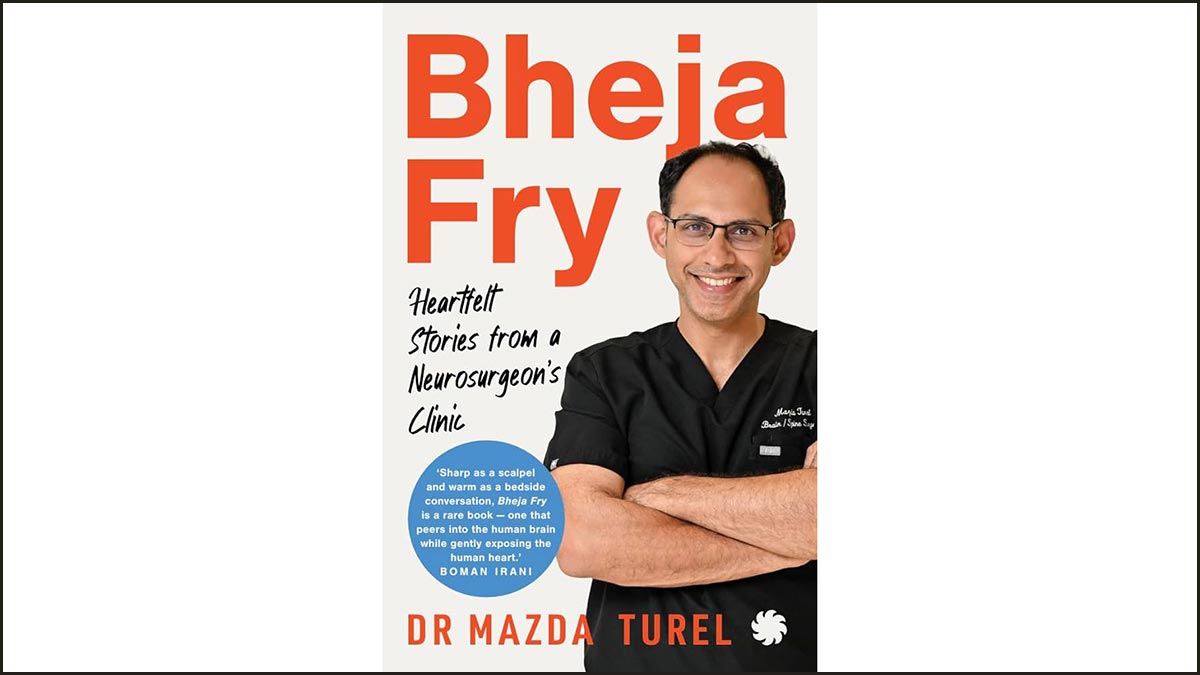
The book’s title, you may think, is a dead giveaway. Its two parts—‘Bheja Fry’ and ‘Heartfelt Stories from a Neurosurgeon’s Clinic’—delude you into thinking that you’ve got the whole picture. Not that the delusion is entirely wrong—the book will make you laugh and sigh in parts. But what the title doesn’t give away is the absolute wonder the book leaves you with—from the science of neurosurgery to the art of language.
Take these sentences, for instance: “A sliver of normal spinal cord circumferentially wrapped the tumour, like the silver foil that encircles an Indian mithai roll. The surgical task was to eat the sweet completely while preserving the foil entirely.” And that’s the beauty of Dr Mazda Turel’s writing: he makes bone dust sound like stardust—magical, with a hint of humour. So you have chapters like ‘The Husband with a Phataka in the Throat’ and ‘The Lady Who Sinned’ to cases like the one where a dog sniffs out a lawyer friend’s cancer and another where Christ, a wandering sage, comes to him from the US with excruciating pain. He doesn’t make light of his patient’s condition or suffering, rather he treats them with a lightness that has become a hallmark of his writing (exhibit: his columns for THE WEEK).
There are the usual suspects as well—the mother-in-law/marriage/wife jokes. But it is when anatomy and comedy come together that it becomes a lesson in the craft of creative writing. Sample this: “Ventricles are cave-like cavities filled with cerebrospinal fluid that give buoyancy to the brain. They are the reason why you can carry 1.5kg of it without feeling the weight, even if you are pig-headed.”
But that is not the only lesson you get. “To work in neuroscience is to watch biology exemplify philosophy in real time,” writes Turel, consultant neurosurgeon, Wockhardt Hospitals, Mumbai. A no-brainer then to find it in his debut book—“We are the ratio of the suffering we caused to the suffering we endured.” He also writes about loss, grief, faith, the loneliness that comes with the profession, the competition, AI, alternative medicine—all of it centred around the squishy mass that makes us who we are.
Turel though did not set out to write a book; he set out to survive Sundays. “When you have a little bit of free time and you really want to do something that you love on a Sunday, either you read or you write,” he tells THE WEEK. “Most people enjoy leisurely reading and I somehow enjoy writing. And, I would want to give my readers something light, something beautiful, something thought-provoking, something funny, all of it—a potpourri of emotions. And that is how you would probably survive your Sunday to get ready for the week ahead.”
The book is a compilation of the columns he wrote for Mid-day, a Mumbai daily. It is neatly divided, as if with a scalpel, into six sections, covering everything from consulting room confessions and clinical crossroads to cliffhangers and conundrums. Each section has 10-odd bite-sized, breezy essays. In a few of the essays, the ending seems rushed, perhaps from years of adhering to column word limits. But, in the end, Turel achieves what he set out to do: humanise doctors and enthral readers with stories of grit, gumption and grace.
The brain, writes Turel, has a way of revealing people to themselves and to others. Through this book, he has also revealed himself.
BHEJA FRY: HEARTFELT STORIES FROM A NEUROSURGEON’S CLINIC
Author: Dr Mazda Turel
Publisher: Juggernaut
pages: 290; price: Rs499
