



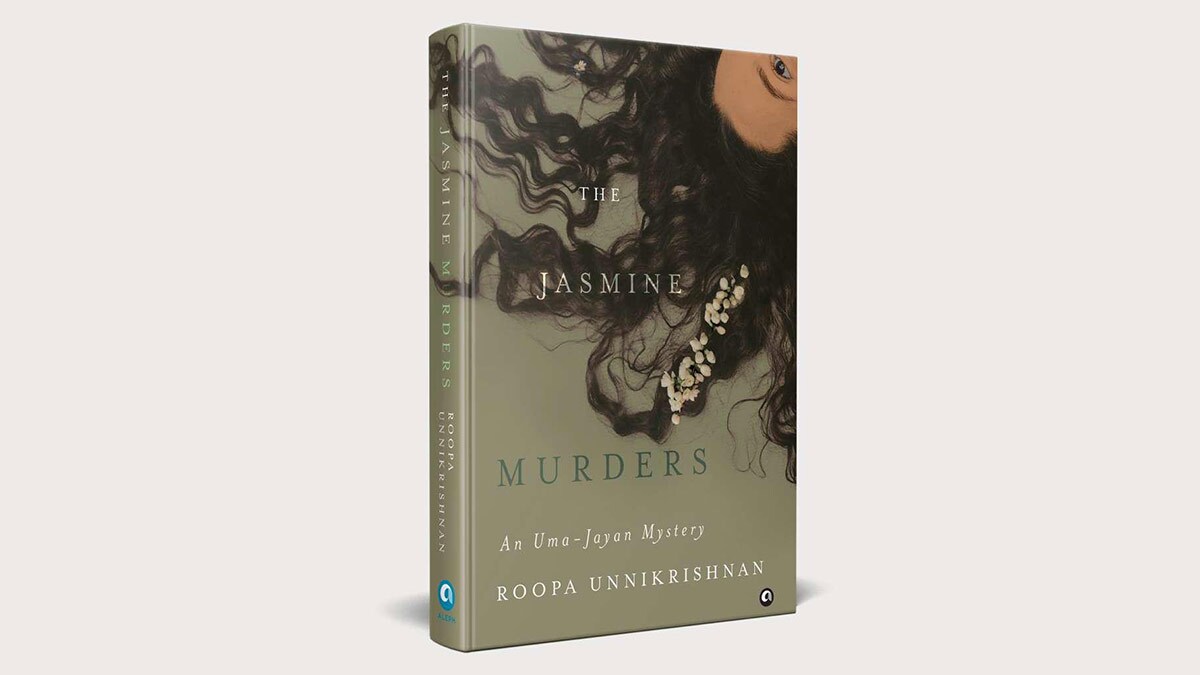
The Jasmine Murders: An Uma-Jayan Mystery is one of those crime novels that sneaks up on you. You think you are walking into a neat procedural—a severed head, a confession, a young cop—and then, before you realise it, you are in a far denser thicket of marriage, class and memory, and of the cruelties that can flourish inside ‘good’ homes.
The opening image is unforgettable: a farm labourer in his small house at dawn, his teenage wife’s severed, jasmine-crowned head in his lap. It is almost mythic in its horror, yet the setting is entirely domestic. The crime is shocking, but it is the ordinariness around it—the smell of flowers and oil, the bustle of policemen, neighbours craning their necks—that really chills.
Enter Assistant Superintendent Jayan; young, idealistic and visibly shaken by what he is seeing in the field for the first time. His instinct is that this supposed ‘crime of love’ is not an isolated madness, but an extreme expression of attitudes society quietly normalises. A parallel thread involving a powerful zamindar household shows how spectacular violence at the margins sits alongside quieter violence protected by status and money.
For all the gore and investigative machinery, this is as much Uma’s novel as Jayan’s. Recently married, transplanted from Kerala to a small Tamil town, Uma arrives with a low hum of resentment inside her: she has “settled”, she tells herself, and will never quite belong.
The novel never ‘fixes’ this through easy romance. Uma’s transformation is incremental and hard-won. Where the men see a case file, Uma sees a girl: the pattern of the jasmine, the harshness of turmeric against damaged skin, the way a life has been rearranged into evidence. As an artist, her instinct is to observe and to render; her sketches become a quiet counter-investigation, a way of insisting: I see what you are trying to look away from.
Her relationship with her mother, Yashoda Amma, adds another layer. The mother arrives like a force of nature—tiny, impeccably turned out, emotionally forceful—embodying that older generation of women who learnt to wield power from within patriarchy rather than against it. Their sparring, their eventual accommodation and the way both of them relate to Jayan give the book a knotted, lived-in texture.
The prose is clean, sensory and economical. Tamil and Malayalam words slip in naturally, so that you feel the texture of speech without being pushed out of the narrative. The early chapters linger on domestic spaces, routines and the rhythms of a small town. This may test readers who want immediate twists, but it pays off.
One reason the book feels more mature than many thrillers is its refusal to treat ‘the criminal’ as a species apart. Suspects are drawn in shades of grey. The narrative never excuses their actions, but insists on showing the pressures, humiliations and inherited wounds that shape them. And it keeps asking an uncomfortable question: if justice fails, if the law favours the powerful, what forms of violence begin to look like the only remaining language? The answer is never simple or comforting. The book does not endorse vigilantism, but it does not pretend that formal justice is always adequate either. You end up sitting with ambivalence rather than moral clarity—and that, for this kind of story, is a strength.
The Jasmine Murders is about how gossip kills, how feudal power seeps into police files, how women navigate love in a world that can turn them into offerings at the altar of male insecurity. It is also, quietly, about a young couple learning what it means to stand together in the face of both private and public storms.
Puri is an author and former diplomat.
THE JASMINE MURDERS: AN UMA-JAYAN MYSTERY
Author: Roopa Unnikrishnan
Publisher: Aleph Book Company
Pages: 240; price: Rs799
