



The year was 2005, four years after Apple had launched the iPod, which revolutionised the music industry, and two years before it would launch the iPhone, which would revolutionise every aspect of life as we had lived it till then. On a pleasant summer day in June, Apple’s co-founder Steve Jobs stepped on to the podium to deliver the annual commencement address at Stanford University. He was urbane and polished, but above all, he spoke from the heart. He described how he had dropped out of college so he could sit in on the lectures he was actually interested in. Some of them, like a calligraphy course, would later help him design the most beautiful typography for the first Macintosh computer. He spoke about being devastated when he got fired from Apple—the company he had helped build—at the age of 30, and how starting again from the bottom gave him an audacity that too much success had taken from him. He spoke about facing death when he was diagnosed with cancer a year earlier. It taught him to live each day as though it was his last.
The speech was a huge hit. Watched over 120 million times, it came to be regarded as one of the most influential graduation speeches of modern times. It has been reproduced in school curricula and even inspired an NBA comeback for the Cleveland Cavaliers in 2016 when basketball legend LeBron James played a clip from it in the locker room before a crucial game.
Twenty-one years later, another tech mogul delivered a commencement address at Stanford: Google CEO Sundar Pichai. It lacked the punch of Jobs’s speech; nevertheless, both Pichai and Jobs addressed similar things. Pichai spoke about the importance of being “naïve and irrational”, while Jobs spoke about the need to be “hungry and foolish”. Both spoke about the sacrifices their parents had made to give them a good education. Both spoke about the importance of following your passion and doing what excited you.
Yet, the reception to both speeches could not have been more different. While students hung on every word spoken by Jobs, many walked out on what Pichai had to say. One of the reasons is that the times have changed radically. Today, there is an undercurrent of discontent simmering among the youth. The world has undergone a seismic shift since 2005. As the Kellogg School of Management pointed out, privacy has become illusory and technology is viewed with suspicion, unlike in the early 2000s. Now in politics, “fundraising and votes are secured through 140-stroke tweetable quotes and sensationalist sound bites”. In the 24/7 economy, product and idea life cycles have shrunk. “We spend so much time on handheld devices that we have almost stopped living ‘real’,” stated the Kellogg magazine. In 2005, tech enabled you to live life to the full. Today, it is the biggest roadblock preventing you from doing so.
Last year, Gallup released the State of the World’s Emotional Health report. It found that the world is on “emotional edge”. Worry, stress, sadness and anger affect millions of people daily, with levels higher than a decade ago. In 2024, 39 per cent of adults worldwide reported worrying for much of the previous day, and more than a third said they felt stressed.
This is caused in part by the world’s instability today. People, especially the youth, are raising their voice against war, unemployment and corruption. According to the conflict monitor ACLED, 88 countries experienced an increase in protest activity in 2025 compared with 2024. These ‘Gen Z protests’ led to the fall of governments in countries like Peru, Madagascar, Nepal, Serbia and South Korea.
Into this highly combustible atmosphere came the commencement speeches of 2026. This year had a roster of prestigious names like Conan O’Brien, Hugh Jackman, Queen Latifah, Harrison Ford and Sarah Jessica Parker. Many of them drew out the lessons they had learnt from their own experiences. Jackman, for example, spoke about the importance of following your heart. Queen Latifah told students to have a “delusional amount of faith” and Parker told them to choose curiosity over comfort.
But there were some speakers who specifically referenced the uncertain times we live in, and how to navigate them. Their advice about surviving in this age is as applicable to us as it is to the graduates.

Renowned journalist and political commentator Fareed Zakaria, for example, addressed the elephant in the world today in his address to the graduates at Bard College: AI. While Jobs’s speech in 2005 reflected a burgeoning enthusiasm about the possibilities of technology, by the time it came to Zakaria, tech—specifically AI—had begun hampering rather than facilitating human connection and empathy. Therefore, while Jobs’s was a call to soar on the headwinds of technology, Zakaria’s was one to return to the roots of our humanity. Even though AI can write essays and compose music, it cannot replicate the higher ends for which man was created: empathy, wisdom, judgement, friendship, companionship, humour, courage, loyalty and love, he said. A machine can write a sad poem, but it cannot weep at a funeral. It can generate a love letter, but it cannot fall in love.
“Your generation will live through extraordinary technological change,” he said. “AI will transform medicine, science, education, transportation, past every profession represented here today. Some jobs will change, entire industries will evolve. But through all of this disruption, humans will still hunger for what only humans can provide. People will still want human beings to teach their children, to help them overcome illness and pain, to console them in moments of grief, to lead them in times of crisis, to make art that is about our human condition. And perhaps most importantly, people will still want to matter to one another.”
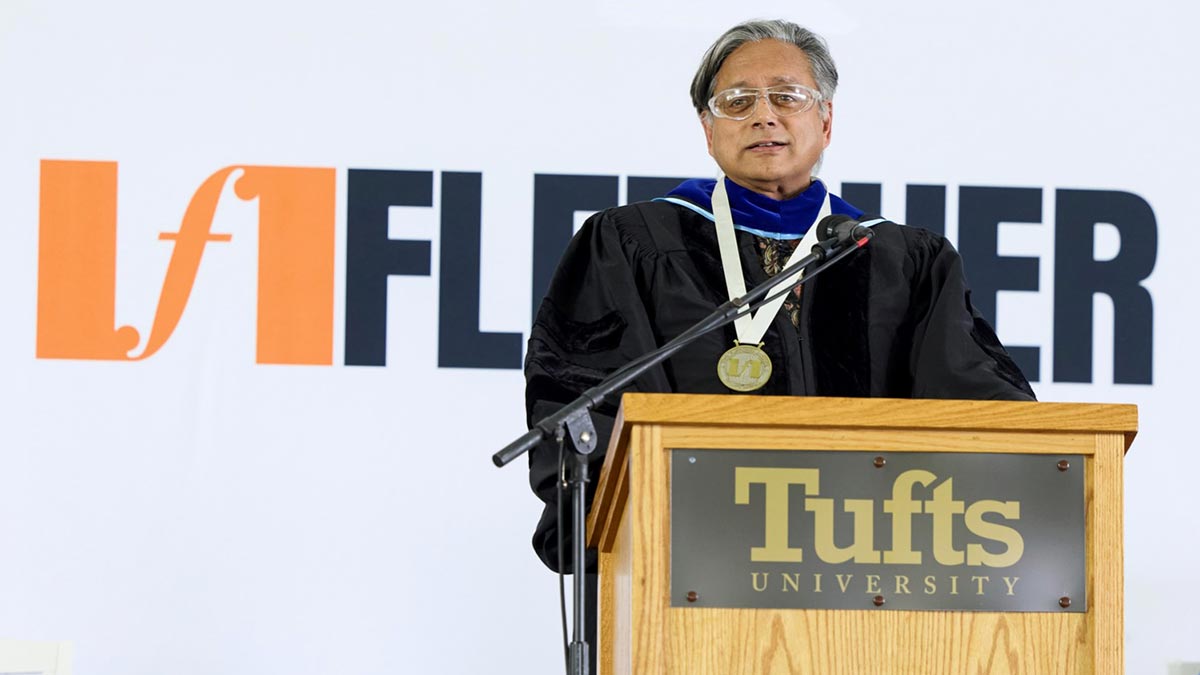
In other words, we still need to hold hands tighter than ever, even if we all get bionic ones in future. A sentiment echoed by parliamentarian Shashi Tharoor in his keynote address to graduates at the Fletcher School at Tufts University, Massachusetts. “We [now] inhabit a world of what my late boss, Kofi Annan, once described as problems without passports,” he said. “Pandemics, climate change, cyber threats, financial contagion, challenges that no nation, however powerful, can resolve alone.”
But instead of sitting at the same lunch table, nations are now taking their trays and finding their own corners of isolation. So much so that there are some who even want to toss aside the United Nations. “This reflects a quiet but significant shift in thinking… where the ability to withstand disruption is seen as a form of power in its own right,” said Tharoor. “This instinct is understandable, but it also reflects a world in which trust is more fragile and the future seems less assured.”
And yet, for all its uncertainty, this is also a moment of possibility, he argued. “As a good professor said, ‘Don’t waste a great crisis.’ The world is already full of intelligent people who can identify problems from a safe distance. What matters is the willingness to take responsibility for solving them,” he said.
Commencement speeches have always been a reflection of the times. For example, as early as 1932, President Franklin D. Roosevelt’s address at Oglethorpe University in Atlanta, urging “bold persistent experimentation”, was a response to the Great Depression of 1929. He stressed the need to fight the impulse to “sit back and do nothing” which, he said, had caused the economic crisis in the first place. “We need enthusiasm, imagination and the ability to face facts, even unpleasant ones, bravely,” he said. Similarly, President John F. Kennedy’s 1963 address at American University was a profound statement on the importance of building “a world of peace where the weak are safe and the strong are just” at the height of the Cold War. What he spoke—about a peace in which Pax America was not enforced on the world by American weapons of war—is as relevant today as it was then.
That’s why this year, when former American speaker Nancy Pelosi urges the graduates to go back to the vision of the nation’s founders to build a “healthier planet, fair economy, safer security and a stronger democracy”, or when actor Harrison Ford speaks about how his commitment to environmental conservation gave his life new purpose, the graduates better sit up and listen. No one can show you the world of tomorrow as clearly as those who have crafted the world of today.
