



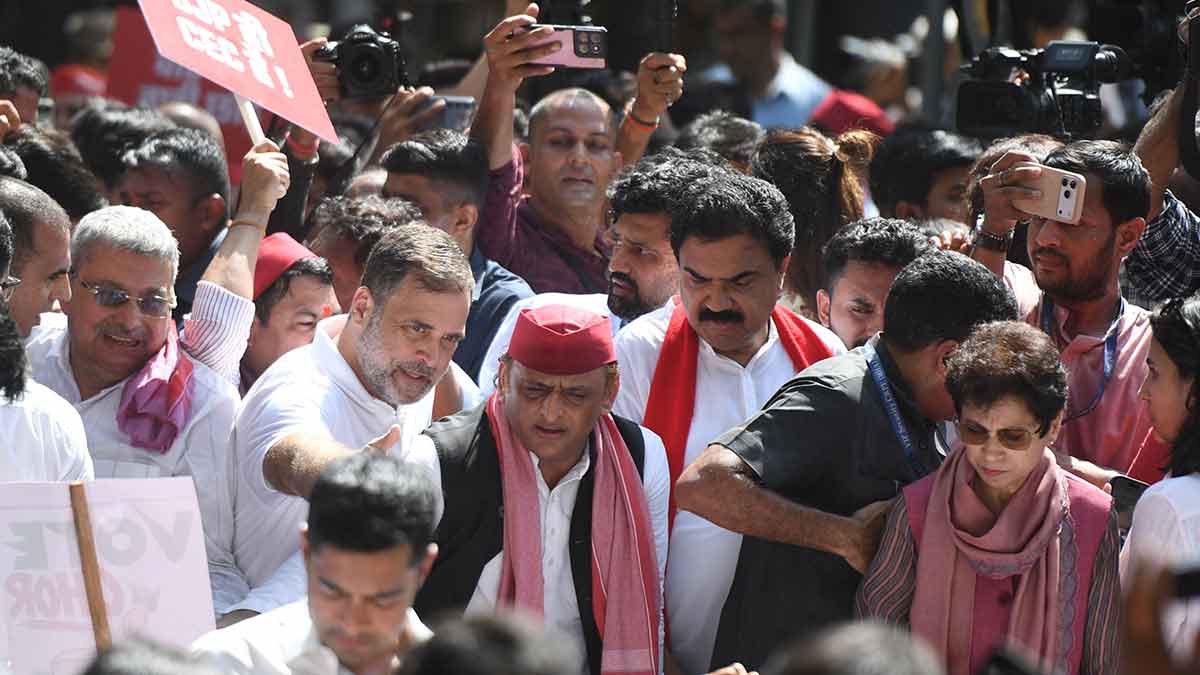
Recently, at a press meet, Rahul Gandhi recalled the time his sister Priyanka Gandhi advised him to draw a clear roadmap to counter the BJP. “You are not understanding this,” he told her. “This is tandav, this is the dance of Shiva. There is no planning in this.”
Gandhi’s remarks set the tone as the INDIA bloc held one of its biggest rallies in Delhi on October 12. And this time, students, professionals and women joined INDIA bloc leaders on the streets. “We have been attending Cockroach Janta Party protests. Today is the first time I came to an opposition protest,” Rajkumar, 50, told THE WEEK.
There has been a visible shift in the composition and mood of the gathering as young participants, including Gen Z protesters who were earlier apathetic to political parties, joined the opposition leaders.
What has kept the opposition going, said Congress leader Manish Tewari, is the voters’ loss of trust in the Election Commission. “Essentially, what is the fight all about? It is about ensuring that the democratic process is clean, transparent and accountable, and that the umpire is neutral,” he said.
Experts believe both sides have reached a point of no return. The potential resignation of Chief Election Commissioner Gyanesh Kumar could lend further weight to the opposition’s allegations and hurt the BJP. If the INDIA bloc backs down, it would undermine the credibility of its campaign and raise questions about its ability to sustain a movement. The confrontation, say political observers, could intensify in the coming months.
While the INDIA bloc has seen internal quarrels in the past, its current campaign has shown greater coherence. But the Congress knows that to sustain momentum, the alliance needs lasting unity, a well-coordinated common narrative and a shared electoral objective.
As per sources in the opposition, the Congress has fine-tuned its political approach in the past few months, making efforts at multiple levels to consolidate the opposition bloc. Gandhi has himself coordinated with leaders such as Trinamool Congress chairperson Mamata Banerjee and Samajwadi Party president Akhilesh Yadav, while Congress general secretary (organisation) K.C. Venugopal has engaged with other leaders across opposition parties. The Congress has also mobilised its state leadership to reach out to regional parties outside the INDIA bloc.
Notably, the Bjiu Janata Dal in Odisha, which had supported the 2023 bill concerning the appointment of election commissioners, has since aligned itself with the opposition on the issue. The YSR Congress, too, has expressed regret over its support for the bill.
In theory, this has weakened the BJP’s chances of cobbling together support from non-NDA parties for any planned constitutional amendment bills, for instance the one on delimitation. If this is reflected in the winter session of Parliament, the Congress would have proof of its strategy working.
There have been instances when the Congress felt it had the BJP on the mat, like when Gandhi coined the term ‘chowkidar chor hai’ in 2019 or when it won a handful of assembly elections. However, it could not translate those gains into a national victory.
“This time, there is traction, interest, social media presence and some kind of momentum in favour of the opposition,” said political commentator Rasheed Kidwai. “But the real challenge is the electoral outcome. A verdict of 50 or 51 means that 51 is the winner. There is no silver medal in politics. If the opposition can win any two states (in the upcoming assembly elections), that would be a major thing. The biggest litmus test is Uttar Pradesh. It alone can make a difference if it is taken away from the BJP.”
Developments in Delhi-NCR could shape the political narrative in the neighbouring state, which is already uneasy over the Ram temple theft controversy. Another allegation of theft could sway the fence-sitters. As per party insiders, the Congress and the Samajwadi Party are therefore trying to prioritise unity despite disagreements over seat-sharing.
In the 2017 assembly elections, they announced their alliance just weeks before voting, leaving them little time to develop a coordinated campaign. In contrast, they had more time ahead of the 2024 Lok Sabha elections, and won 43 of the 80 seats in the state.
Coordination seems to have improved further. “Had it not been so, we would have seen the Samajwadi Party missing at some places to register its discontent,” said a senior MP. “But from Parliament to the streets, the two have made sure they are seen together.”
There seems to be an urgency in the opposition camp to not only mobilise people across states, but to also deny the BJP time to devise a counter-strategy. The Congress wants to consolidate opposition ties both inside and outside Parliament, and is looking beyond the assembly polls to the Lok Sabha elections in 2029.
However, at the moment, the Congress’s plans of injecting unpredictability into the movement remains a gamble unless it can pull off a coup by widening differences between the BJP and its NDA partners such as the Telugu Desam Party and the Janata Dal (United).
Such unpredictability was last seen in 1979, when Indira Gandhi exploited the differences within the Janata Party. Charan Singh withdrew support from the Morarji Desai government, paving the way for the former to become prime minister with outside support from the Congress. Soon after, Indira withdrew support and returned to power.
A similar political rupture might be difficult today, but with Indian politics, a surprise is never far away.
