



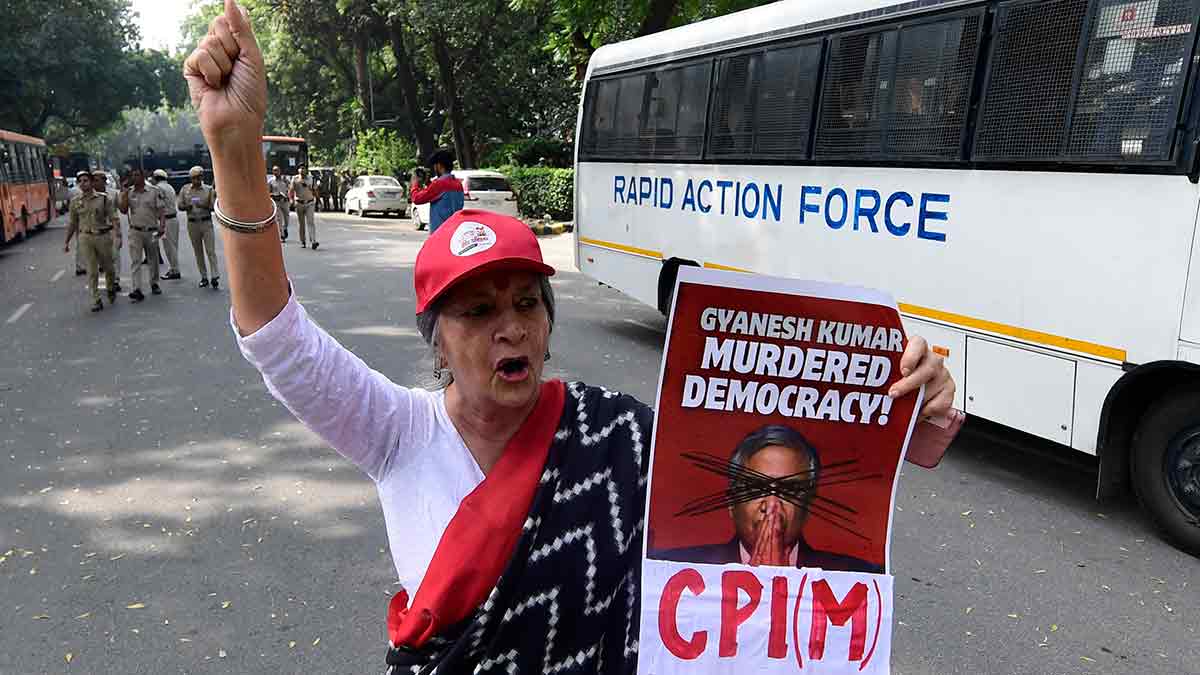
On October 10, when my comrades and I, led by our party general secretary M.A. Baby, were demonstrating near Jantar Mantar demanding the resignation of Gyanesh Kumar, we were detained by the police, locked in a prison van meant for hardened criminals, driven around Delhi and finally taken to a police station 20km away.
After some time, the officer at the thana came to meet me. He recalled first seeing me at a protest 40 years ago! He had just joined the police force and was posted at Parliament Street police station when they received an urgent call: women had chained themselves to the main gate and fences around Parliament and had to be removed immediately.
The memory came flooding back. It was 1986, and we from the All India Democratic Women’s Association were protesting against the bill to overturn the Shah Bano judgment. Around a hundred of us had adopted the method made famous by the suffragettes: we chained ourselves with locks to the main Parliament gate and the fences around and threw away the keys.
“I can never forget that day,” the officer told me. “I was so young and had never witnessed such a scene. We were helpless, rushing around to find cutters to break the chains. We finally had to buy them. And all the time, you were shouting slogans.”
In those days, learning the lessons after the Emergency, the administration did not create much difficulty in getting the required permission for demonstrations and dharnas. The Boat Club and its surrounding lawns were then the designated space for protests in Delhi. After the demolition of the Babri Masjid and the communal mobilisation that followed, public protests were prohibited there and Jantar Mantar was designated as the alternative site. Though much more restricted, it was still near Parliament. Over the decades, it has become much more than a designated space. Today, it is a historic site of democratic mobilisation, linking the struggles of ordinary people to the heart of parliamentary democracy.
At a personal level, I have so many memories of our struggles at this site. We comrades, as so many countless others, have been beaten by the police, tear-gassed and blasted by water cannons at Jantar Mantar. I particularly remember a CPI(M) demonstration against price rise organised by the Delhi unit, with a substantial mobilisation of women. We were at the front breaking the barricades. Further to my left stood Molina, the leader of our unit in Bhoomiheen Camp, a jhuggi-jhopdi colony demolished by the present government earlier this year. Molina was a fragile-looking but strong woman who worked as a domestic worker. When the water cannons opened, the force of the water lifted her off the ground. A photograph captured her gripping the barricade, her body almost parallel to the ground. She, like many of us, was badly injured.
Jantar Mantar has also witnessed some of the largest demonstrations by women. From 1996 onwards, thousands of women from every walk of life marched every few months demanding the Women’s Reservation Bill. It is here that one of the most prolonged struggles for justice of the female wrestlers took place. Gold medal winners, the pride of India, sat on these dusty roads demanding justice. During parliamentary sessions, Jantar Mantar brings together those whose voices might otherwise go unheard: adivasis displaced from their lands, workers denied minimum wages, women who have suffered violence. Members of Parliament regularly come to address these gatherings, taking the demands back to Parliament. Jantar Mantar connects the street to Parliament, strengthening democracy. There have been ups and downs, victories and defeats, but the spirit of Jantar Mantar has remained strong. It is this symbol of protest close to the seat of power, which is sought to be demolished by the Modi government.

The home ministry under Amit Shah has now denotified Jantar Mantar as a designated protest site. There is a Hindi proverb: Jangal mein mor naache, kisne dekha [The peacock dances in the forest, but who sees it]? The Modi government wants to make protests invisible, sanitise public spaces and marginalise popular dissent. Two of the new designated protest sites are 20 to 25km from Parliament, symbolising the distance between an arrogant government and the people. The closest designated site is Ramlila Maidan, but hiring it costs lakhs of rupees. The message is clear: protest only if you have the money!
An authoritarian government, deploying Hitlerite methods, uses its full force to crush a peaceful movement defending the right to vote against its theft through the ongoing Special Intensive Revision. This fundamental democratic right is under threat from a chief election commissioner who heads a constitutionally mandated autonomous institution that is increasingly functioning as an extension of the ruling party. The attempt to banish protests demanding the resignation of the CEC to distant locations is part of the same agenda: to suppress dissent and make the erosion of democratic rights appear “normal”.
As the young protesters would say: Think again, bro. It is not happening.
This movement is not merely an expression of dissent. It is the voice of patriots fighting to defend the Constitution. The baton of Jantar Mantar has been taken up by a new generation of young fighters. They know that Jantar Mantar is a symbol of struggle. We must not let it go.
Karat is a CPI(M) leader and a former member of the Rajya Sabha.
