



As Sergio Gor, the US ambassador to India, sat in a boat on the placid waters of Loktak lake in Manipur, his mind would have been on the events taking place more than 1,700km away, in Delhi.
Diplomacy has a lot to do with timing. With the capital becoming a fortress as top world leaders gathered for the BRICS Summit on September 12 and 13, Gor had chosen September 11 and 12 to visit Manipur.
Traditionally, the northeastern state hasn’t been on the US radar. Except maybe in 2023, when the US Commission on International Religious Freedom was scathing in its comments on the ethnic clashes between the majority-Hindu Meiteis and the Christian Kukis.
In hindsight, it might have been a good idea for Gor to be away. The Delhi Declaration of September 12 had come out heavily against the US without taking names. It said: “We condemn the imposition of unilateral coercive measures that are contrary to international law.” It was an obvious reference to the tariff war President Donald Trump had started.
The declaration also expressed “deep concern” about the Cuban situation, arising from the tightening of unilateral blockade. It noted the adverse impact on the country’s economy, energy supplies and the worrying humanitarian impact on the Cuban people. Cuba has been under US sanctions since 1962.
Even close US ally Israel figured on the hit-list. “We express our firm opposition to the forced displacement, temporary or permanent, under any pretext, of any of the Palestinian population from the Occupied Palestinian Territory, as well as any geographic or demographic changes to the territory of the Gaza Strip,” the declaration said.
In a brownie point for India, the Pahalgam terror attack found strong mention. “We condemn in the strongest terms the terrorist attack in Jammu and Kashmir on April 22, 2025, during which 26 people were killed and many more injured. We reaffirm our commitment to combating terrorism in all its forms and manifestations, including the cross-border movement of terrorists, terrorism financing and safe havens.”

These statements came against the backdrop of colder-than-usual bilateral ties with the US, caused particularly by Trump’s wayward comments.
More interestingly, there seems to have been a thaw in ties with China, six years after the brutal Galwan encounter. The spirit was exemplified by a two-day meeting between corps commanders of the Indian and Chinese militaries in the newly set up talking point near the still-hazy international border in Arunachal Pradesh’s Kibithu sector. The talks were held in Wacha on the Indian side on September 6 and Damai on the Chinese side on September 7. Significantly, these were the first such talks at border posts near the LAC in the eastern sector. Such a mechanism already exists in eastern Ladakh.
Arunachal Pradesh has been a sticking point between the two south Asian neighbours. China doesn’t recognise Indian sovereignty over Arunachal Pradesh and considers most parts of the state as part of ‘Southern Tibet’.
The talks were also interesting because of reports of a recent intrusion by Chinese troops in the Taksing area of Arunachal’s Upper Subansiri district.
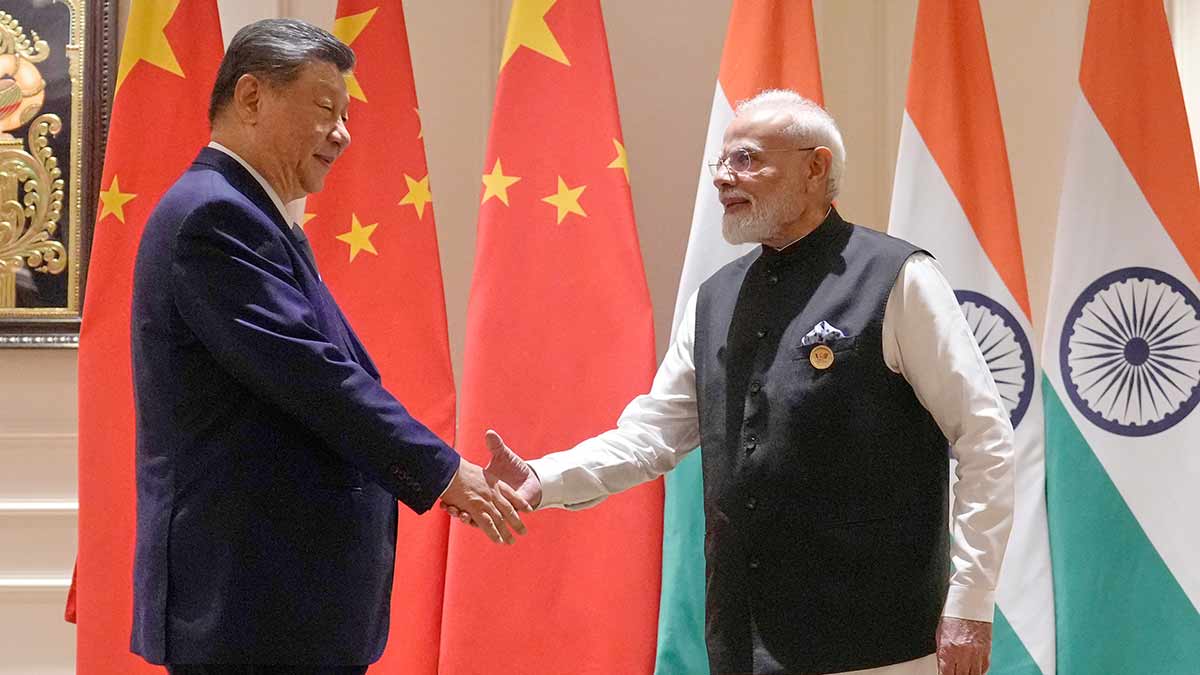
The military talks were not a one-off. They carried over from the meeting between National Security Adviser Ajit Doval and Chinese Foreign Minister Wang Yi in Beijing on August 25. Prime Minister Narendra Modi and President Xi Jinping had already met twice in a span of less than two weeks—August 31 in Bishkek on the sidelines of the SCO Summit and then again on September 12 on the sidelines of the BRICS Summit.
The flurry of meetings points to one thing: India and China may be settling in for a tango. The defence ministry’s Annual Report for 2025-26 sets the tone. “The year 2025 witnessed significant reduction in deployment of People’s Liberation Army forces opposite Northern Borders,” it said.
The move towards better ties hinges on the three ‘D’s—disengagement, de-escalation and de-induction. Disengagement refers to pull-back from eyeball-to-eyeball situations, de-escalation entails moving troops to areas further back from the LAC, and de-induction means withdrawal of frontline troops to training areas and major bases.
A serving Indian lieutenant general who has commanded in sensitive areas of Arunachal told THE WEEK: “What has happened is that there are no eyeball-to-eyeball situations in eastern Ladakh now. It is disengagement and a partial de-escalation. The talks in Wacha-Damai are to kickstart the first and second processes. In our past dealings, we have noticed that the Chinese commit to one thing and then do something quite the contrary. What is happening is a thaw, but we have to be on guard. We are prepared for any eventuality.”
But why is the trust deficit so wide? “It is mainly because of history,” said the general.
Border issues no doubt form the core of India-China discord. Gautam Bambawale, former Indian envoy to China and Pakistan, told THE WEEK: “This is a structural constraint in India-China relations and sets some limits to our cooperation.”
Importantly, the Galwan clash is too fresh in the memory: “There is no closer relationship,” said Bambawale. “Eastern Ladakh set back the relationship by ten steps. Now, since 2024, we have taken four-five steps forward. So the relationship is not even where it was in 2019.”
A key takeaway from the BRICS Summit is China’s unconditional signature on the Delhi Declaration, which reiterates support to India’s aspirations to play a greater role in the UN, including the security council. There is, therefore, considerable optimism that India-China ties are set on a northward direction despite disagreements on a few issues that are grounded in the strategic competition between the two neighbours.
An interesting perspective came from an editorial in the Chinese government mouthpiece Global Times on September 14. It said: “BRICS members do not agree on everything. That is precisely why this consensus (Delhi Declaration) carries more weight. Living multilateralism does not crush different voices into one. It enables countries with differences to have both the will and the capacity to coordinate on major issues and find the greatest common ground.”
