



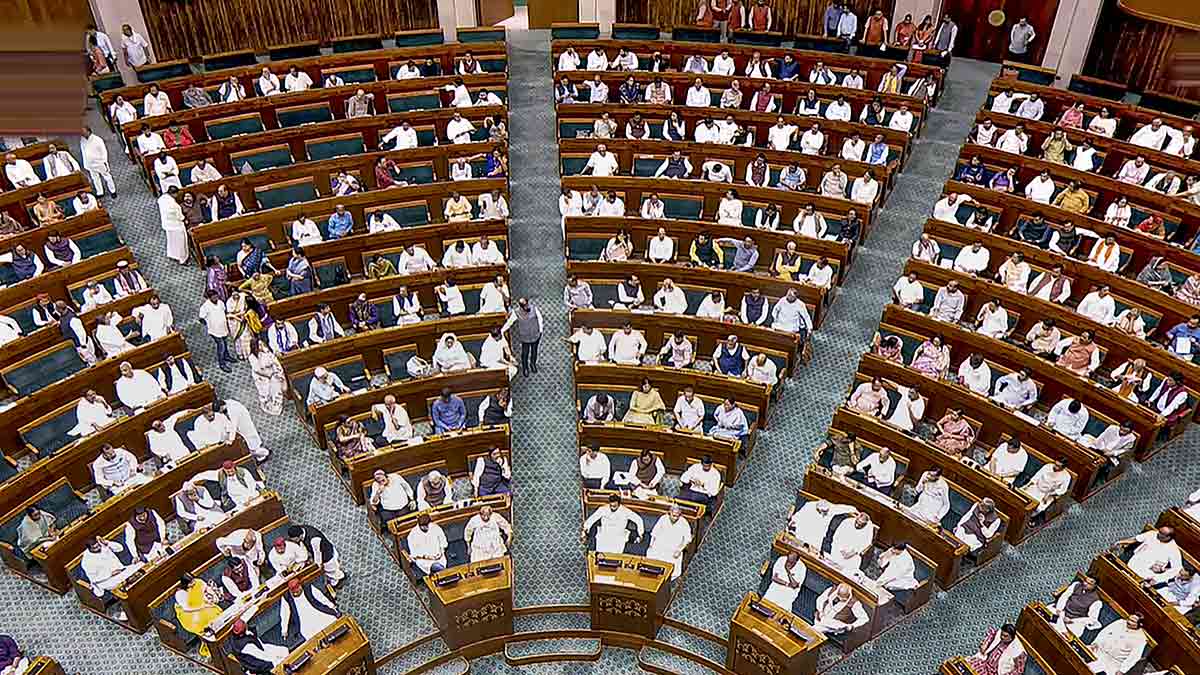
On June 8, two meetings took place in Delhi at the same time, just a few kilometres apart. Each could shape national politics in the months ahead.
At the Constitution Club, Trinamool Congress supremo and former West Bengal chief minister Mamata Banerjee and her nephew, Lok Sabha member Abhishek Banerjee, joined a meeting of the INDIA bloc to work out a common strategy against the BJP and present a united front.
At the Motilal Nehru Marg residence of Union Minister Bhupender Yadav, the BJP’s election in-charge for West Bengal during the campaign that had just ended the Trinamool’s 15-year rule, a different meeting was under way. Kakoli Ghosh Dastidar, a four-term MP from North Kolkata and the Trinamool’s chief whip in the Lok Sabha until a fortnight earlier, was there. So was Suvendu Adhikari, the state’s new chief minister. Around them sat 20 MPs preparing to switch sides.
Within hours, Dastidar submitted a letter to Lok Sabha Speaker Om Birla seeking a separate seating arrangement for the group. The MPs said they wanted to work with both the Centre and the state government for West Bengal’s development, citing the previous regime’s “lawlessness and misgovernance”. Another twist followed within days. The rebels merged with the Nationalist Citizens Party of India, a little-known outfit.
The script differed slightly from that of the breakaway faction of the Raghav Chadha-led Aam Aadmi Party in the Rajya Sabha, which had merged with the BJP in April rather than forming a separate party. In both cases, the rebels ensured they had the support of two-thirds of their respective legislative parties to avoid attracting the anti-defection law.
Both the AAP and the Trinamool argued that the anti-defection law had nevertheless been violated. Their contention was that parliamentary rules recognise a merger only when two-thirds of the original political party merges with another party, not merely two-thirds of its legislators. Both parties challenged the move, though in different ways. The AAP filed a single disqualification petition before the speaker. The Trinamool, which has a battery of lawyers among its parliamentary ranks, filed 20 separate petitions based on the same provision.
Several Trinamool leaders loyal to Mamata accused the rebels of switching sides to shield themselves from agencies such as the ED and the CBI and alleged that some had been bribed. Rebel MPs were said to be considering defamation proceedings against colleagues making such claims. The defections have reduced the Trinamool’s Lok Sabha strength to eight MPs from 28 MPs.
The Trinamool’s case rests on paragraph 2(1)(a) of the Tenth Schedule of the Constitution. It argues that a legislative party alone cannot effect a merger and that, since the original political party has not merged with anyone, the rebels should be disqualified. P.D.T. Achary, former secretary-general of the Lok Sabha and one of the opposition’s most-cited authorities on the Tenth Schedule, agrees. “The Tenth Schedule clearly states that a merger must be carried out by the original political party, not by MPs,” he said. “The Supreme Court’s judgment in the Shiv Sena case made it equally clear that the political party and the legislative party are separate entities.”
For Achary, the distinction is fundamental: “A legislative party cannot act independently of the original political party. It cannot simply declare itself a separate group. The MPs can agree to a merger, but they cannot create one. The merger must originate from the political party itself.” Applied to West Bengal, his conclusion is straightforward. “In this case, the original political party, the Trinamool Congress, has not merged with anyone.”

Until that happens, Achary argues, the legal status of the rebels remains unchanged. “Under the law, these members continue to be members of the Trinamool Congress unless a lawful process is completed. There is no provision in law to recognise them as a separate group.” Nor, in his view, does the speaker have much room for discretion. “After the Tenth Schedule was enacted, dissidents became liable for disqualification. The speaker cannot simply treat them as a separate faction.”
Before the West Bengal controversy had settled, Maharashtra produced another shock that intensified the battle between the National Democratic Alliance and the opposition. It even acquired a nickname: Operation Tiger. The episode marked a second split in the Shiv Sena as the party entered its 60th year.
If West Bengal unfolded gradually and the AAP saw a clean, same-day merger, Maharashtra delivered the drama for which Mumbai politics is known. On June 19, six of Shiv Sena (UBT)’s nine Lok Sabha MPs formally joined Eknath Shinde’s faction, which had originally engineered the split. A second breakaway from the Thackeray family has once again raised Shinde’s political profile.
As in West Bengal, the Shiv Sena (UBT) and its ally, the Nationalist Congress Party (Sharad Pawar), relied on the same constitutional argument, citing paragraph 2(1)(a) of the Tenth Schedule. The matter, too, is expected to reach the speaker, with the opposition prepared for a prolonged legal battle if necessary.
If West Bengal and Maharashtra suggest that the merger provision has become a potent political weapon, developments in Tamil Nadu show that the phenomenon is not confined to the Centre. On May 4, the Tamilaga Vettri Kazhagam (TVK), a two-year-old party built around actor C. Joseph Vijay, won 108 of the 234 assembly seats and ended nearly six decades of alternating dravidian rule. The political shift became evident during the assembly’s first confidence vote. Twenty-five AIADMK MLAs crossed the floor to support the new government. Within days, 21 returned after the party initiated disqualification proceedings against them.
India has seen such episodes before, which is precisely why the anti-defection law was enacted. Yet the BJP’s rise has also fuelled unrest within opposition parties struggling to hold their ranks together. The BJP has not been entirely immune. In Karnataka, some of its own MLAs switched sides to help the Congress win an MLC election.
THE 362 QUESTION
During the 2014 Lok Sabha campaign, the BJP’s slogan was “272 Plus”. By 2024, it had become “400 Plus”. After falling short of that target, the party’s quieter objective now appears to be 362 seats, the two-thirds majority required for constitutional amendments in the Lok Sabha.
The recent defections point to a broader objective. The immediate goal is securing the numbers needed to pass the delimitation bill, which would increase the number of seats in the Lok Sabha and state assemblies. When the bill came up in April, the government secured 298 votes of the 528 MPs present. It required 352 votes and fell short by 54.
The NDA views delimitation as the first step towards a wider set of reforms, including women’s reservation and, eventually, one nation, one election. With only three years left before the 2029 election, any delay in delimitation could push the implementation of women’s reservation to 2034 unless the government changes the legal linkage between the two.
The opposition argues that this urgency explains the current political churn and accuses the BJP of using money and pressure to build the numbers it needs. The BJP, however, rejected the allegation. “We are not responsible for what is happening in these opposition parties. People are fed up. MPs are fed up with their respective leaders,” said BJP spokesperson Tuhin Sinha. He said the real trigger was the delimitation debate itself. “A large number of young people were expected to enter politics and, when these parties blocked that, it created resentment. There was anger that the leadership neither works nor allows anyone else to come forward.”
Asked whether the BJP was simply benefiting from opposition disarray, he said: “Democracy has always been a game of numbers. There was a time when we struggled for numbers. I still remember Vajpayee ji’s speech in 1996 when he said numbers were important in democracy. We cannot be apologetic if parties choose to align with us for a larger purpose.”
The Congress sees a more deliberate political project. “The anti-defection law is not even being followed,” said party spokesperson Anshul Avijit. “I have immense respect for the speaker and presiding officers, but they are appointed by the political party in power. Their primary affiliation is to that party. I am not saying they cannot be neutral, but that consideration is always present.”
Sinha, however, argued that the new MPs were joining other political parties, not the BJP. “In one place people may be joining Eknath Shinde’s party; elsewhere they may be joining another political formation. The recognition and legal status of those parties remain intact.” He also argued that the latest cases differed from the original Shiv Sena split. “Here, nobody is claiming to be the original party. For instance, the Trinamool is not trying to prove that it is the original Trinamool. It has broken away and merged with another party. These are completely different situations.”
THE POLITICAL CALCULATION
The more intriguing aspect of the West Bengal episode is that, unlike the AAP case, the BJP has shown little urgency in inducting the rebel MPs. The calculation appears far more political than legal. Before the assembly polls, the BJP had shifted strategy, relying more heavily on its own cadre than Trinamool turncoats while distributing tickets. Party leaders believe the election result represented a rejection of Mamata Banerjee’s politics and did not want that message diluted by absorbing large numbers of her former colleagues.
Keeping the rebels outside the BJP also avoids complications under the Tenth Schedule and preserves the appearance of political diversity. Not all the defectors could realistically have been accommodated in future elections. “The BJP wanted to prevent the Trinamoolisation of its own party,” Mahua Moitra alleged.
The arrangement resembles the Maharashtra model, where Shinde’s party remains a separate entity serving a distinct support base. The AAP case was different. Most of the Rajya Sabha MPs lacked an independent political base and had been nominated by the AAP itself. Maintaining them as a separate bloc would have served little political purpose.
The growing scale of defections in favour of the BJP points towards a more bipolar political system, in which regional parties increasingly align with either the BJP or the Congress. Some Congress leaders privately acknowledge that such a shift could eventually help their party recover lost ground.
The larger concern, according to many opposition leaders, is the prospect of prolonged one-party dominance. During Narendra Modi’s 12 years in power, most regional parties and political families have either weakened substantially or been pushed to the margins. “The method is to legitimise every decision through the language of law and due process,” Avijit said. “Everything can be justified through due process, but that does not make it democratic.”
Yet the NDA remains some distance from the number it ultimately seeks. Even after factoring in the Trinamool rebellion and the Shiv Sena (UBT) split, the alliance’s strength in the Lok Sabha remains around 320, well short of the 362 seats needed for constitutional amendments. This places renewed focus on non-aligned parties such as the DMK, the YSRCP and the Akali Dal. The government has kept its channels open with the DMK. If enough opposition MPs abstain, the effective two-thirds threshold could be lowered.
The picture is more favourable in the Rajya Sabha, where the NDA is estimated to be in the mid-150s against the 164 required in a 245-member house. Bypolls and vacancies created by defections elsewhere could narrow that gap further. All eyes will be on the next parliamentary session when the NDA government introduces the delimitation bill.
