



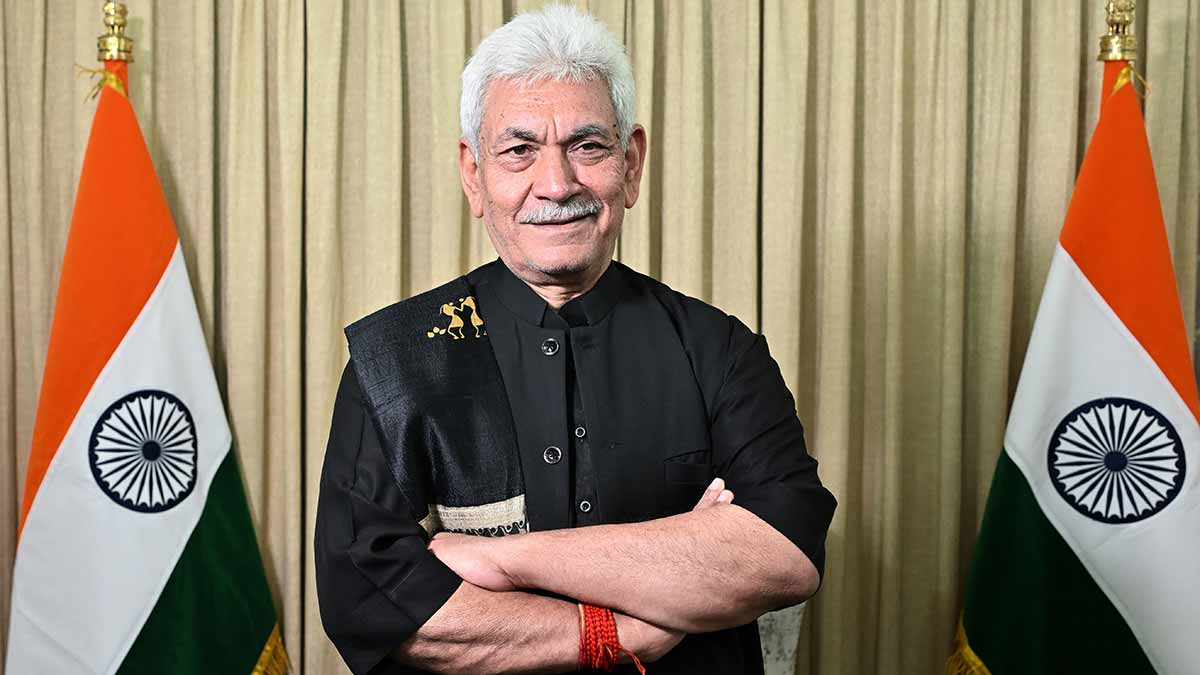
Not all Lok Bhavans match the grandeur of the one in Srinagar. Nestled in the Zabarwan Hills and overlooking the Dal Lake, the pre-independence-era building was where we met Lieutenant Governor Manoj Sinha, after he had addressed a rally in Shopian as part of his 100-day adyatra, a campaign that has been drawing massive crowds—a rarity even for political leaders. After a four-kilometre evening walk through the gardens, home to nearly every fruit for which Kashmir is famous, Sinha sat down for a conversation with THE WEEK.
In August, Sinha will complete six years in office. With another 50 days added to that tenure, he will become the third longest-serving occupant of the gubernatorial post in Jammu and Kashmir.
Much has changed in the valley in recent years. The region has witnessed a period of relative peace, and security forces have gained the upper hand against militants. Tourists continue to flock to Kashmir during the summer months despite the terror attack in Pahalgam last year.
Sinha is now focusing on a serious challenge faced by border states—the drug menace. Fuelled by trafficking networks operating across the border, the narcotics trade poses a grave threat not only to society but also to national security, as the profits help sustain terror modules. Sinha spoke to THE WEEK about the battle against drugs, the security situation, and the region’s most forceful political demand—the restoration of statehood.
Edited excerpts:
Q/ Your Nasha Mukt Jammu and Kashmir campaign is nearing the halfway mark. What are the concrete outcomes?
We launched a 100-day Nasha Mukt Jammu and Kashmir campaign with a clear strategy to assess how effectively we could act and control the situation.
From April 11 to May 20, 856 first information reports were registered and 946 offenders arrested. Around 758kg of narcotics were seized, including nearly 10kg of heroin. As many as 22,686 units of psychotropic substances were seized. Thirty-six detentions were made under the Prevention of Illicit Traffic in Narcotic Drugs and Psychotropic Substances (PIT-NDPS) Act. As many as 128 properties worth more than Rs60 crore were attached. Awareness programmes were organised at 2,846 hotspots, sensitising nearly five lakh people. Action was initiated against erring druggists and chemists. As many as 186 driving licences and 244 vehicle registrations were cancelled or suspended, while 116 passports were recommended for impounding.
These figures from roughly 40 days show the intensity and seriousness with which the police are acting.
Q/ We have seen large crowds at your padyatras and rallies. Tell us about the response from families and women in particular?
People see this as a problem affecting their own homes, which is why participation has increased. Women, especially mothers, have an important role in such campaigns. The compassion and sensitivity with which they can help victims trapped in addiction cannot easily be matched by others.
That is why we have formed more than 7,000 women’s committees at the panchayat level. We are repeatedly encouraging their involvement because they can contribute immensely. We are also trying to create parent brigades and youth clubs as part of this effort.
Q/ You have linked drug trafficking to cross-border narco-terrorism. How organised and active is this network across the Line of Control, and what steps are being taken against it?
In Jammu and Kashmir, terrorism and smuggling are essentially two sides of the same coin. The money reaches organisations that promote radicalisation, purchase weapons and fuel terrorism. Investigations have established this connection.
Q/ Rehabilitation is an important part of any anti-drug campaign. What has the administration done on this front?
There are three aspects to this issue. First is disrupting the supply chain completely. Second is large-scale awareness. Third is rehabilitation.
I believe we have achieved considerable success on awareness. In disrupting the supply chain, too, I would say we have achieved nearly 90 per cent success. Rehabilitation, however, remains a challenge.
We have formulated a detailed rehabilitation policy after discussions with stakeholders and officials. It is difficult work, but we are committed to implementing it sincerely. The first step is identifying such individuals, ensuring long-term treatment and tracking them so they do not relapse. It is equally important to connect them with employment opportunities. A comprehensive policy has been prepared and some people have already benefited from it.
Q/ There has been bulldozer action against some of those who are alleged to be traffickers and smugglers. Critics say such actions bypass due process. How do you respond to that criticism?
Under the PIT-NDPS Act, there are provisions for attachment of properties. All action is being taken within the legal framework. As for demolitions, one has to consider that there are people who had no means of survival a few years ago but have suddenly built massive narcotics-linked properties, often on government land.
If someone encroaches on government land, and builds what people call “narco palaces” while destroying the youth of society, the administration is bound to act.
At a public meeting in Shopian, I clearly said that if even one innocent person has faced wrongful action, we will conduct an impartial inquiry. Anyone found responsible for targeting an innocent person will also face legal action.
Q/ Drug trafficking on such a large scale cannot function without political or police complicity. Has action been taken against people within the system?
We believe that every section of society has both good and bad elements. Our police force has brave personnel who sacrifice their lives for the country and contribute to development in Jammu and Kashmir. But if there are corrupt elements within the system, they, too, will be identified and action will be taken.
Q/ Do you think continuation as a Union territory under an LG is better than statehood?
Before the assembly elections, governance was directly under the LG administration. It would not be appropriate for me to comment in detail on that period now. But I can say that we made significant progress in creating a transparent system focused on peace, prosperity and a people-first approach.
Now there is an elected government. In a democracy like India, it cannot be argued that LG rule is preferable to statehood.
As for statehood, when Article 370 was abrogated, the home minister had clearly laid out the sequence: delimitation first, then elections, and statehood at an appropriate time. Prime Minister Narendra Modi has also publicly reiterated this.
People ask about the timeline, but I cannot specify that.
Q/ From an administrative perspective, is there any benchmark for when a Union Territory becomes ready for statehood?
Determining a timeline is not within my domain. But, I understand parliamentary processes and the significance of assurances made in Parliament. On that basis, I believe statehood will happen.
Q/ After the Pahalgam attack and Operation Sindoor, tourism in Jammu and Kashmir was affected. Are tourists returning now?
Tourism has largely returned to previous levels. Domestic and foreign tourists are arriving in large numbers. One of our indicators is whether flights are full and whether hotels are unavailable due to high demand. We regularly receive calls from people saying their relatives are visiting Kashmir and they cannot find accommodation. That itself indicates tourism has revived substantially.
Q/ What message would you give to people in India and abroad who may still have security concerns about visiting Kashmir?
My message is clear, and you can also see it yourself from the large number of people participating fearlessly in padyatras in Shopian.
I would simply say that everyone is welcome in Jammu and Kashmir. There is strong security, peace and normalcy. The weather is pleasant and people should visit without hesitation.
Q/ For decades, Kashmir was viewed nationally and internationally through the lens of conflict. Has that perception changed?
In my view, it has not merely changed. It has been completely transformed.
Q/ Srinagar is now increasingly connected with the rest of India through rail services. What impact has this had on tourism, local mobility and trade?
Tourists are benefiting, but local people have also gained greatly from improved transport connectivity. Many people here had never travelled by train before.
In hilly regions, roads can be disrupted anytime due to weather or landslides. Railways provide a dependable alternative. Kashmir’s horticulture sector has also benefited. Cherries are now being exported abroad, and the Railways are helping facilitate transportation.
Last year, when roads were damaged due to floods, the Railways transported large quantities of apples to Delhi. During snowfall, roads often close and petroleum supplies become difficult, but railway connectivity has improved those logistics as well.
I believe rail connectivity will bring enormous long-term benefits to Kashmir.
Q/ You are nearing six years in office. Personally, what have you learned from governing Jammu and Kashmir?
I have learned that if your intentions are honest and you remain in continuous dialogue with people, you can understand problems properly and find solutions.
Q/ Is there any achievement in your tenure that is personally close to your heart?
One thing that gives me immense satisfaction is meeting families affected by terrorism who suffered for years without support. We had launched major rehabilitation drive for the Next of Kin (NoKs) of civilians killed by Pakistan-sponsored terrorists.
There is a legal provision here to provide government jobs to such victims’ families. We were able to provide jobs to people who had endured pain for 20 or even 30 years. I have witnessed deeply emotional moments while interacting with them. Seeing them now living peacefully is among the most satisfying experiences of my tenure.
Q/ What major challenges would you like to address in the coming years for the people of Jammu and Kashmir?
I do not see any extraordinary challenge beyond ensuring that peace and prosperity continue uninterrupted.
Prime Minister Narendra Modi launched the Vibrant Villages Programme with the idea that border villages are not the last villages of India, but the first villages and the first line of defence.
The government has fixed several benchmarks for these villages, including road connectivity, 4G access, electricity and DTH connectivity. We have also added our own focus areas, such as employment for youth, empowering women’s self-help groups and connecting them with livelihood opportunities.
Private investment is coming in, and we want local people to benefit from employment opportunities. We have fixed three parameters for annual evaluation: improvement in literacy rates, rise in incomes, and reduction in migration from villages.
