



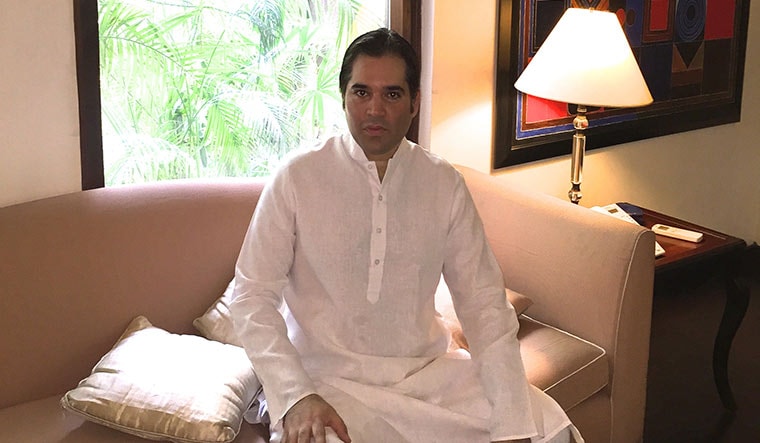
FEROZE VARUN GANDHI’S first book, A Rural Manifesto: Realizing India’s Future Through Her Villages came out in 2018 when farmers were protesting the agrarian crisis. The well-researched book, packed with facts and anecdotes, stood out at a time when the issue was essentially discussed as a political one. Presciently, when the pandemic hit, along with the farmers’ agitation, a national conversation was started about rural India. Five years later, Gandhi is back with another treatise, this time on urban India.
The Indian Metropolis: Deconstructing India’s Spaces follows the earlier format of academic rigour, coupled with anecdotes and facts, to talk about our decrepit cities, flawed policies, dejected citizenry and apathetic officials. “For India to shine, transformation of its cities is necessary,”writes Gandhi. Through nine chapters, he discusses issues like urbanisation, water availability, crime, health care, transportation, affordable housing, employment, financing and planning. With its brilliant insights, easy and intelligent writing, the book is relevant not only to law and policy makers and urban planners, but also to ordinary readers.
Gandhi, a three-time MP, has made policy and governance his forte, speaking out on issues he believes in―a rarity for a politician. He now plans to scale his initiatives for marginal farmers across geographies and strata, with a focus on solving problems for the rural and urban poor. Excerpts from an interview:
Q/India’s cities are bereft of parks and face significant pollution of air and water. How can we make our cities liveable?
A/To have sustainable urban development, there is a clear need to have more urban green spaces. Bringing in more urban green spaces can mean a general reduction in stress and greater levels of mental and physical fitness. The more urban green spaces in a city, the higher the quality of life, [thereby] helping to equalise spatial and economic inequalities. Placing a value on this can be rather hard…. This concept of embracing nature as a restorative agent is one that emerges from our urban history, with tales of large sal forests surrounding the city of Pataliputra.
And yet, India’s cities have notably failed to consider the need for green spaces in their master plans. At the government level, we face a significant poverty of understanding about the value of forests and green zones in our cities and their intangible benefits.
Another way forward is for a general push to create or restore urban forests―leading cities in the world (like Singapore, Seoul, Bangkok) have sought to build green spaces. In this regard, the ministry of environment, forests and climate change’s Nagar Van project is a promising initiative. In the past few decades, there has been talk of creating at least 200 city forests in India, albeit with little in implementation….
Going forward, urban master plans should plan for identifying common public land on the outskirts and plan for their conversion into forestland. Environmental zoning mandates can also be strengthened further, particularly to protect keystone geographical and biodiversity-rich areas. Implementing these master plans will require better collaboration with local ward committees, with a push for a change in mindset among city planning officials about the possibility of coexistence between urban forests and residential complexes.
Q/India’s cities are not able to handle traffic volumes, making them gridlocked. What are the solutions?
A/Indian cities have historically been compact, with people accessing jobs and services across relatively short distances, with a high share of walking and cycling. However, as our cities started to sprawl out, policy priority was given to infrastructure like motor vehicles, while discouraging cycles and rickshaws.
Very few cities have begun the journey of reclaiming public spaces away from cars, while focusing on building pathways for pedestrians and linking them with public transportation nodes…. While the urban transport policy has focused on providing those without their own cars an affordable and yet barely usable means of public transport, we need to consider incentives and policy options to shift motor vehicle owners towards public transport. Such a step is necessary to ensure the survival of the Indian city itself―the negative impacts of road congestion, ensuing pollution and rising carbon emissions mandate such steps.
We also need to embrace the change in definition of public transport. Where once it stood for fixed routes and schedules, using old and infrequent buses, modern Indians need on-demand availability of public transport, offering door-to-door connectivity, while providing the highest standards in safety and comfort. Simply ordering 1,000 buses or approving the next metro phase will no longer do. We have to embrace multimodal transportation, integrating both public and private transportation players into the mix. At the same time, we must encourage the proliferation of age-old public transportation options like the rickshaw, while offering it a technological boost (e-rickshaw).
We need to skew our urban transport policies towards non-motorised transport. Often, urban policymakers seem to consider such transport options as the ones clogging up existing traffic, when in fact they play a significant role in transporting a large passenger volume.
Q/How do you see current politics, especially the debate around freebies?
A/All political parties offer freebies now. In 1967, C.N. Annadurai (founder of the DMK) promised 4.5kg of rice at 01, if his party was elected. The trend has reached other states as well―the Delhi state government has notably offered water and electricity (up to a certain limit) free for the city’s voters. An entitlement mentality been encouraged creating a cradle-to-grave welfare state….
Governments announcing freebies should be required to provide a funding plan. To bolster Parliament (and state assembly) budgetary understanding and enhance their ability to act, a budgetary office should be established to aid in writing policies and conducting budgetary analysis. More importantly, we need to have a conversation within and between political parties to curb this widespread abuse. Making such promises is an insult to voters, when many such promises are simply left unfulfilled or partially so.
Q/How can India’s cities solve the problem of urban unemployment? Is an urban version of the Mahatma Gandhi National Rural Employment Guarantee Scheme (MGNREGA) the way to go?
A/India faces a shortage of jobs in general, and also a shortage of quality jobs in particular. India’s open unemployment was estimated at 6.1 per cent in the Periodic Labour Force Survey 2017-2018, with ~20 per cent of all educated youth unemployed. Urban areas, in general, had greater unemployment. In such circumstances, it may be worthwhile considering an employment guarantee programme in urban areas….
It’s not a novel idea―India has had a history of urban employment schemes. The Swarna Jayanti Shahari Rozgar Yojana (SJSRY) was launched in 1997, with a focus on wage employment and self-employment…. However, a majority of such schemes were rarely demand-driven, with a limited set of beneficiaries.
The idea of an urban employment guarantee scheme is one whose time has come. There are murmurs already―in 2019, in Madhya Pradesh, the government initiated the Yuva Swabhiman Yojana, which offers employment to skilled and unskilled workers. Kerala, since 2010, has run an initiative (Ayyankali Urban Employment Guarantee Scheme). Even the Supreme Court has weighed in on the debate, stating that the right to life, offered under Article 21 of the Constitution, is not simply one enabling individuals to exist but is also broad enough to offer a right to livelihood and a right to dignity. MGNREGA… is arguably an implementation of the right to livelihood, albeit in a rural context while offering a right to work. Broadening this to an urban locale is the most natural extension for the Indian state.
Q/Has sanitation as an urban problem been solved by government initiatives like Swachh Bharat Abhiyan?
A/Sanitation and waste management was never a major concern for pre-independence India, and it has remained so ever since. The colonial government focused on preventing cholera epidemics…. Colonial government, instead of funding an expansion of municipality-based sanitation through sewers, chose instead to intensify manual scavenging. Any collection inefficiencies were blamed on the poverty-ridden scavengers, a bias that remains ingrained in our municipal institutions. Post-independence, India’s cities have grown haphazardly, mostly in unsanitary conditions, with outbreaks tempered by the widespread use of antibiotics and insecticides. Mutual collaboration between the urban middle class and the hinterland has been disincentivised by institutional apathy and unequal economic progress….
Systematic thinking remains lacking―we retain limited public participation and even more limited institutional funding, combined with a feckless policy and legal framework. Political will, combined with active surveillance and institutional support, can turn our cities around. Changing our cities from disease-prone, filthy conurbations to smarter cities is a challenge that must be met through vigilance and better execution. What we need is a network of treatment plants and piping infrastructure.
Meanwhile, Israel offers a role model. It built a national network of water treatment plants and reuse pipelines between 1970 and 1990, seeking to use natural reservoirs to return effluent water to aquifers. In addition, it has sought to use differential pricing to convince farmers to use treated wastewater for irrigation.
For full interview,
Visit www.theweek.in
THE INDIAN METROPOLIS: DECONSTRUCTING INDIA’S SPACES
By Feroze Varun Gandhi
Published by Rupa
Price Rs1,500; pages 824
