



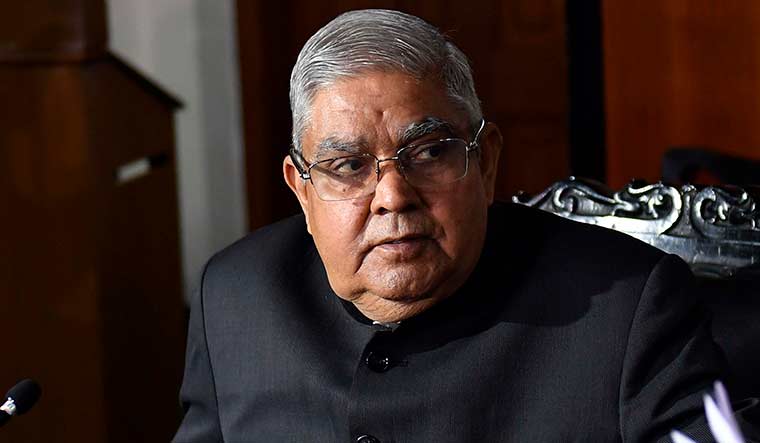
WEST BENGAL Governor Jagdeep Dhankhar, along with Chief Minister Mamata Banerjee, accompanied Prime Minister Narendra Modi on his aerial survey of the state’s cyclone-ravaged districts. The trio was the first to witness the destruction, as government officials were unable to access the districts even four days after Cyclone Amphan hit the state. In an exclusive chat with THE WEEK, Dhankhar talked about the devastation he witnessed and the difference in Banerjee’s demeanour during the chopper ride. Edited excerpts:
Post the aerial survey, what is your assessment of the destruction?
Such fury of nature has not been seen in West Bengal in recent times. The rains and heavy winds caused massive damage to crops and infrastructure. Kolkata happens to be one of the five severely affected districts. Our scientific predictions were helpful in timely evacuation of lakhs of people. Eighty lives have been lost. Sixteen districts have been impacted in varying degrees.
The prime minister announced Rs1,000 crore advance assistance. But the chief minister said it might be part of the devolved Central taxes due to the state, which would be later adjusted.
This is no time to engage in hair splitting or taking a political stance. While the state presentation indicated a scenario, it also reflected that due to inaccessibility, assessment is yet to be done. Only after ground evaluation can there be a rational way forward…. I would, for sake of efficacy and efficiency and to curtail mismanagement, favour that all assistance finds its way to the intended beneficiaries.
Five lakh people were evacuated and rehabilitated by the state government. Is that not commendable?
During this crisis, I was in active touch with Central agencies. The state, however, could not be persuaded for such engagement. The Indian Coast Guard performed in an exemplary manner, (and ensured) no death on sea. The Border Security Force played a significant role in the Sundarbans…. Our defence forces were ready to provide relief. Evacuation was tough, given the Covid-19 situation. This was achieved effectively by state and Central agencies working in tandem. At the level of prime minister and home minister, there was action mode approach much before the landfall of Amphan. All agencies need to be appreciated for their commitment.
The biggest challenge now would be ensuring physical distancing even as Covid-19 cases are on the rise in the state.
In the review meeting (at Basirhat), the prime minister reflected on this dilemma. On one hand, all are being exhorted… to stay put at home, while lakhs had to shift out of their homes due to Amphan. He called upon all to do the difficult balancing act so that our Covid-19 combat is not compromised. Covid-19 combat has to be unabated, otherwise we will face a scary scenario. All precautions need to be fully adhered to.
As you mentioned, there should be no politicisation over relief work. Do you think that is possible?
The chief minister’s political antenna is ever in peak form. I have flagged her on numerous occasions, saying that in matters of development or in dealing with the Centre [her political approach] was inappropriate. This has led to a confrontational stance with the Centre, which has adversely impacted the people. For example, farmers all over the country are benefiting from the PM-KISAN scheme except in West Bengal. Our 70 lakh farmers have so far been denied Rs7,000 crore while all others have got Rs10,000 per head.
Was the confrontational stance evident during the chopper ride?
During the recent visit of the prime minister, I noticed that the political antenna of the chief minister was in disabled mode. I, for the first time, saw a ray of hope in the confrontational dark tunnel. Continuance of this will benefit all.
