


 Add as a preferred source on Google

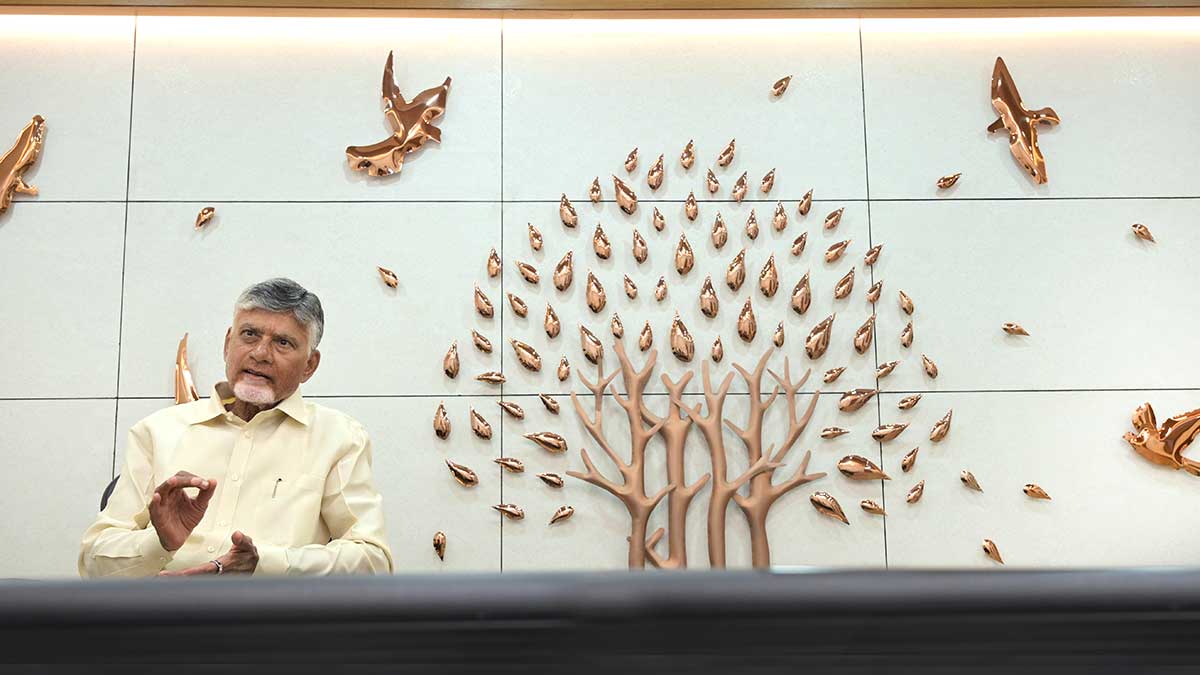
Interview/ N. Chandrababu Naidu, chief minister, Andhra Pradesh
Amaravati is markedly less urban than the bustling Vijayawada. The Krishna flows unhurried through the fertile plains of Andhra Pradesh, with patches of farmland, settlements and groves softening the landscape on its banks.
The area around Chief Minister N. Chandrababu Naidu’s residence is quiet, reflecting the rural character. The setting offers an interesting contrast to his political vocabulary of technology, investment and urban transformation.
Naidu has just returned after a long day’s work at the secretariat. A battery of officials, a few business heads, and young men and women with laptops are seen walking in and out. In a candid conversation with THE WEEK, he talks about his vision for Amaravati and for the people of Andhra Pradesh, and how he has changed his working style from being a CEO CM to a leader of people. Excerpts:
Q/ You have seen Andhra Pradesh change from a largely agrarian economy to a state talking about AI and quantum computing. Which transformation has surprised you the most?
When I started focusing on IT in the mid-1990s, it was the first step towards creating new opportunities for Indians. Those were the days when BSNL had separate telephone lines for international and domestic calls. There were only two public sector companies offering telecommunications services. We have come a long way since then.
I started setting up engineering colleges and worked towards improving bandwidth. Then came a series of developments, including the arrival of mobile phones. At that time, a mobile phone cost Rs20,000.
I approached Reliance, and that was when Dhirubhai Ambani started Reliance Infocomm. With economies of scale, the price of a mobile phone came down from Rs20,000 to Rs2,000.
Then everyone started studying IT, and Indians went all over the world. Wherever you go, you will find Indians, and among them, a significant number are Telugu-speaking people. Within 25 years, we became one of the leading earners in terms of per capita income. Today, our people are capable of moving into AI, quantum computing and other cutting-edge technologies. If you handhold, facilitate and encourage them, they will become future leaders.
Indians are doing extremely well. There are three major reasons for this: the economic reforms of 1991, the adoption of technology in the mid-1990s and our demographic dividend. Our citizens, particularly our young people, are exceptionally talented. With the right education system and motivation, they can excel globally.
Q/ When you envisioned Hyderabad, the focus was on software. Today, the vision has expanded to quantum computing and deep tech. Where does this vision come from?
We have learnt and evolved continuously. I started with IT and established HITEC City. I attracted several companies and established many colleges. I also brought in flagship companies such as Microsoft. As a result, Hyderabad became a hub for the knowledge economy.
Today, global capability centres (GCCs) are major players. Hyderabad accounts for 12 per cent of the total global companies, while around 20-23 per cent of India’s GCCs are located in the city.
Now we have moved to the next level. We are focusing on data centres, AI, quantum computing, space technology, drones, robotics, electronics, semiconductors and rare minerals.
Andhra Pradesh, meanwhile, is emerging as a green energy valley. I am not merely talking about green energy; I want to create an entire green energy ecosystem. Soon, every home in Andhra Pradesh will become both a producer and a consumer of green energy. I should be able to generate power, use it, supply the surplus to the grid and draw power from the grid when required.
Deep technology is the next step. Quantum computing will enable extremely fast calculations, predictive analytics and advanced research. That is why I have named Amaravati’s headquarters Quantum Valley.
We are also planning to explore quantum biology and develop a Bio Valley. There will be several breakthroughs in health care, particularly in personalised medicine, cancer treatment and genetics. We are working on how best to develop and integrate these areas. I am visualising India’s future at different stages, and my people are preparing for it.
Q/ You have survived electoral defeats, witnessed political realignments and navigated major changes such as the bifurcation of Andhra Pradesh. What is the one lesson that these setbacks have taught you electoral victories could not?
I have always been ahead of my time. Sometimes people may not understand what I am doing, but 10 or 20 years later, they see the results for themselves. That is when they realise the value of what I had envisioned. Sometimes, I have to carry people along with me.
Earlier, I was obsessed with getting things done continuously. But these days, I am preparing myself not just to work with the same intensity but also to carry people along. If people are with us, they will remain committed, and I can continue experimenting, consistently and successfully.
I lost elections twice, not because I had failed to deliver, but because I was moving too fast, driven by my obsession with getting things done. I was unable to communicate properly with my party and the public. Now people understand my vision better, and I am also communicating more effectively and giving time to different aspects of governance.
That is why Andhra Pradesh’s growth rate has now touched 13.44 per cent in agriculture, while overall growth has exceeded 12 per cent this quarter. However, there was considerable destruction before 2024. I am now rectifying that through three pillars: welfare, development and good governance. We are delivering every service in Andhra Pradesh online.
Q/ You have often been associated with long-term development projects. Has your definition of development changed from infrastructure and investment to something more human?
I have undertaken several important initiatives. In fact, I was a pioneer in water management. I have contributed to almost every major area of development in this country.
In the early 2000s, I convinced Atal Bihari Vajpayee to promote micro-irrigation. I submitted a report on the subject, and the country is still following the recommendations made in that report.
I have also consistently advocated linking rivers, including the Ganga and the Cauvery, to protect and better utilise the country’s water resources. However, when the NDA lost the 2004 elections, the initiative did not move forward.
Now, in Andhra Pradesh, we are completing the Polavaram project. Through Pattiseema, we have linked the Godavari and Krishna rivers. The water you see in this region is Godavari water, not Krishna water. This interlinking has transformed the region into a fertile agricultural belt.
We are also taking Godavari water to Visakhapatnam through the left main canal. I intend to complete the Polavaram project on the Godavari by next March. We are also working on bringing water to Veligonda through a tunnel in the Nallamala forest.
I laid the foundation for another project 30 years ago, and it is now in its final stages of completion. It will connect Srisailam to Kuppam, covering nearly 660km. We have spent Rs3,500 crore on this project. These initiatives will help resolve drinking water shortages. My aim is to undertake many more projects and programmes for water conservation.
Q/ You were once described as the CEO of Andhra Pradesh. But today, you seem to have embraced a more holistic approach.
Earlier, everyone recognised me as the CEO chief minister. I have always dreamt of development combined with progressive growth. But, as you rightly point out, I have always believed that the human touch is equally important.
For instance, we have recently initiated a project in Rayalaseema. It was once a prosperous region. During the time of Ashoka, Swarnagiri was its capital, and the area had gold mines. Over time, however, it became backward and faced severe water shortages.
We have launched India’s largest private-sector gold mining project at Jonnagiri in Kurnool district, in Rayalaseema. I have renamed Jonnagiri Swarnagiri to recall the region’s golden past. The mine is expected to produce around 1,000kg of gold annually, eventually scaling up to more than two metric tonnes. In its first year, it is expected to produce 400kg, increasing to 900kg the following year. This is about reconnecting with our history and rediscovering Andhra Pradesh.
Rayalaseema has enormous potential, particularly in horticulture. We have recently laid the foundation stone for an initiative to develop Rayalaseema as a global horticulture hub, with an investment of Rs1 lakh crore. This will comprise Rs40,000 crore in government funding and Rs60,000 crore in private investment. We aim to cultivate 20-25 crops, drawing on varieties from places such as Kerala and Hyderabad.
Apart from this, my goal is to link the Godavari and Cauvery rivers, and then connect the Godavari to the Mahanadi, the Mahanadi to the Ganga and the Ganga to the Brahmaputra. If we achieve this, India will become fertile and unstoppable.
In Andhra Pradesh, I want to link all the rivers. If we can connect the Godavari to the Cauvery, we can integrate the river systems of all four southern states and eliminate water shortage across the region.
Q/ What advice would you give to a younger Chandrababu Naidu?
With experience and technical knowledge, I can approach things differently today. Back then, I had to push people to think and act with vision. Now, with everything becoming data-driven, I can convince people with evidence. That is the biggest change.
If the younger Naidu were to meet me today, he would see the same person who built Hyderabad, with the same drive and determination, but now equipped with data and AI. With technology, I can transform even a remote area. By analysing data and performance records, I can assess how effectively things are being implemented.
Q/ Should Amaravati be remembered as your political legacy?
No. We will always create new things. Many people criticised me for developing Hyderabad, particularly because of my focus on Cyberabad. Some even argued that the emphasis on Hyderabad created an imbalance in development in Andhra Pradesh. Others have praised my contribution to Cyberabad.
But every contribution, big or small, is ultimately about development. I have done everything according to my conscience and in the interests of the people. The people of Andhra Pradesh know this, and that is my biggest achievement.
In India, we have not been able to build enough good cities that offer a high quality of life. We are developing Amaravati as a city that brings together green spaces, blue infrastructure and deep technology. I want it to become one of the most liveable cities, catering to everyone—the young, children and the elderly.
