



LET US START with the arithmetic. In the 2024 Lok Sabha election, the BJP polled 23.59 crore votes; the Congress polled 13.67 crore. India’s total vote count stood at 64.64 crore.
Set that against the country’s Gen Z population, born between 1997 and 2012, which demographers put at above 40 crore: the single largest generational cohort, more than the BJP and the Congress’s combined votes in 2024, and on its own the world’s third-largest population, ahead of the US. Given the success of the Cockroach Janta Party-anchored student movement, politically aware Gen Z voters could prove a far more potent force in 2029. And that is worrying the political class.
The government’s tactical retreat—Union Education Minister Dharmendra Pradhan’s resignation—signalled the challenge was significant. The protest had threatened to overshadow the “good work” of the BJP-led government. Unlike the farmers’ agitation, which was largely confined to Punjab, Haryana and parts of UP and where the three laws were withdrawn only after 11 months, this response was surprisingly quick. “It’s a cause for worry and introspection,” a senior BJP leader admitted.
The traditional argument goes: to win polls, sentiment must convert to arithmetic. The opposition, particularly the Congress, hopes the sentiment can help reverse setbacks in Bengal and Bihar. The party had expressly aligned itself with students, but cashing in on a movement’s energy takes more than optics.
The most consequential precedents are Anna Hazare’s anti-corruption movement in 2011 and the farmers’ protest (2020-21)—proof that street movements translate into votes, though not always as expected. Though Aam Aadmi Party national convener Arvind Kejriwal, Hazare’s closest lieutenant, split away and rode the movement’s energy to a stunning Delhi win, the bigger beneficiary was farther from the protest site. Prime Minister Narendra Modi and the BJP built their entire 2014 campaign on the anti-corruption plank. The farmers’ movement, surprisingly, didn’t benefit the farmers who floated their own party either. Instead the AAP, a new entrant in Punjab, swept the elections, though the movement did push farmers’ interests and Sikh sub-nationalism to the centre.
The lesson: being adjacent to a movement’s anger can produce a different outcome. Strategists across the aisle agree that converting the movement into electoral gains needs organisational discipline and youth infrastructure built well before the next election.
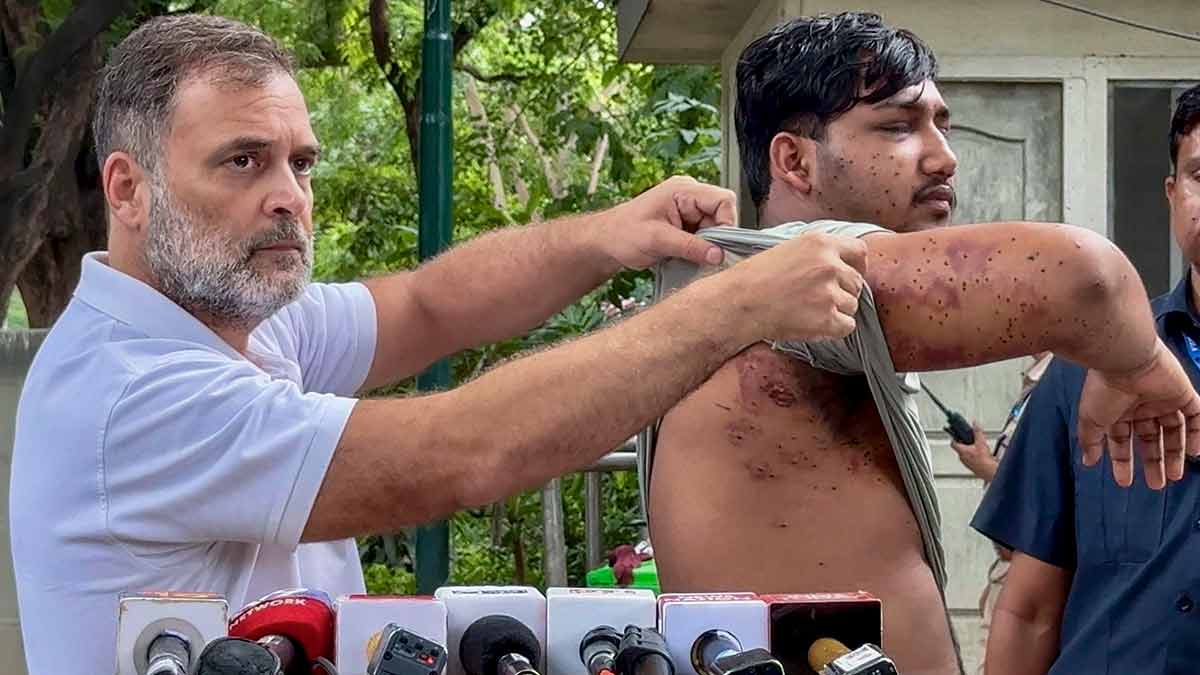
The Congress initiated the students’ issue through its Chhatron Ki Goonj campaign in June. Helmed by Leader of the Opposition Rahul Gandhi, it aims to cover 28 cities in 40 days. Insiders claim Rahul’s acceptability as an ideological counter will resonate with a Gen Z that has shown a remarkably independent mind, and the party’s attack over the crowd-control measures is expected to feature prominently in its grassroots campaign, not just for the coming assembly polls in UP, Punjab and Uttarakhand, but elsewhere, too.

“India is passing through a huge economic crisis, societal disharmony and bankruptcy of governance,” said Congress Rajya Sabha MP and general secretary Randeep Singh Surjewala. “The Ram temple donation theft, the movement over paper leaks, rampant unemployment and widespread rural unrest will act as a tsunami against the religious polarisation built by PM Modi and the RSS. Rahul Gandhi is acting with sincerity and commitment to constitutional principles.” Party insiders feel the recent sequence of events has opened a window for dissent and a chance for it to take control of that space by holding the government accountable.
The BJP has dominated the Congress for 12 years across assembly and Lok Sabha elections, in Parliament and on the narrative front, and has shown a rare knack for absorbing pressure during almost every major protest. But this time, the opposition believes a non-political force has changed that dynamic.
That will be tested most clearly in Uttar Pradesh. The state with 403 assembly seats spanning 80 Lok Sabha constituencies will see the return of ‘UP ke do ladke’ (UP’s two youths)—a slogan coined for Akhilesh Yadav and Rahul in 2017 that flopped then, but did better during the 2024 Lok Sabha polls. A large number of students from Uttar Pradesh and Bihar travelled to Jantar Mantar to protest. The Samajwadi Party-Congress alliance believes the movement has boosted its mobilisation. The SP, which after 2022 focused on soft hindutva and expanded its base through the pichda, dalit, alpsankhyak slogan, is, analysts said, now better placed to take on the BJP.
Jawed Ali Khan, the SP’s Rajya Sabha MP, says: “The biggest achievement of this movement is that the government was made accountable. Second, the fear among different sections of society, and even in political circles, has been wiped out. That fear is not there any more.”
Jitendra Kumar of the department of political science, Lucknow University, asserts that the Congress and the SP will benefit from this opening.
In Punjab, the ruling AAP is facing similar challenges over exam leaks and police response, but it is seen as closest to CJP founder Abhijeet Dipke. Some observers say the party could benefit if it regains its edge in Delhi. Though the CJP has ruled out a political debut, its actions in the coming months may amplify the anti-BJP space. And, the AAP and the Congress will compete for that space.
The BJP is not expected to cave in easily, and will likely respond with a strategy that unfolds gradually. “Political parties are trying to exploit the issue for mileage,” said spokesperson Gopal Krishna Agarwal. “The BJP will respond to that politically. The public understands the difference between narratives and actual corrective action. If we are taking corrective measures, that naturally influences public sentiment, which is why we are doing so.”
Sentiment within the saffron camp may appear subdued, given Gen Z’s reaction and, more worryingly, the abuse directed at the prime minister—posts the government has moved to take down. But, the episode has pushed the party to expand outreach: BJP leaders have been asked to increase their Instagram presence, the preferred platform for young people, and the prime minister himself used it to engage them three times in three days. Right-wing-affiliated youth wings are engaging with young people on campuses to understand their anger and promote the government’s agenda. “Students have faced a genuine problem, and the BJP will do everything possible to resolve it,” said Agarwal. “We have full sympathy for their cause. The prime minister himself is looking into the matter. We are committed to addressing it.”
Apart from Pradhan’s resignation and exam reforms, including a new bill, the early initiatives include a panel to suggest further reforms. Headed by Nandan Nilekani, co-founder of Infosys and founding architect of Aadhaar, it also has former ISRO chairman S. Somanath; Tapan Deka, former director of the Intelligence Bureau; Prof V. Kamakoti, director of IIT Madras; Anita Karwal, former education secretary, and senior bureaucrat Amrit Lal Meena.
Another part of the response is expected to generate heat in the days to come. The Centre is addressing the law-and-order issue despite an understanding with CJP negotiators that no action would be taken against protesters. “It is a key aspect, whether administrative or law and order,” said a party leader. “It involves the police, the courts and the government’s responsibility to ensure proper administration and maintain law and order.”
That brings us back to the arithmetic. In 2024, nearly 40 per cent of the 18-19 age group, eligible first-time voters, registered. By 2029, enrolment may rise given how central student issues and their language have become. Indeed, during the debate on exam leaks, MPs across parties were heard dabbling in Gen Z expressions such as “delulu” and the viral gibberish term “Vasteguna Huiya”, mixed in with Millennial phrases like FOMO that they probably thought were Gen Z. Given that Gen Z will be intensely wooed by Boomer, Gen X and Millennial politicians alike, it may be time to brush up on the vocabulary.
