



LISBON
For most of the past decade, Portugal was promoted as one of Europe's most welcoming countries. A sunny, comparatively cheaper corner of the European Union, it opened its doors to immigrants, especially from Brazil, India, Bangladesh, Nepal, and Pakistan, to staff its farms, construction sites, kitchens and other underutilised jobs. Even when language was a barrier, many came because Portugal was their gateway to Europe and the world.
The mood within Portugal, however, is changing. Immigration has become a talking point following the growth of far-right party Chega, which is currently one of the biggest forces in parliament. Party leader André Ventura has warned against Portugal being “demographically replaced” and jobs being “stolen”, with pointed references to the recent wave of south Asian arrivals. The hostility is no longer a secret.
According to the International Migration Outlook 2025 of the OECD (Organisation for Economic Co-operation and Development), Portugal's immigrant-born population has reached roughly 12 lakh, which is about 11.7 per cent of the country’s population—a rapid 30 per cent growth since 2014. According to the Indian Embassy in Portugal, the Indian-origin diaspora is estimated to be around 1.8 lakh. As of March 2026, there are 98,616 Indian nationals in Portugal, including 12,875 Overseas Citizenship of India card holders. But these numbers only include documented residents and those awaiting residentship. Include the undocumented, and the numbers could double.
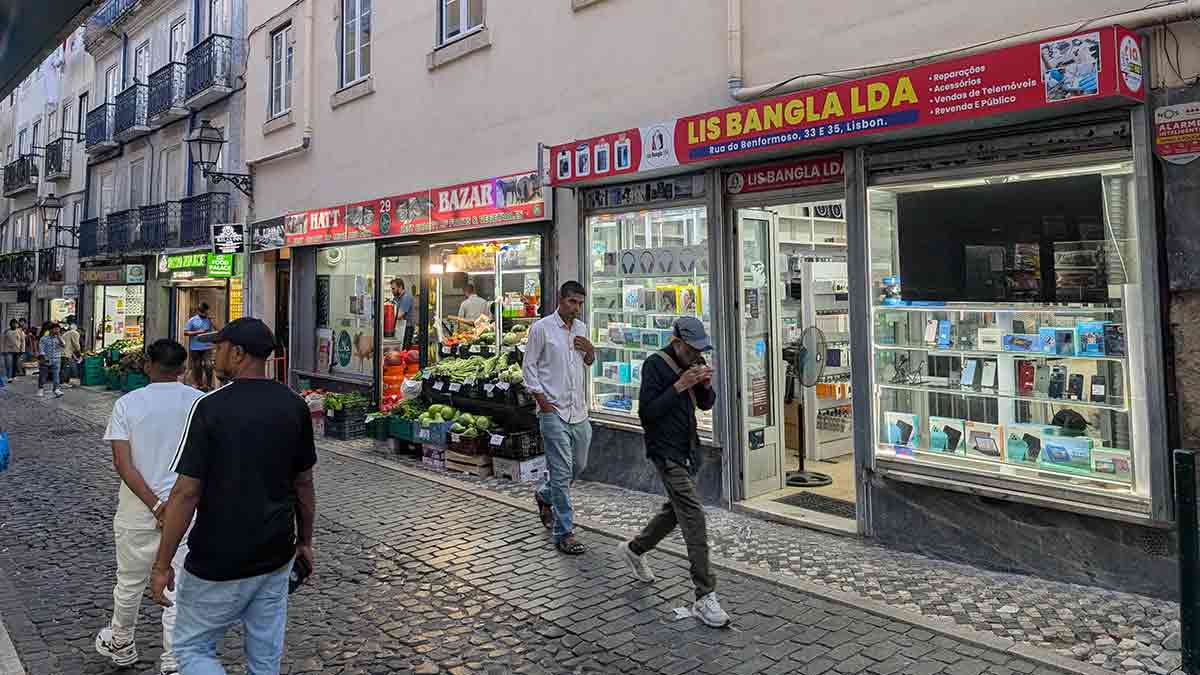
A specific distortion complicates the picture: the conflation of south Asian nationalities in public life. In Lisbon's central stations, particularly between the Martim Moniz and Intendente stretch, over 100 businesses are operated by Bangladeshi/Pakistani/Nepali immigrants, many branded as ‘Indian’ restaurants.
This creates a guilt-by-association dynamic. Issues linked to any south Asian business—be it labour disputes, noise complaints or even quality violations—are frequently reported in local media as ‘Indian’ problems, even when they involve people of other nationalities. Even as Portugal boasts its anti-racism campaigns, for the majority, the brown skin is still Indian.
“There is no proper evidence of a coordinated effort by Bangladeshis or Pakistanis to impersonate Indians and damage the community's reputation,” said Helia, a town planner at Cascais Municipal Corporation in Lisbon. “Rather, we see a structural conflation where Portuguese society treats south Asia as a monolith, and Indians bear the reputational cost of incidents they did not cause.”
Many Portuguese residents whom THE WEEK spoke to were uncomfortable about the topic and did not want to disclose their surnames. “Yes, they are creating problems. Well, I am not against legal residents. It is just the illegal residents who come here on a support visa, do nothing, acquire the SNS (Serviço Nacional de Saúde, the national health service) benefits, and don't go to work. It is our tax they are draining for nothing,” said Dom Suma, a restaurant worker.
This is a common issue in the working-class centres, especially in Lisbon. The SNS does provide urgent medical care to undocumented migrants. Standard SNS coverage and access to social security benefits require legal residency and, in most cases, a history of contributions. Unemployment benefits, for instance, require 360 days of prior registered employment.
Data from the Social Security Institute and AIMA (Agency for Integration, Migration and Asylum) indicate that the vast majority of Indians in Portugal are economically active, concentrated in agriculture, construction, hospitality and transportation sectors. And in the cases of undocumented entries, the fault lies with employer practices and not migrant freeloading.

Still, the black mark remains. In a country where the average monthly wage hovers around €850 (around Rs91,000) and pensioners live on modest incomes, the sight of young immigrants idling in public squares projects a sense of unfairness that right-wing parties feed to the public. “I have seen young men (immigrants) early in the morning chilling at parks and drinking beer... they don’t go to work,” said Dom Suma.
Another concern is their unwillingness to assimilate. “Let them come, we need everyone here. It is not that they are taking our jobs; they do the jobs nobody else wants,” said Jorge, an army veteran. “My concern is that most do not learn the language. If you are going to be here for more than a year, have the courtesy to learn the language and culture. It will benefit you, rather than trying to implement your own cultures here.”
Language acquisition is a huge concern. Many Indians work in enclave communities—south Indian restaurants, Punjabi mini markets and construction sites—where Portuguese is barely needed for daily survival. Language classes for immigrants do exist, but are overbooked and overpriced and poorly timed for those working 12- and 14-hour shifts on farms, factories or kitchens.
Cleanliness is another issue. “It is a big issue in places like Martim Moniz, Intendente and Anjos, where the south Asian population is the highest. It feels like you have landed in Mumbai or Delhi. The smell is horrible,” said Rui, a musician living in Anjos. “Once an important historical place, Martim Moniz has now turned into an Indian street. Drugs, brawls, pickpocketing... everything can be found here. People avoid these places at night.”
In the major city centres, the visible presence of south Asian life—Bollywood movie posters, halal butchers, jewellery shops and spice shops—has transformed streets that a decade ago felt truly Portuguese. For older residents, this is more like a cultural dislocation.
Lisbon's municipal services have struggled to keep pace with rising population density in these neighbourhoods, where historic buildings have been converted into overcrowded bed-sharing. Overflow of drugs, sight of trash bags strewn across streets, paan stains, clusters of men street-rotting, and pickpocketing have become a common scene in the Alfama region. The area though has been a troubled zone for decades, predating the south Asian influx, because of Africans and gypsy communities. Even then, the “smell” of “Indian” cooking and the lack of hygiene that fills the stairwells of buildings and streets are big issues.
The Portuguese uniting against the Indians is not out of hatred, but a sense that the state has lost control. Portuguese residents see a government that opened the doors to mass immigration. Though it started to fill labour gaps, irregularised intakes and lack of housing, language training or urban services has worsened the situation. Also, the rise of Chega and the 2025 citizenship reform, which doubled the residency requirement from five to 10 years, reflects this political pressure.
The cruellest irony is that sometimes Indians dig the hole for Indians. The highest costs of this backlash fall not on those who fuel the complaints, but on other Indians who did everything right. Legal, tax-paying, law-abiding residents find themselves treated as a collective liability. They, too, have to answer for a crime or incident they weren’t remotely connected to. Indians are refused rental accommodation regardless of income or references. Some hotels demand extra documentation, create strict laws for Indian nationals or even inflate deposits. Entry to certain bars and clubs is denied under vague pretexts that never seem to apply to others in the queue.
“I follow every rule,” said Anoop, an Indian restaurant chef. “I pay my taxes. I am polite to my neighbours. I even speak a bit of Portuguese, and still some landlords look at me like I am a risk they are taking. What more can I do? I cannot change my face.”
