



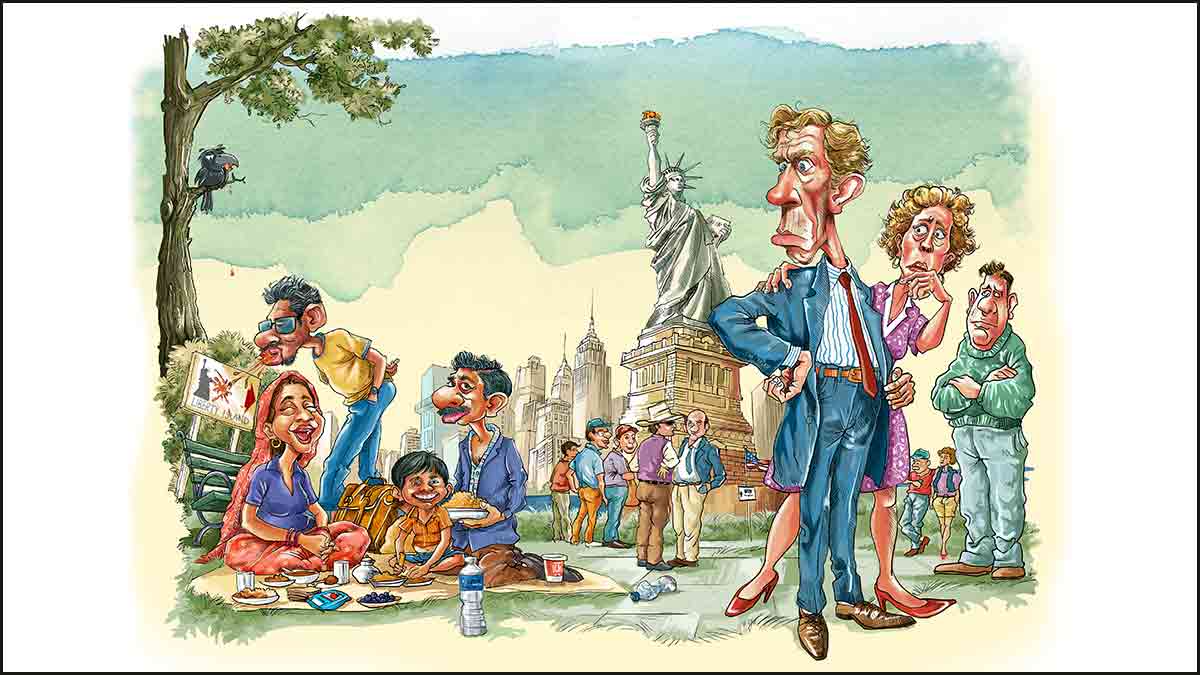
NEW YORK & NEW DELHI
Joel Jacob* is very upset right now.
The twenty-something software engineer was hyper-excited when his pitch based on a work for a multinational auto client was selected to be presented at a technology conference in Toulouse, France, recently.
Growing up dreaming of visiting Paris, Jacob started making his itinerary—land in Paris, do sightseeing for a couple of days and then head to Toulouse for the conference. And, he wondered, “Is it possible to go to Barcelona, in Spain, which was just a couple of hours from Toulouse?” After all, why miss out on a chance to visit the home ground of his favourite football team at Camp Nou!
But all his dreams came crashing down when his visa application was rejected. Dejected, he went over the whole process with the travel desk at his startup firm, only to find his documentation to be perfect. What could have gone wrong then?
It was then that an acquaintance working in the consular section of a western European country told him: “Visa sections of many western European nations have been informally briefed, in varying degrees, to be cautious of young Indians, particularly those going as students and tourists. This has happened after increased reports of Indians behaving poorly while in foreign lands.”
Atithi devo bhava (guest is like God) may be a charming Indian tenet that makes India truly incredible, but when Indians go as atithis (guests), we do not proffer that much godly a vibe. At least some of us.
And it is a problem that is compounding the way the world looks at India.

EAST OR WEST, INDIA IS THE BEST?
◆ A typical night in Sydney was disrupted by a blaring boom box and a DJ console blocking a metro train vestibule, as an eager set of revellers turned the transportation system into their personal party spot. The bunch of Indians, returning from a Diljit Dosanjh concert at the CommBank Stadium in the Parramatta neighbourhood, decided to continue singing and dancing, even as some commuters joined in while some looked aghast.
◆There are more than a handful of Indian male bloggers on social media who specialise in content centred around picking up women abroad. In many cases, personal liberty crosses the line and becomes cringe misogyny as they trash-talk to women in street-level Indian language. A popular blogger in a video was seen calling out to a lady in Venice in coarse Hindi while floating on a gondola: “Why just look at me? Aa ja, baith ja (come, sit near me)!”
◆A movie screening was disrupted in London when a raucous Indian audience celebrated by throwing popcorn up in the air, just like how some fans celebrate when their hero first appears on screen back home. It landed all over the cinema hall floor. When the staff stopped the screening, a belligerent desi retorted, “There is no sign saying we can’t throw our popcorn on the floor!” The staff responded, “Come on, that is common sense!”
◆An English neighbourhood was woken up at 3am with a loud Kishore Kumar song blaring from outside. The culprit? An Indian delivery boy on his moped playing ‘Yeh Vaada Raha’.
◆With more and more Indians celebrating festivals in public places, rift lines are getting strained, since many Indian rituals involve public processions, immersing idols or offerings like flowers in water or breaking coconuts on the streets. The annual Ganesh Chaturthi procession in Paris, or a visarjan (idol immersion) in London, a Ganga aarti in a Canadian freshwater lake—all recently went viral for the wrong reasons, with hate spewed on Indians for breaking laws and polluting water bodies.
◆In Toronto, the city police gave up as Indian revellers blocked the city’s main Dundas square on Diwali night with cars, crackers and cacophony. Birmingham police in the UK arrested 21 south Asians after they threw crackers on buses and on the streets on Diwali night.
◆A video of an Indian lady caught shoplifting in the US went viral, as she claimed, “I forgot to pay”. Be it stealing from a street vendor in Vietnam, a hotel in Bali or a department store in the US, the damage is done even if such incidents are done by a fraction of Indians abroad.
◆Journalist Brooke Davies filmed herself walking around London counting paan stains in public areas of the city. “I’m spending my days counting them—and I have counted upwards of 50 in just half an hour. (Many) members of the community are absolutely sick of it,” she said. From tourist spots like Pattaya to immigrant-heavy towns like Leicester, there are now signages in public places warning against spitting paan on footpaths and the like.
◆Shreya Mahendru, an influencer based in Thailand, highlighted reports of Indians not paying sex workers as agreed, gleefully taking pics of women in bikinis on beaches without consent and fighting with hotel staff. “I am not trying to moral police, but the misbehaviour and sheer entitlement need to be called out,” she said.
◆A Canadian caught three Indians dumping a sofa in the forested area near his house in Mission, British Columbia. After chasing them, he not only made them load the sofa back into their pickup truck but also followed them to the Mission Sanitary Landfill to ensure it was disposed of legally. He called it “a lesson in being Canadian”.
DEEP IMPACT
The late 1950s and 1960s were categorised as the ‘Ugly American’ era. Americans abroad, particularly in southeast Asia, were called so because of their alleged arrogant and self-entitled behaviour with the local populace. These days, it seems like Indians have taken over that mantle. But it is not just a matter of image or reputation. The bigger problem is how perception in the post-truth era contributes a long way to how foreign governments formulate policy, work out trade deals and shape bilateral policy.
There is already churning happening, be it the Trump administration’s crackdown on H-1B visas and sending illegal Indian immigrants back in shackles or Canada rejecting about 74 per cent of Indian student applications last year. Some tourist guides in Amsterdam and hotels in Bali apparently now have separate ‘Indian guest management’ briefing, while many bars and clubs in Thailand follow an unofficial policy of keeping out single Indian men, especially in groups. Rules and fines against spitting paan are now publicly put up anywhere from Pattaya in Thailand to Brent in the UK.
“Such incidents can influence the broader perception environment in which bilateral relationships operate,” said Hema Bajaj, area chairperson (human resources & behavioural sciences) at NMIMS School of Business Management. “Trade and economic partnerships are often strengthened by trust, familiarity and positive people-to-people interactions. When local communities, service sectors or business networks repeatedly encounter negative behavioural patterns, it can contribute to stereotypes that subtly shape how tourists, students, professionals and even companies from a country are perceived.”
Earlier this year, Australia put Indian student visa applicants in ‘Evidence Level 3’, the highest risk category. Some universities have also begun restricting or outright banning visa applications from five Indian states, including Punjab and Gujarat. The UK has also made its permanent residency requirements more stringent. Though the Indian passport did move up the Henley Passport Index this year, it has lost visa-free travel access to three countries.
FROM SUCCESS TO EXCESS
It wasn’t always like this. For some time now, we had gotten used to story after story of Indians doing well abroad. Be it Indians taking over as CEOs of some of the world’s biggest companies, to Indian medical professionals earning admiration for their excellence and hard work, to Indians becoming the wealthiest immigrant cohort in countries like the US and the UK, it seemed like Indians abroad were a shining North Star for others to emulate.
But this also led to two trajectories that now seem to have come together. One, more and more Indians are shifting abroad, either as students or as professionals. Two, the rising numbers are raising fears of an immigrant influx, fitting right into a ‘fear of the outsider’ narrative that has been gaining currency in many democracies over the past decade.
Indians reaching a critical number is a major factor in both cases. From just above 60 lakh Indians all around the world at the beginning of the 1990s, Indians today have become the biggest diaspora in the world, at 3.72 crore. Students have been a particularly big floating population, with their numbers rising by nearly 200 per cent this century.
This has led to strength in numbers—both a boon and a curse. A boon, as this has seen thriving Indian communities, with the diaspora becoming a vote bank with its own distinct voice in countries like Canada and the UK. And a curse for two reasons. First, they found themselves in the crosshairs of conservative politicians who played up the fear of the outsider taking over one’s homeland in a juicy piece of irony, since the same narrative has been played in India against groups like Muslims and Bangladeshis. Second, while Indians stayed under the radar when they were in smaller numbers and assimilated into mainstream western society, with more numbers, Indians have begun standing out, in many cases for the wrong reasons, and sticking to their own kind.
“At 5 million [in the US alone], you have a critical mass, [meaning] there are some towns where the entire community is Indian—they live together and marry each other because there are enough of them now,” said US-based Indian author Meenakshi Ahamed. “The internet has globalised culture, so their bonds with India remain strong, with cell phones, constant travel home and strong roots in their own culture.”
Now, the problem with that? “This attracts attention and I think that what the Indians haven’t done as successfully here probably is get involved in their communities,” said Ahamed. “They tend to give money to their villages, schools or temples in India, but have been slower to give to their local community.”
Worse, they never identified with Black struggles or the issues of the Hispanic migrants in the US, and this meant they were caught unawares and without allies when the rising recent tide of political racism hit them.
“I have been to a couple of meetings in Silicon Valley where Indians have asked me, ‘What should we be doing to connect with other people? It is something we haven’t thought of doing before,’” said Ahamed. “The one answer I give them is, ‘Don’t give money to Stanford, give it to the local community college, the free health clinics, etc.’ These are the charitable things that Indians could do that makes (the rest of the) community feel that they care and that they are a part of the community.”
THE NEW INDIA, THE NEW INDIAN
Add to that what sociologists call a new Indianness, a supposed ‘new idea of India’, with its sense of cultural superiority and a sense of newfound outrage over colonialism—narratives pushed at home and abroad particularly through a potent use of social media over the past 12 years.
“The rise of hindutva in India has certainly spilled over in these ugly ways, carrying that same kind of energy, that same sense of entitlement and superiority,” explained Sabrina Dhawan, who teaches at the New York University and is better known as the scriptwriter of the cult classic Monsoon Wedding. “Because you know it is not about being Hindu, it is hindutva—believing that you are superior. It is like saying being Indian means being aggressive, assertive and intimidating. The idea of being an Indian was very different earlier.”
And when it spills over into loud rituals or raucous festive processions, it invariably leads to friction. Take, for example, one of the tallest Hanuman statues in the world, which is not in India, but in the Texan town of Sugar Land. At 90ft, the statue looms over the small town with a sizeable population of Hindus and Christians, enough to spark a backlash, with one American conservative leader billing it “a third world invasion”.
“If someone went into a Hindu majority town in India and put up a giant statue of Christ or Mary, wouldn’t you be ticked off? There have been temples built around the US and nobody minds them, but a 90ft statue in a small town where it is visible from all sides?” asked Ahamed. “I am a Hindu from both sides of my family dating back generations, and I find it smacks of insensitivity!”
Added Dhawan, “American culture has always been a melting pot, always absorbing various migrant cultures into it. Earlier, we all melted into whatever was considered mainstream. Now, we are in the pot, but we are not actually melting. We are trying to stick to our ethnic identity. There is a reluctance to engage.”
As Pratik Jain, cofounder of the prominent political advocacy group I-PAC, wrote in his LinkedIn post: “For every Indian trying to save India’s face abroad, there are four who are ruining it. We complain about racism abroad while exporting our worst cultural habits. We demand respect while showing none. What we could hide within our borders is now on full display.”
The behaviour often reflects the underlying insecurity instead of superiority, explained life coach Acharya Anita. “Since the foundation is weak, the ego compensates by becoming louder. This seeming boldness is often an expression of unresolved anxiety,” she said.
THE EMPIRE STRIKES BACK
But there is also a vociferous line of thought which argues that this is just sour grapes, of Indians being targeted because they are doing well abroad. Is there any truth to it?
Rushal Mehra*, a Delhiite who moved to Toronto and became a Canadian citizen recently, explained, “Canada needed a lot of outsiders to work frontline jobs during and after Covid because the locals were afraid of doing such jobs during the pandemic, and now the very same people are complaining that outsiders have come and taken their jobs! The education system in Canada was dependent on money coming in from India—they even lowered their admission standards at one point to take in more Indians. And now, they have changed the rules, which will make many of these students who had taken admissions in the hope that they can settle here go back arbitrarily.”
It is argued that with more Indian travellers who are more visible, there will be more incidents. “There is definitely a stereotyping and a bigotry towards Indians that gets amplified when Indians occupy more space in media or in the public sphere, you know, business, tech, politics,” said Dhawan. “Every immigrant group—Jews, Muslims, Irish, Italians, the Chinese—has been accused of not assimilating enough to the country they migrate to. [It is just that] those groups have been around for longer [and] whatever they brought in has mixed in and it is India’s time now. In two generations’ time, whatever Indians brought in will also be part of the mix and it will be some other new group which will be accused of not assimilating.”
THE THREE CS
The three Cs are also a daunting fact—class, caste and culture.
“What people sometimes will see as bad behaviour is actually a cultural difference,” argued Dhawan. Mehra also points to the time factor: “Newly arrived migrants tend to be more culturally insensitive. I find newly arrived Indian colleagues constantly asking me about my personal life, when I am going to get married, which is never encountered from local Canadians or older Indians.”
Little things like offering a visitor tea or coffee (must-must in India, not so in many countries in the west), saying ‘please’ and ‘thank you’ at shops and restaurants (not a common sight in India but incredibly important abroad), sociologists feel, should not be read too much into.
“It is not that there is anything wrong in it as such. But in the global glare, it becomes a matter for shaming by the prejudiced side, for them it is a convenient confirmation of the sense that these people will disrupt their social order,” said Chandan Gowda, academic and author. “Indians who move abroad are under tremendous pressure to show that they actually share the same civility, that they won’t disturb the social order and the civic order.”
Neil Taylor, a UK national and recruiter, argued that it was more a narrative that plays into divisiveness. “There is certainly a cultural mismatch at times, but that is not always associated with public disorder, loudness and disruptive behaviour. Japan and Nordic countries have different norms to the UK, to Brazil and to India. And in truth, these complaints could be made about any nationality. How many times have we heard about disruptive UK passengers flying from the UK airports to Spain?”
Tougher would be to justify the prejudices of class and caste that Indian immigrants have taken global, so much so that US states like California and cities like Seattle had to pass legislation banning discrimination based on caste. Also, Harvard University and the Toronto District School Board recognised casteism as a form of discrimination. Alistair Steel, a professional with the UK’s National Health Service, told THE WEEK, “Without exception, I have found Indian health care workers to be courteous, respectful and considerate. While I have rarely seen any conflict, I think some Indian colleagues can sometimes treat their fellow Indians unfairly based on caste or seniority, both within work and outside of it. I expect this is perhaps more reflective of the culture within Indian hospitals, and doesn’t seem to extend to non-Indian colleagues.”
IS THERE A WAY OUT?
As Indians go global, these are challenges that foreign societies take on as they enjoy the value addition desis bring in—it is a package deal. Yet, there is perhaps no excuse for the boorish behaviour of many Indians, like using public fountains to wash clothes (as was reported from Europe last year) and stuffing bags with food from the hotel’s complimentary breakfast buffet to save on lunch costs, or creating public nuisance like doing the dandiya atop the Burj Khalifa. But what can be done?
Mehra from Toronto pointed out how, when he went to study in Canada a couple of decades ago, he had to undertake an orientation course at the Canadian Culture Centre, which has since been discontinued. Such measures, or at least a refresher sensitisation training, could go a long way.
Though minor steps, they contribute to a crucial whole. As Hema Bajaj summed up, “As India’s global presence grows, there is an increasing need to emphasise on cultural awareness and responsible travel and civic behaviour. In a globally connected world, everyday conduct abroad can indirectly influence a nation’s reputation, and reputation remains an important, intangible factor that supports long-term international collaboration and trade.”
*Some names have been changed on request
