



THE FUTURE OF Palestinians is no longer being written in the exhausted vocabulary of the two-state solution. It is being written in Gaza’s ruins and in West Bank villages watching the Palestinian map shrink. The central question now is whether enough land, social ties, political dignity and ordinary life will remain from which Palestine’s future can still be built.
This is what makes Israel’s apparent victory so potentially pyrrhic. Israel has degraded Hamas on the battlefield, and reduced its capacity to wage a conventional fight. Yet, the deeper issue is the political and emotional landscape that the war has created. A victory that destroys an enemy’s arsenal while enlarging the reservoir of future resistance carries its own strategic cost.
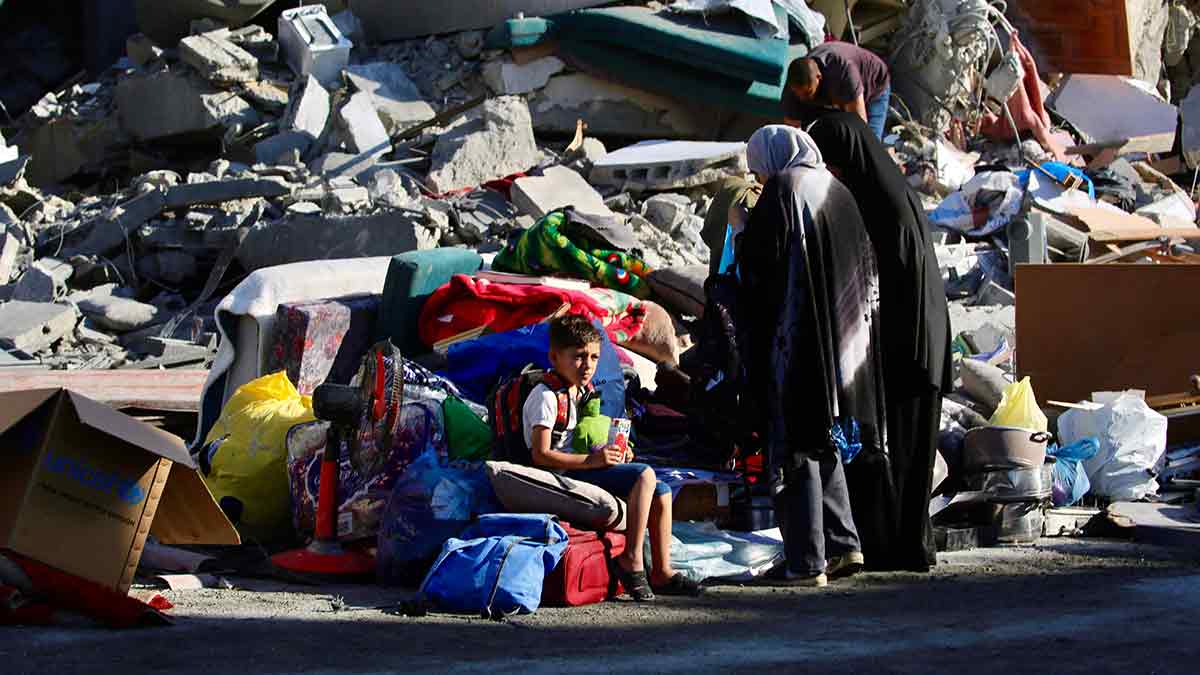
Gaza and the West Bank are facing complementary versions of the same narrowing future. In Gaza, Palestinians confront the destruction of shelter, schools, hospitals and the basic continuity of life. In the West Bank, they confront settlements, raids, settler violence, checkpoints, land seizures and the humiliation of a Palestinian Authority unable to protect them. Gaza represents the fear of annihilation; the West Bank represents the fear of erasure.
Palestinians are being pushed back into a raw struggle over land, demography and survival. They see Gaza ruined, the West Bank eaten piece by piece, East Jerusalem isolated, Arab normalisation proceeding around them, and humanitarian pity replacing political rights.
Long before October 7, some Israeli strategists had convinced Prime Minister Benjamin Netanyahu that the old formula of land for peace no longer served Israel’s long-term interests. Territory, in this view, had become too dangerous to surrender and Palestinian sovereignty too risky to tolerate. Maximum land with minimum Palestinians—that became Israel’s strategic preference. The West Bank is becoming a laboratory of demographic management, defended more openly by an Israeli society radicalised by the growing belief that Palestinians must be contained rather than politically answered.
This hardening in Israeli society has been met by a corresponding hardening among Palestinians—within Hamas, around the Palestinian Authority, and especially among the silent majority. The Palestinian Authority’s institutional identity was built around diplomacy and gradual state-building. That language now sounds hollow against the backdrop of failed governance, corrupt leadership and an inability to protect Palestinians from violence and economic suffocation.
This dynamic has forced a regional reckoning. Before October 7, some Arab capitals believed they could look away from Palestine, wrapping normalisation in promises of economic modernisation and security treaties, and accepting vague American assurances that Palestinian rights would eventually be addressed. The Abraham Accords rested on the assumption that Palestine could be bypassed without detonating the regional order. Gaza has severely damaged that assumption.
Egypt’s refusal to absorb Palestinians into Sinai was one of the first serious turn of Arab refusals to participate in the demographic removal of the Palestinian question. Cairo drew a line: Gaza’s population could not be transferred as the price of regional convenience. Mass displacement would turn Egypt into the custodian of Israel’s unresolved Palestinian problem, forcing it to inherit the consequences of a crisis it cannot contain. That refusal has reinforced a broader counter-alignment emerging around Saudi Arabia, Egypt, Qatar and Turkey: a loose, defensive coalition of states wary of a region reorganised by Israeli expansion.
Turkey’s role in this realignment deserves particular attention. For years, Ankara maintained a balance: rhetorically pro-Palestinian, economically entangled with Israel and strategically reluctant to pay a real price for either stance. The war has clarified that ambiguity. Turkey suspended trade with Israel, deepened its engagement with Hamas, and positioned itself as a more credible interlocutor for the Palestinian cause in ways that Egypt and Saudi Arabia—strong-armed by Washington—cannot easily replicate. Israeli strategic thinking has begun treating Turkey as a future security problem. When Iran is weakened, Turkey becomes the next regional power capable of projecting influence into Arab spaces. Turkey has the military capacity and institutional reach to become a long-term patron of Palestinian political and civil society.
Iran, meanwhile, has learned that its most reliable deterrent tools are those directly under its control: the Strait of Hormuz, threats to Gulf infrastructure, and ballistic missiles that can impose costs while relying less on non-state actors. Tehran still has reason to keep Hamas and Hezbollah alive enough to complicate Israel’s security environment. Their degradation changes their function rather than their removal from the strategic field.
This is why Hamas support in the West Bank matters so much. Many Palestinians may dislike Hamas as a governing authority but still respect it as a symbol of defiance, seeing it as the only force that refused to surrender while diplomacy produced only settlements, checkpoints and humiliation. Hamas has been degraded militarily, yet has survived as an emotion.
The future of Palestinians appears bleak because every moderate option is losing meaning. The two-state solution is no longer discussed; the Palestinian Authority is recognised but not empowered; Gaza is mourned but not rebuilt; and Arab normalisation is celebrated while Palestinian rights are deferred. In such a landscape, Hamas—and the emotion it now carries—does not need to win in Gaza to gain ground in the Palestinian imagination. It only needs every other alternative to fail.
Husseini is a political analyst based in Washington and Beirut.
