



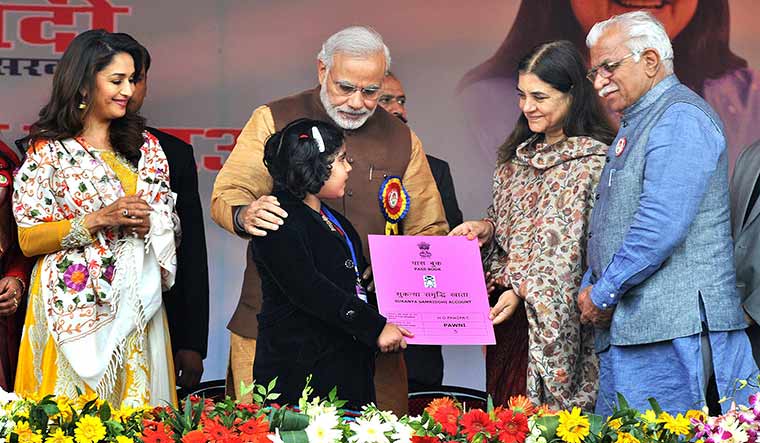
Haryana Chief Minister Manohar Lal Khattar came to power a few months after Narendra Modi was elected as prime minister in 2014. Soft spoken but resolute, Khattar powered his party to power again in 2019.
Khattar talked to THE WEEK about the success of his government’s welfare schemes, the ‘Haryana model’ and, of course, politics. Edited excerpts:
Q/ Prime Minister Narendra Modi is entering the 10th year of his tenure. How do you see its impact and the coordination between the Centre and your state?
A/ The Modi government has focused on technology, out of which good governance has flowed. We started e-tendering in panchayats. It was opposed by many people; strikes were called, as e-tendering prevented pilferage of funds.
The double-engine formula has helped. We get inspiration and ideas from [the Centre]. We are able to plan as we are placed well in terms of resources and revenue. We have hugely benefited from the double-engine government.
Q/ We have seen governments and political leaders talk about the Gujarat model, the Delhi model, and even the Rajasthan model. Is there a Haryana model?
A/ We started a Svamitva Scheme, though initially the name was Lal Dora Mukt Yojna. There were no revenue records in lal dora areas (red-tape properties). So whatever the residents and sarpanches said was taken as the truth. It used to lead to quarrels. So we started updating revenue records and gave titling. (The scheme allows creation of accurate land records for rural planning. It also helps rural population to use their property as a financial asset for borrowing).
PM Modi started it as Svamitva Scheme and launched it nationally. We never sought publicity. Our Central leaders asked us to talk about the good things we are doing. Look at Parivar Pehchan Patra―it was recommended by the prime minister to all BJP-ruled states. Some have started following it. We implemented online transfer policy for school teachers. I know eight states which have started doing it. Now, it is up to you to talk about the Haryana model.
Q/ How have you been able to ensure 24x7 power supply?
A/ Before the BJP government came to power, all power companies were in the red. The line losses were to the tune of over 34 per cent. Not only were the people not used to paying bills, but they also took it as an insult [to be asked to] pay them.
In 2015, I was to address a rally. My MLAs put forward 25 demands. I said I will fulfil all demands, but I also have one. They were surprised. I said I will carry a jholi (small bag) and beg people to pay their bills. The MLAs were so petrified they asked me to cancel the rally. Such was the fear to ask for bill payments.
There was anger initially. We started the Jag Mag Gaon Yojna under which we said we would provide 24x7 power if all were to pay bills. Gradually, people started paying up and installing meters in their houses. We asked them to clear their dues in instalments. Of 6,200 panchayats, as many as 5,600 have 24-hour electricity supply.
There was a mindset change.
Q/ The Parivar Pehchan Patra scheme and its linked benefits are being talked about. How does it work?
A/ The Indian government came up with Aadhaar for citizen identification. But we realised that individuals are not central but the family is. The family works a unit, and whatever may be the number of members in the family, we should have a mechanism to help them all. The idea of Parivar Pehchan Patra was thus born.
A five-member panel went to all households to get self-declared data, but many declared their income to be below Rs1.8 lakh per annum. We also connected birth and death registrations with this. Among people who had declared their income to be below Rs1.8 lakh per annum, we found out that nearly 3.25 lakh had filed income tax returns, and 82,000 had either government or private jobs. When we started finding these anomalies, people started [giving information]. We also connected the electricity bill payers, and those who sent their children to private or government schools.
We created a data [bank] and linked schemes. This led to giving out ration cards to more than 12.5 lakh more people whose annual income was below 01.8 lakh. Eight lakh people were taken out from the [below poverty line] category and their ration cards suspended. We gave one month to file objections, of which only 2.25 lakh applied, out of which one lakh got their cards back. There are 1.25 lakh people whose cards were deleted.
Q/ Political parties promise freebies during elections. Your views.
A/ This is wrong. No self-respecting person would want to take anything free. Only someone who has lost self-respect may want it.
We are giving what people need. We are generating employment, skilling people and creating opportunities. We are giving free ration to 31 lakh people who earn less than Rs15,000 per month. We run the Ayushman Bharat health scheme as started by Modi. People who have low income get support and benefits in terms of health, education, housing and food. We provide Rs71,000 as gift for poor girls to get married. We give power for 02 per unit for the first 200 units.
Q/ Opposition unity is being planned. What will be the impact at the national and state levels?
A/ This happens in every elections. All those who want to defeat the bigger party comes together. Their basic motive is selfish.
Q/ What is your assessment of the 2024 polls?
A/ We will return with a bigger majority. People trust the Modi government.
