



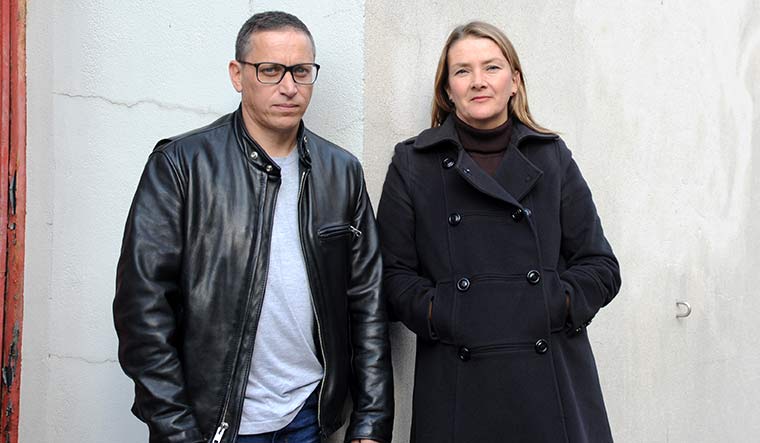
The roots of failure of one of the longest armed conflicts in US history lies in America’s calamitous and disastrous relationship with Afghanistan,” journalist Adrian Levy told THE WEEK in an interview from London.
Levy recently co-authored Spy Stories: Inside the Secret World of the RAW and the ISI, published by Juggernaut, with author-journalist Cathy Scott-Clark.
On India’s role in Afghanistan, he said that Delhi had been busy nurturing its relationship with the national government, forgetting that there was an Afghanistan beyond Kabul. Excerpts from an interview:
What role do you see for Delhi in Afghanistan?
India did many things in Afghanistan. It pumped in cash and resources and created a relationship, but perhaps its biggest failing was that it was late in [reaching out to] the other side (Taliban). Kabul is not equivalent to Afghanistan; India put too [much trust] in the US mirage there. It went late to Doha. Its reach mirrored the US’s. We must remember that the Taliban is not India’s enemy. It never was.
As much as Indian intelligence agencies like R&AW want to build a narrative that Pakistan will be the biggest worry again, there is evidence to suggest that groups that have decamped as a result of constant purging by Pakistan are now operating in the lawless lands across the Durand Line. Elements of the Islamic State, Al Qaeda, Tehreek-e-Taliban Pakistan, Jaish-e-Mohammad and Lashkar-e-Taiba are forming deadly battle-hardened groups inside southern Afghanistan and will attack anyone, including Pakistan.
What are the other worries in Afghanistan?
First, it is the chaotic space created in places in Afghanistan by insurgents who fled Waziristan and FATA (Federally Administered Tribal Areas), where terror groups are deeply entrenched inside communities. They will continue to spark tension around the Durand Line and beyond. Second, there are spoilers like Iran, which has funded sections of the Taliban to hamper the US; and Russia, which had previously lost in Afghanistan, and is engaged in a contest with Washington. There is Turkey, which is deep into Pakistan, rivalling Saudi, and wants to be seen as a regional power. So, the failed state and the spoilers together pave the way for a breeding ground for evil forces and dangerous groups to thrive.
In 20 years, there have been some changes. The Pakistan army has come through 18 years of war for the better, and Rawalpindi has spent a lot of money to fortify the Durand Line with fencing and tech. What is far from clear is how and whether adventurist elements within the military and the intelligence establishment have now been enabled, too, to prosecute their old anti-India project.
In the book, you draw links between the 2019 Pulwama attack and Afghanistan.
Jaish-e-Mohammad plotted Pulwama inside Afghanistan. They had occupied compounds alongside Al Qaeda and other terrorist outfits. While the public statements and perception were completely different, that the ISI and the Pakistan military establishment were to blame, the facts suggested that the command and control structure was inside Afghanistan. If you look at the aetiology of forensics, a similar device was used in the 2008 bombing of the Marriott hotel in Islamabad. Aluminium powder was used to create enormous heat. So, what you have are Al Qaeda engineers, Jaish leaders and even men trained by the now dead [Al Qaeda] commander Ilyas Kashmiri, who targeted Pulwama. What we see is how few people are needed to spill blood and create the architecture of terror. But what happens afterwards, despite the evidence, is that India lambasts Pakistan. The political project takes over.
So are you saying that R&AW is good at perception management?
India has had great success in projecting itself as benign. It is a masterful thing done through soft and hard power, where you gather a cloak around yourself to disguise all hot actions and instead portray yourself as being the patient, perpetual victim of Pakistan terror. Good play, as ISI would say. There has been Pakistan-backed terror and insurgency. But that is all we see. Thanks to this cloak.
In the book, you describe Kulbhushan Jadhav as an asset and not an officer. What is the difference?
In Jadhav, Pakistan spotted an opportunity. India required a new facility post 26/11; there was a need to step up and deploy assets that had access deep inside Pakistan and neighbouring countries to illuminate operations by Jaish, LeT and Al Qaeda. Given that actions by these groups had been switched down to only a simmer in Kashmir, they re-formed in Karachi and elsewhere looking for new routes to attack India. All agencies in India needed to reset around this thesis, be it the Indian Navy, the Intelligence Bureau or R&AW.
India worked hard to make connections through assets in Tehreek-e-Taliban Pakistan and [among] Baloch nationalists, as well as seeking influence in places like Iran’s Chabahar Port, which was the natural competitor to Gwadar Port. So, there is China and Pakistan in Gwadar and R&AW and Iran in Chabahar. What we have are two ports of extreme strategic importance in Central Asia. And then there is Kulbhushan Jadhav working in Chabahar, but also able to traverse Pakistan and India. The man has at least two forms of official identity, mis-describing his religion and an actual address in Mumbai that the ISI learns is linked to a former senior police officer. The ISI sees a perfect opportunity to trap India. To build Jadhav from a roving itinerant—a roving ear—into being seen as an Indian master spy.
Are you saying Pakistan’s claim on Jadhav is real?
What cops do is detect crimes and put them through the criminal justice system, but what spymasters do is latch on to a crime and let it run as long as possible to see what the man is up to. They germinated an idea—in this case a conspiracy to attack a Pakistan air force base—and thrust upon him plans for the base, making him a party in a serious criminal conspiracy. They waited to see whom he would contact. Would he find a Baloch national? All along, in the background, they know he is a family man with kids. So, Jadhav gets jammed between spy wars of two sides.
