



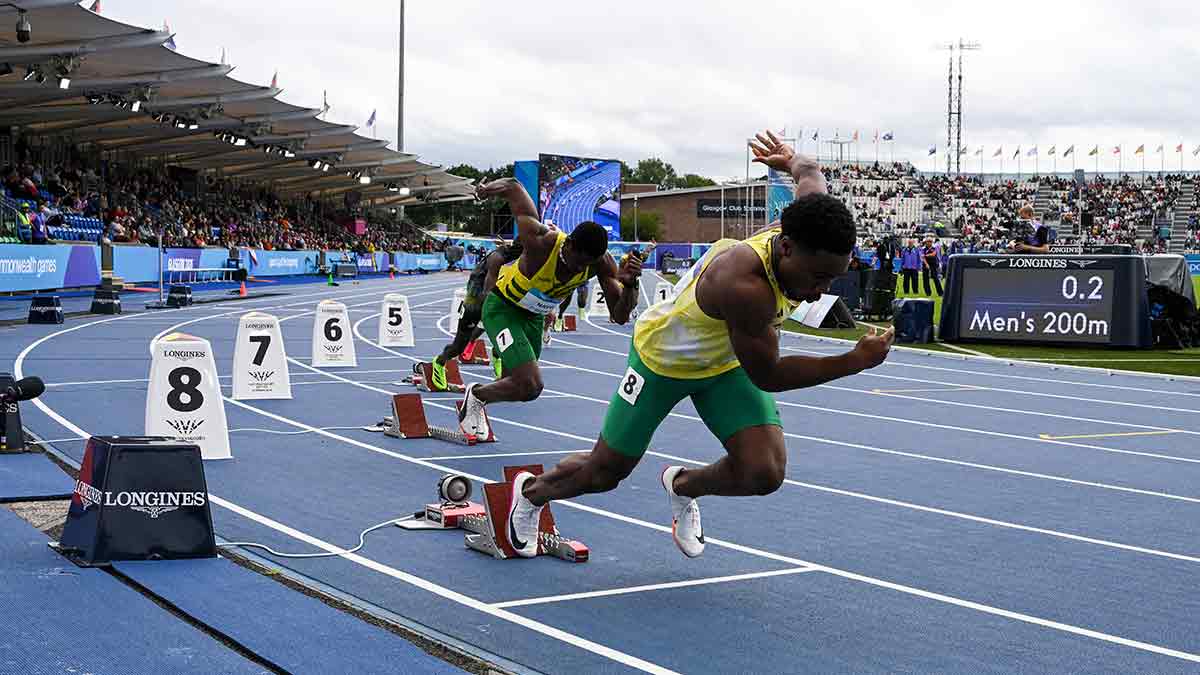
SPORTING EVENTS ARE high-pressure affairs, not just for athletes but also for those keeping the score. The stakes are even higher when it is a major international multi-sport competition, like the Commonwealth Games. So, what goes into timing events like these? The short answer: a lot.
For over 60 years, every record at the Commonwealth Games has been timed and confirmed by Swiss watchmaking giant Longines. The brand has been the official partner and timekeeper of the Games since Perth in 1962. It has brought its own A-game to timing not just milliseconds, but microseconds, too.

At the recently concluded Commonwealth Games in Glasgow, Longines equipped the event with high-precision technology, like E-guns to ensure perfectly synchronised starts, the photo-finish-scanner ultra that captures up to 40,000 digital lines per second to determine results, and touchpad technology in swimming that converted athletes’ finishes into exact time measurements. Other technologies, including photo-finish systems, real-time tracking systems and next-generation graphics solutions, supported events such as cycling.
The Games also saw more than 103 tonnes of equipment representing 555m3 of operational infrastructure. It also saw the participation of 150 Longines timekeeping specialists, and 105 volunteers and technical officials.
In 1878, Longines created its first-ever chronograph movement, the most classic of watch complications whose start-stop-and-reset function is most used in racing—this specific movement became so successful that watches equipped with it were used at American racetracks to precisely time horse races. Longines went on to develop timing equipment like high-frequency stopwatches capable of measuring 1/10th of a second in 1910 and 1/100th of a second in 1916. In 1949, it introduced the quartz-based Chronocamera, which printed a time-stamped photograph accurate to one hundredth of a second. In the 1950s came the Chronocinegines that could record 100 frames per second, and Contifort, a photo-finish camera that printed a film strip with a white line indicating where the finish line was crossed.
To commemorate its legacy, every edition of the Commonwealth Games also sees the brand release a Commonwealth edition watch. This year, it was the HydroConquest Automatic Glasgow 2026 Limited Edition, with a gradient teal dial and pink seconds hand, which mirrored the colours of the edition. Available in two sizes—39mm and 42mm—both versions offer 72 hours of power reserve and are limited to 2,026 pieces.
From Perth 1962 to Glasgow 2026, Longines isn’t just watching the Games. It is timing history.
