



The loudest thing about Hanoi is its quietness; of course, with the exception of some tourist traps. The operative word is functional, starting with the airport, which is neither too big nor too small. Even the giant Nhat Tan Bridge, the gateway to the city from the airport, looks like a poor cousin of Mumbai’s Bandra-Worli Sea Link. The downtown has its fair share of big buildings, but the overwhelming impression is that of a matter-of-fact business centre rather than a glittering showcase city typical of emerging Asian countries.
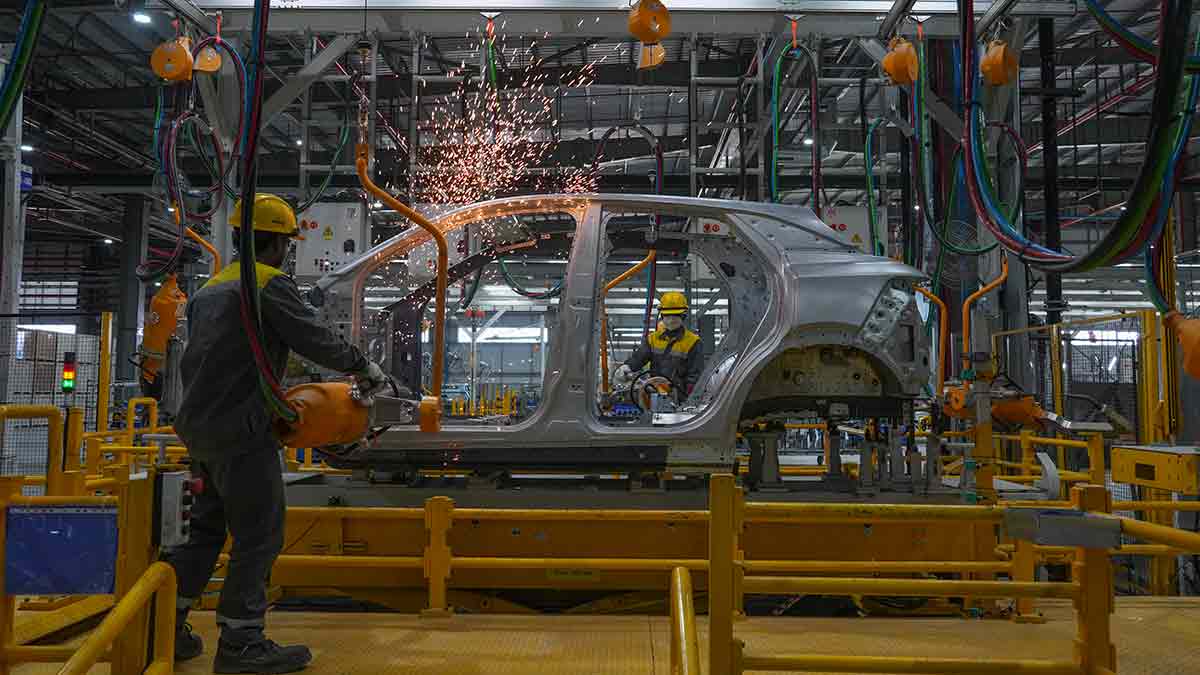
Vietnam does have its poster boys. Only, they aren’t where you expect them to be. Drive out east along the Hai Phong Expressway, you come across the Dinh Vu-Cat Hai economic zone, Vietnam’s real gem. The area has manufacturing plants spread across kilometres, making everything from electric vehicles to heavy industrial machinery. A clutch of port facilities spread from Bach Dang river estuary to the deep sea in Lach Huyen ensure that the products promptly go out into the world markets.
And it is just one of the many. In a hundred kilometres, you come across Yen Binh Industrial Zone, where Samsung has one of its biggest phone manufacturing plants and high-tech components and renewable energy equipment plants. Go down south and you see another spate of massive industrial and logistical parks around Ho Chi Minh City, extending right into the Mekong delta and the South China Sea.
Substance, rather than style, is Vietnam’s motif. And along with its regional cousins, its strident growth has triggered a heated rivalry with India. It is, however, as much as an opportunity for India as it is a challenge.
For the record, India’s Look East policy is as old as liberalisation, yet except for a free trade agreement (FTA) that came into effect in 2010, the needle hasn’t made any leaping swings. While the Narendra Modi government upgraded the ‘Look East Policy’ to ‘Act East Policy’, its focus has overwhelmingly been on the defence and foreign policy realms, rather than on business and trade.
On the face of it, India is all in, with Prime Minister Modi declaring earlier this year during a visit to Malaysia that India was “open”. Yet, the approach is no match for how trade with western countries is done. In fact, New Delhi has been reviewing the ASEAN-India Trade in Goods Agreement (AITIGA) because it has led to an overwhelming imbalance favouring the ASEAN nations—imports surged 234 per cent, while exports went up by just 130 per cent. This has led to rumblings from India’s domestic businesses that China was bypassing restrictions imposed by India on its cheap products by routing them through these countries.
New Delhi is clearly looking to the east more from a strategic eye of containing China than developing business. The sharper focus on East Asia has been more on defence and strategy, with both Vietnam and Indonesia in line to buy BrahMos missiles from India.
In trade, the needle has always pointed westward—be it the US, India’s biggest trading partner, or European countries. Or even the countries in the Middle East. FTAs with these countries always assumed priority.
While eastern economies like Japan and Singapore do have big investments coming in to India, they are mostly of a specific nature—Singapore is a conduit for capital outflows, and Japan’s big investments in India’s public infra (like the Delhi Metro or the Mumbai-Ahmedabad Bullet Train project) is more an antidote to Beijing.
A ‘PLUS ONE’ INVITATION
Vietnam came into its own when the post-Covid supply chain mismatch threw global trade into disarray. As the world became aware of the dangers of depending on one single country for all manufacturing, the result was a conscious move to diversify, billed ‘China Plus One’. There was immense excitement in India about this, that this was India’s chance.
But reality was a tad different—a NITI Aayog report noted that India’s success in harnessing the China Plus One momentum was ‘modest’. Vietnam, on the other hand, seized the moment. “Vietnam was likely to succeed any day because it was easy for a large number of companies located in China to move to a bordering country. The huge infrastructure there was also helpful for export, for example shipping insurance and other facilities. It created a very natural environment for Vietnam to grow fast,” said Vikas Prakash Singh, economics professor and programme director at Great Lakes Institute of Management, Gurugram.
The move from China started trickling into Vietnam in 2018 when the US first tried tariff restrictions on China. So when China Plus One became a major business movement post Covid, Vietnam was all set—quick centralised permissions, tax incentives for big multinationals, ready land and power supply in dedicated industrial zones, a network of highways and ports. Add to that a technically qualified work force and an extensive network of trade pacts with most leading consuming countries, and attracting business was a breeze.
While in sheer numbers, India’s FDI inflow may be higher, the mark Vietnam made with its export-oriented, high volume plug-and-play manufacturing parks is not just unbeatable, but a lesson to be learned.
For India, both its advantage and disadvantage is its domestic market. It is so big that most Indian businesses are happy to contain themselves within the borders, without bothering too much about exports. “With low population, Vietnam does not have to produce much for its own people, so it can easily become export oriented with a small economy,” said Singh. “But India has to maintain a huge internal demand. So if we compare the exports as ratio of GDP, India is far behind Vietnam.”
In this tariff era, it is not lost on India how crucial trade has become to lifting up its fortunes. And how depending on one big market like the US could be risky under the current geopolitics.
And that is where East Asia comes out as an option India cannot ignore any longer. Other countries are already moving towards this—Vietnam’s biggest conglomerate, the Vin Group, has not only invested more than $1 billion, but it is promising around $11 billion investment.
Interestingly, India already has a consensus with countries ranging from Malaysia to Philippines to cooperate on matters of defence, maritime, technology and agriculture. It just needs to be sped up to cover more trade, especially of consumer goods.
As more and more Indian capital moves abroad ostensibly in search of global opportunities, Indian companies need to shed their conventional ‘westward’ focus. “Indian businesses have gone global in sectors you would not even believe,” said Ramakrishnan Mukundan, CEO of Tata Chemicals. “When we had the tariff crisis with the US last year, within a month, with the support of the government, we were able to pivot. Our fastest growing markets have been some of the new ones that opened up in Africa. Sometimes crises help. We have responded well. Indian capital is going abroad to grow.”
As India finds new partners in the east, it can be a ‘heated rivalry’ which can help either party grow rather than a vicious competition. As Sachin Guria, a junior co-ordinator from Delhi University’s DBE Entrepreneurship Cell, noted, “Vietnam and India actually complement each other in global supply chains. Vietnam brings efficient, high-volume manufacturing in electronics, textiles. India is strong in complex industries like pharmaceuticals and automobiles and it also has a huge domestic market. Apple follows this model, scaling in India while keeping strong operations in Vietnam.”
India’s to-do list is precise. “India needs to integrate well with Southeast Asian nations both through physical trade routes and digital payment routes,” said Singh. “India-Myanmar-Thailand Trilateral Highway needs to be completed on priority; review of AITIGA needs to be completed fast to bridge any gaps. Skilling of domestic talent is of utmost importance as we integrate with economies having higher per capita income.”
