



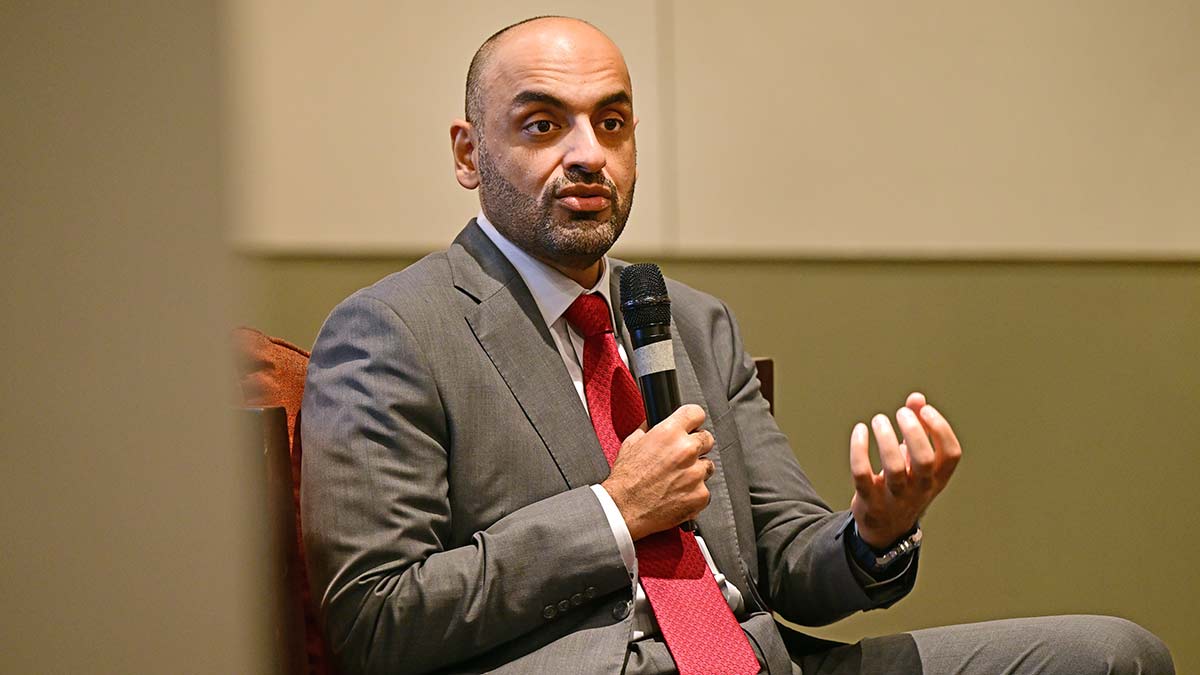
Interview/ Mohammad Ali Rashed Lootah, president and CEO, Dubai Chambers
As president and CEO of Dubai Chambers, Mohammad Ali Rashed Lootah oversees the implementation of strategic initiatives and plans of one of the largest economic development arms in Dubai. He also serves on the board of the Dubai Free Zones Council, Dubai Media Council and Emirati Human Resources Development Council, and is a member of the University of Dubai Board of Trustees. In conversation with THE WEEK, Lootah explains the robust engagement between India and Dubai and the next wave of Indian investments. Excerpts:
Indian firms are now the largest foreign business community at Dubai Chambers. What is driving this surge?
The strongest indication of the depth of this relationship is that growth has continued from an already high base. A record 18,465 new Indian companies joined Dubai Chamber of Commerce in 2025, and a further 7,579 joined during H1 2026. By the end of June, the number of active Indian member companies reached an all-time high of 85,841, up 15 per cent year-on-year. This is also part of a much longer trend. Between 2016 and 2025, the number of active Indian member companies increased by more than 211 per cent.
What is particularly significant is the diversity of this community. Indian businesses are active across trading and services, real estate and business services, construction, transport, and many other sectors. We are also seeing growing interest in technology and other future-facing industries.
Q/ Where does India rank among Dubai's top FDI source markets? Which sectors are pulling the most Indian capital?
India was the leading global source country for greenfield FDI capital into Dubai in 2025, accounting for 18.7 per cent of the total. Indian FDI into Dubai reached US$ 2.28 billion across 337 projects during the same year. Over the decade from 2016 to 2025, Indian investment into Dubai totalled around $8.8 billion. This reflects the increasingly strategic role the emirate is playing in the international expansion plans of Indian companies.
The sector mix is also becoming broader. Alongside established areas of activity, we are seeing significant opportunities emerging in AI and the digital economy, advanced manufacturing, agritech and the green economy. Our engagement with Indian businesses is increasingly focused on connecting companies with opportunities in these high-potential sectors.
Q/ Where is the next wave of Indian investment headed?
The next wave of Indian investment will be broader in scope and increasingly driven by technology, advanced industries and innovation. Indian companies bring strong expertise in areas such as AI, deep tech, fintech and digital services, while Dubai provides an environment where new technologies can be commercialised and adopted at scale.
Dubai’s new two-year agentic AI initiative, led by Dubai Chambers, is helping turn this potential into practical opportunities. The initiative is designed to accelerate private-sector adoption through specialised training, incubators, support for companies developing and using agentic AI solutions and dedicated funding. For Indian technology companies, this creates new avenues to contribute to Dubai’s digital transformation and bring innovative solutions to market.
The potential also extends well beyond the digital economy. We see significant scope for growth in advanced manufacturing, agritech, green technologies and next-generation logistics. Across these sectors, Indian companies can combine their expertise with Dubai’s business ecosystem, international connectivity and access to global markets to develop new partnerships and expand internationally.
Q/ How has the India–UAE Comprehensive Economic Partnership Agreement changed things on the ground for businesses moving between the two markets?
The CEPA has translated the strength of the UAE–India relationship into practical commercial advantages. The agreement significantly reduced or eliminated tariffs across a wide range of goods, simplified customs procedures, and expanded market access across over 100 services subsectors. For companies, that means fewer barriers, easier access to opportunities and a more efficient environment for doing business across the two markets.
The momentum since CEPA entered into force in May 2022 is clear. Non-oil trade between Dubai and India increased by 35 per cent between 2022 and 2025, rising from AED 164.9 billion to a record AED 222.5 billion. Our shared ambitions are also continuing to grow.
Q/ For an Indian business deciding where to expand next, what makes Dubai a strong bet?
For an Indian business owner, one of Dubai's biggest advantages is that it reduces many of the practical barriers associated with international expansion. Companies enter a market with a highly developed business ecosystem, advanced infrastructure, access to capital and talent and strong connections with customers and partners. They are also operating within an environment designed to enable companies to make decisions quickly and pursue new opportunities as they emerge.
The scale of existing Indian participation is another important factor. With more than 85,000 active Indian companies already registered with Dubai Chamber of Commerce, companies entering the market are joining a mature and highly established business community.
That wider confidence is reflected in Dubai's overall investment performance. In 2025, Dubai ranked first globally for greenfield FDI projects for the fifth consecutive year, attracting 1,253 projects.
Q/ Do you think Dubai can be the launchpad for Indian companies with global ambitions?
Dubai can provide an international base from which an Indian business can build its presence across several regions while continuing to pursue opportunities in major global markets. Dubai’s strength lies in the combination of connectivity and market access. Businesses can engage with customers, investors, suppliers and partners across the Middle East, Africa and wider international markets through Dubai’s highly developed trade, logistics and financial infrastructure. This allows companies to centralise important parts of their international operations, develop cross-border partnerships and enter multiple markets from a single well-connected base.
We are already seeing this change in the way Indian companies approach Dubai. Increasingly, they are establishing operations here with regional and international scale in mind, rather than viewing the emirate solely as an individual export market.
Q/ Where do you see the trade corridor between Dubai and India five years from now?
The next milestone should be measured by the depth of the relationship as much as by its overall size. Trade will remain fundamental, and the UAE and India have already set an ambitious target to double bilateral trade to $200 billion by 2032. But, over the next five years, we also expect to see a greater share of the relationship driven by investment, technology, innovation, and companies building long-term operations across both markets.
AI, deep tech, fintech and digital services will emerge as important new pillars of cooperation. We also want to see more partnerships between companies, more joint innovation, and more Indian businesses using Dubai as part of their international growth strategies. If we achieve that, the relationship five years from now will be larger, broader, and more deeply integrated across a wider range of sectors.
