



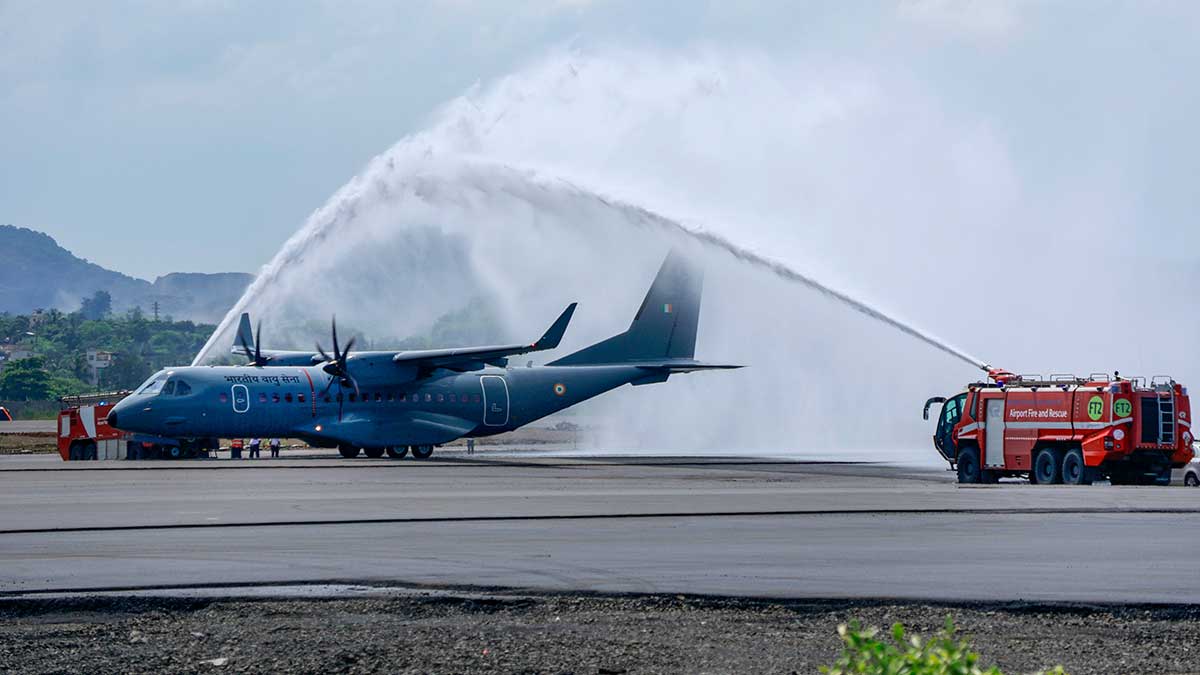
About a month ago, in a hot summer sky, a military plane came to life high above Vadodara in Gujarat. It was no ordinary flight, though.
The C-295 was the first-ever large-bodied plane to be ‘Made in India’, part of a Rs22,000-crore collaboration between Airbus and Tata to produce 56 transport planes for the defence forces. While 16 of these would come in a fly-away condition from abroad, the remaining 40 were to be assembled in India.
“From the seas to the skies, our India is becoming increasingly secure and self-reliant,” said Prime Minister Narendra Modi, in his Mann ki Baat radio broadcast soon after the flight.
Despite being one of the biggest aviation markets, the fastest-growing in the world, India imports each and every one of the aircraft it needs. Its airlines have on order nearly 2,000 planes, possibly more than any other country in the world, either from America’s Boeing or Europe’s Airbus. “For the next 10 to 15 years, Indian carriers will induct about 100 aircraft annually,” said Union Civil Aviation Minister Ram Mohan Naidu earlier this year. All of them will come from foreign manufacturers, as things stand now. In fact, India does not even have the capability to build a certified airline bucket seat, let alone a plane. Timetooth Technologies recently earned certification for seats, but for small aircraft.
It then begs the question: while a concerted effort has been there to develop indigenous military aircraft as well as to acquire aerospace technology in defence, why is it that India has always been an importer when it comes to civil aircraft?
Surprisingly, it is not because it could not, but it would not.
Ghosts of our own making
“Capability was there, but priority was different,” said C.G. Krishnadas Nair, former managing director and chairman of Hindustan Aeronautics Limited (HAL). “When India became independent, it did not consider at the political level that aircraft manufacturing was a priority item. To some extent, India considered that as a luxury item. That we did not have the money to spend for that. HAL had the capability then, but there were problems at the border, so the government took a decision that whatever capability we had would be used for making military aircraft, not civil aircraft.”

Nair, in his just-released book Indian Aircraft Industry: A Brief History and the Way Forward, called it ‘a lost opportunity’. The first commercial flight in India took place in 1911, just eight years after the pathbreaking Wright Brothers flight. And J.R.D. Tata’s iconic maiden flight of Air India (then called Tata Airlines) took place just two decades later.
After the World War II, during which HAL engineers picked up expertise in assembling and overhauling warplanes, the country’s domestic aviation thrived, with the firm doing a roaring business converting some 200 war-surplus Dakotas into civil planes. Several private airlines flourished, before a government policy in 1953 shut them all down and converted them into two public-sector airlines, Air India and Indian Airlines.
“Although India then had a large number of domestic private airlines, it did not consider manufacturing commercial aircraft, as such requirements were perceived to be small and could be met by imports from foreign OEMs,” Nair reminisced.
In fact, J.R.D. Tata did win a contract to manufacture light aircraft during the war years, but his hopes to expand his Pune facility to make civil planes after independence were dashed when the government’s Industrial Policy Resolution of 1948 reserved the aircraft industry as a ‘strategic’ sector under the control of the government. “If the Tatas were allowed at that time to start this, perhaps it would have gone on to become an aircraft company like Boeing,” said Nair.
HAL continued to make foreign planes under licence from the UK’s A.V. Roe & Company (better known in India as AVRO) and Germany’s Dornier, but these were strictly for defence use. In fact, any proposal from HAL to venture into the indigenous manufacture of planes for civilian use was promptly shot down by the mandarins in New Delhi, said Nair.
Learning to fly, again
The liberalisation of the sector in the early 1990s dramatically altered the scenario. The post-liberalisation surge in middle-class prosperity, the arrival of private airlines and affordable airfares led to an air travel boom.
From one crore passengers in the mid-1980s, when there were just Indian Airlines on domestic routes and Air India on international routes, the number of air travellers jumped to 2.6 crore after the Open Skies Policy of the early 1990s. Last year, the number of domestic air passengers alone was around 17 crore. Catering to their needs is an ever-expanding fleet of planes—around 800 in operation at the last count.
ETA delayed
India now wants to be part of an elite group of nations that have passenger aircraft manufacturing capabilities. Two announcements this year have been the most serious in intent, in a series of pledges dating back to the 1990s, when India first spoke of getting into aircraft manufacturing.
The first is the tie-up of HAL with the Russia’s UAC, which makes the Sukhoi. The plan is to make the SuperJet-100, a narrow-bodied passenger plane that can accommodate 100 plus passengers. Announcing the collaboration at the civil aviation trade fair Wings 2026, the then HAL chairman and managing director D.K. Sunil said that the plan was to lease 10 or 20 of these planes before going in for local production at HAL’s facility in Kanpur or Nashik. “We see a good market, upwards of 200 aircraft, for an aircraft of this size in the Indian market,” he said. Ravi K., the current chairman and managing director of HAL, declined to comment.
The other is the deal between Brazil’s Embraer and Adani, which talked about making E-175 regional jets. Jeet Adani, director of Adani Defence & Aerospace, said that the partnership was “a vision taking flight”. “It represents India’s determination to make world-class aviation capabilities on our own soil…. turning aspiration into action,” he said. The venture is reported to have zeroed in on Dholera in Gujarat as its base, with a likely start of production by 2028.
The mile-high club
It goes without saying that it will be an uphill battle. The complexity of technology is one factor, while the enormity of the task, ranging from R&D and skilled manpower to the availability of components and raw materials, is another. Not to forget, of course, the economic feasibility of it all.
The commercial aircraft market is almost entirely ruled by Boeing and Airbus—96 per cent of all large commercial aeroplanes sold come from either. Trying to join that high table will take all of India’s dexterity, and then some.
However, there are lessons India could learn from the two entities that control the remaining 4 per cent—Embraer, and, more importantly, China’s COMAC.
Lessons from the Great Wall
The Commercial Aircraft Corporation of China was set up in Shanghai the year China made its ‘debutante ball’ on the world stage—the Beijing Olympics in 2008. The aim was straightforward: break the west’s duopoly in aviation.
COMAC has since built the regional jet ARJ21 as well as the C919, which competes directly with the Airbus A320 and the Boeing 737, the bread-and-butter models of civil aviation. These narrow-body jets can carry around 175 passengers and form the bulk of the world’s, and India’s, fleet. COMAC is also ambitiously developing the C939, a massive wide-bodied aircraft for long-haul international routes.
COMAC, however, is yet to receive certification from regulators in the US and Europe, which means the planes cannot be used on international routes with the exception of a few neighbouring countries. EASA, the European regulator, has bluntly said that the validation is a complex exercise and would take at least two more years.
Is India ready for that long walk on that tightrope. And more importantly, should it really bother reinventing the wheel?
Fasten your seat belt
For India, the attraction lies in the fact that all the growth its domestic air travel market has seen in recent years pales in comparison to the projected growth over the decades to come. That would require thousands of aircraft. Doesn’t that make for sound economics?
“No, it is impractical to make the economics work,” said a former IndiGo executive who did not wish to be named. “We are trying to force-fit something when there is no unmet need here.”
There are two options before India—first, the tie-ups like the one announced between Embraer and Adani; and second, India attempting its own indigenous commercial aircraft manufacturing. “I don’t know how viable manufacturing a passenger plane in India will be. At the end of the day, you are competing with Airbus and Boeing, who have been doing this forever,” said the industry veteran.
Some experts believe the upcoming collaborations for 100-seater passenger planes will not work in India even for UDAN, the government’s subsidised regional air connectivity scheme. “You have too much fuel being burnt with only 100 seats in a plane, and unlike other markets like the US where such regional jets pay pilots less and charge customers more, you can’t do that in a price-conscious market like India,” he said.
The alternative—going for the 130–200 passenger-capacity sweet spot where most of India’s domestic traffic now plies—may not be smart, either. Airbus (A320) and Boeing (737) have this category sewn up with a global scale model which makes the economics work. An upstart competing against such behemoths will find the climb too steep.
And China might not be the right example to emulate. “The Indian aviation market is a drop in the bucket compared to China. And China can make something like local manufacturing work because it is all controlled. In India, you can’t mandate airlines to buy only from local manufacturers,” said the industry veteran.
Long haul
The cost factor isn’t much of an advantage, either. Take maintenance, repair & overhaul, or MRO, which the government has been pushing to set up in the country. Earlier, all planes and engines in India used to be sent abroad for MRO. But the fact is that the cost difference isn’t much, as parts, which make up 85 per cent of the cost, still have to come from abroad.
That is why experts believe India needs to aim for a supply-chain ecosystem first. There are a few Indian parts suppliers to Boeing and Airbus, and the effort should be to develop this further. While aircraft manufacturing, which is more about assembling components developed and manufactured across a global supply chain, could still be aimed for, actual progress would be achieved only when a component industry rises up.
“Aerospace supply chains are shifting to India whether it is fuselage, landing gear, engine blades or some other components. Once that happens in a big way, feasibility of complete aircraft manufacturing in India increases. Obviously, they will still need to find capabilities of assembling in India which very few players are doing. But I think that’s more of a long-term bet,” said Ishank Kataria, partner at the consultancy EY-Parthenon.
The Modi government has been nudging the likes of Airbus and engine maker GE to set up manufacturing in India, but nothing has fructified yet.
But like all good things, it is better late than never. “Today, being a $4 trillion economy, I don’t think the government will really push any of the funds or focus towards commercial aircraft manufacturing,” felt Kataria, “But as the economy grows and develops strong capabilities in some of the core areas required for complete aircraft manufacturing, then the government could start thinking about these things.”
Manoj Chacko, managing director and CEO of FLY91, an Indian regional airline based in Goa, perhaps sums it up best: “The country has a large and growing demand for aircraft, components and aviation services, supported by a strong engineering and technology talent base,” he said. “These factors provide a solid foundation for building globally competitive aerospace manufacturing capabilities.”
India, it seems, is in it for the long haul, and is not ready to wait twiddling its thumbs at the departure gate anymore.
India’s strengths and weaknesses
Advantages
* India is already a big supplier of components and services, including design and engineering, to Airbus and Boeing. The brains are there, only the factories and engines have to follow.
* India has a good chance to become a global MRO hub (maintenance and repair); this is where steady jobs and money lie.
* World wants to reduce its dependence on China for raw materials and component manufacturing. India could be a beneficiary of the ‘China plus one’ shift.
Disadvantages
* The lacunae is engine making, a zealously guarded technology only a handful possess. Though the government has been trying to get makers like GE to set up shop, they are wary after the China story.
* Lacks the layered network of component suppliers that mature aviation nations enjoy.
* An aircraft is as good as its certification to fly. Indian regulators need to acquire spotless credentials for the rest of the world to accept an India-made plane.
* Setting up an aircraft assembling plant does not amount to much savings, since parts come from all over the world.
* Not easy to force leading airlines like IndiGo and Air India to order locally manufactured planes
