



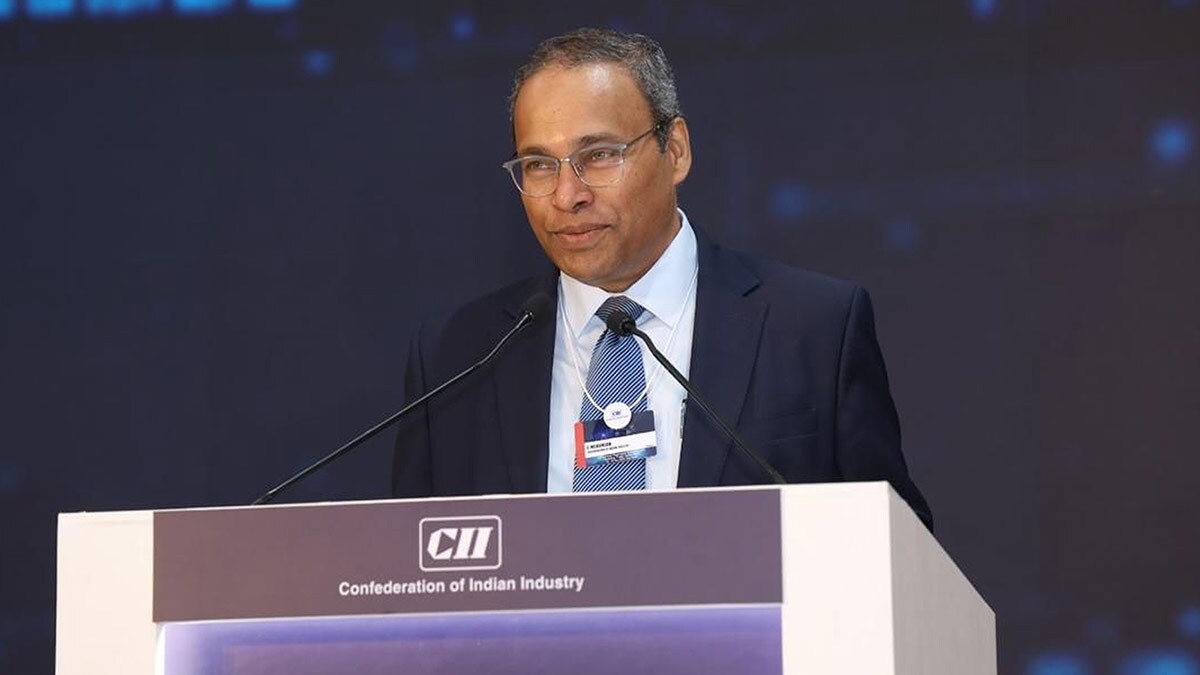
Interview/ R. Mukundan, president, Confederation of Indian Industry
India’s economy has been facing strong headwinds ever since the US-Iran military conflict began. The GDP growth rate is expected to dip this year; the rupee has been the worst-performing currency in Asia; the threat of inflation looms; and the global rally in AI stocks has been draining foreign direct investment (FDI) from the domestic market.
Despite these challenges, R. Mukundan, who took charge as president of the Confederation of Indian Industry (CII) in May, is bullish about the resilience of the Indian economy. A Harvard alumnus and managing director and CEO of Tata Chemicals, Mukundan says Indian businesses have long exhibited the ability to tide over crisis. Excerpts from an exclusive interview:
Q/ How can the Indian economy get out of the present fix?
We have just come through massive disruptions on multiple fronts. There have been disruptions in West Asia, geopolitics and technology.
But these disruptions also provide an opportunity to do what we have always been advocating—continue reforms and improve competitiveness of not just the industry, but agriculture and service sectors as well; and at the same time, preserve the well-being of the common citizen.
There are broadly four areas—four Fs—in my reform agenda. One is fiscal and monetary policy reform. Then there are foundational reforms—looking at competitiveness, ease of doing business, cost of doing business and speed of doing business. Third is factor reforms—land, labour, power and infrastructure, including logistics. When these things, like roads, rail and freight corridors are addressed, the private sector feels more encouraged to put capital in place. We also cannot ignore energy transitions.
I will go to the fourth—being future ready. We need to work with the farm and mining sectors, and education and health. You pick a sector, and [you would find that] the industry needs to spend more of its revenue on how to use technology and innovate [in that sector].

The current context has highlighted one big issue in terms of FDI flows. How do we improve it? I think there are mechanisms to make it easy for FDI to come in. It is also related to one foundational issue I spoke about—ease of doing business.
We now know the next powering of India cannot come on the back of just selling to India only. Indian firms have to open themselves to reach out to consumers around the world. At the same time, we must open up India for FDI to come in.
We need to shift from FTA (free-trade agreement) to FTU—free trade utilisation. There are opportunities in every area for which we have signed agreement. Utilisation ratios can be improved, which then effectively opens up Indian goods to the foreign market.
We have to increase the momentum and we need to scale up, which is why we say things like PLI (production-linked incentives) are important.
Q/ If you say India is on a sound foundation and has great growth levels, why is it that we see so much stress everywhere—from unemployment to [small] companies struggling.
We have this analogy of an adolescent child whose joints feel pain, or some kind of awkwardness, all the time. It is not stress. The body is growing, and in that growth, sometimes, something grows faster, something is slower. It takes a process of adjustment.
So till we become what our prime minister says, Viksit Bharat, or till we hit a per-capita income of, let’s say, $20,000—which we will hit soon—a similar sort of process will continue.
Q/ The per-capita income right now is [between] $2,000 and $3,000.
It is more than $3,000. The issue is, there are parts of India that are above this and others that need to grow. If these parts don’t grow, the average won’t move up. And you will have extreme inequality.
Q/ But isn’t that exactly the issue? The economic restructuring of the last six years and Atmanirbhar Bharat—haven’t they accentuated it?
We had less than 100GW of power; we are now talking about 500GW. We have crossed 100GW in just renewable energy. Look at mobile phones—16x growth. Power—3x growth. Roads—5x growth. These are not small numbers.
If you say, ‘We have had such growth, but why the stress?’ [Because] you design a system needed [for] four trillion (a $4 trillion GDP). But if you are hitting four, you [would] try to design systems which are ready for $8 trillion [in GDP]. That is the process.
And there will be external events which will come. The stress that you see now (oil crisis) is not just an energy issue. This pressure point is coming from an event over which we have no control. Everyone is facing it.
Now, we may be doing well, but is that fair to the common man? So, obviously, there is also what I would call a per-person issue. Our GDP numbers are good, but we need to improve per-capita [figures]. Compared to other countries, we have done well, but we should also do better.
We have to look at the current situation as an opportunity. We are extremely well placed, but our ambition must not be less than double digit [in terms of GDP growth].
Q/ Have you seen major economies growing at 10 per cent or more?
See, this is the whole issue. If [English athlete and neurologist] Roger Bannister had said nobody can cross the four-minute (barrier) in running a mile, nobody would have crossed it.
But after Bannister crossed it, everybody started crossing it. So, the reality is that we are limited by our vision. We are also limited in terms of our capability and internal cohesion. We need to have cohesion—people should come together, the vision should be clear and, finally, we must build capability.
Q/ Finance Minister Nirmala Sitharaman used to say that the government has done as much as it could to facilitate the corporates, but they still have not made as much capital investment as needed.
[Last year] Rs9.7 lakh crore of private investment came. [It was] Rs6.9 lakh crore [in 2024] and Rs7.7 lakh crore [in 2025].
Now, let me give some data. [Investments in] metal products including steel is Rs75,000 crore, which is getting implemented now. Automotive sector investments, including Toyota’s plant in Aurangabad and the expansion of Hyundai and Maruti put together, is Rs76,000 crore. This is happening in one year, not in two or three years.
The expansion in chemical products that is happening in both public and private sectors is Rs68,000 crore. In textiles, it is Rs37,000 crore.
So, the point about investments needing to gather momentum may have been true four or five years ago. In the last two years, we have seen the momentum increasing.
In fact, CII did a poll, [which found that] despite the crisis in West Asia, investment commitments have not come down. People are saying that West Asia reconstruction will be a big opportunity. Defence is going to be another big opportunity.
Q/ Then what exactly is the issue? Are we underemployed, or are we not qualified enough? Is our young generation out of sync with what is required today?
We have to tell the youth that skill-based education is equally important. Also we have to upskill people.
The new education policy is so flexible. The biggest issue is that we have to go to universities saying, ‘Please adopt it. It actually adds points to your degree for vocational skills.’
Q/ Corporate India needs to go global. What exactly do they need to do, or are they already doing it?
Indian businesses have gone global in sectors you would not even believe. India was the second-highest investor in the US in terms of physical capital investment last year. [US Ambassador to India] Sergio Gor made that statement.
When we had the [tariff] crisis with the US last year, we were able to pivot with the support of the government within a month. Our fastest-growing markets have been some of the new ones that opened up in Africa and other places.
Sometimes crisis helps. We have responded well. Indian capital is going abroad to grow. Our issue is, we have to increase the foreign capital coming in.
