



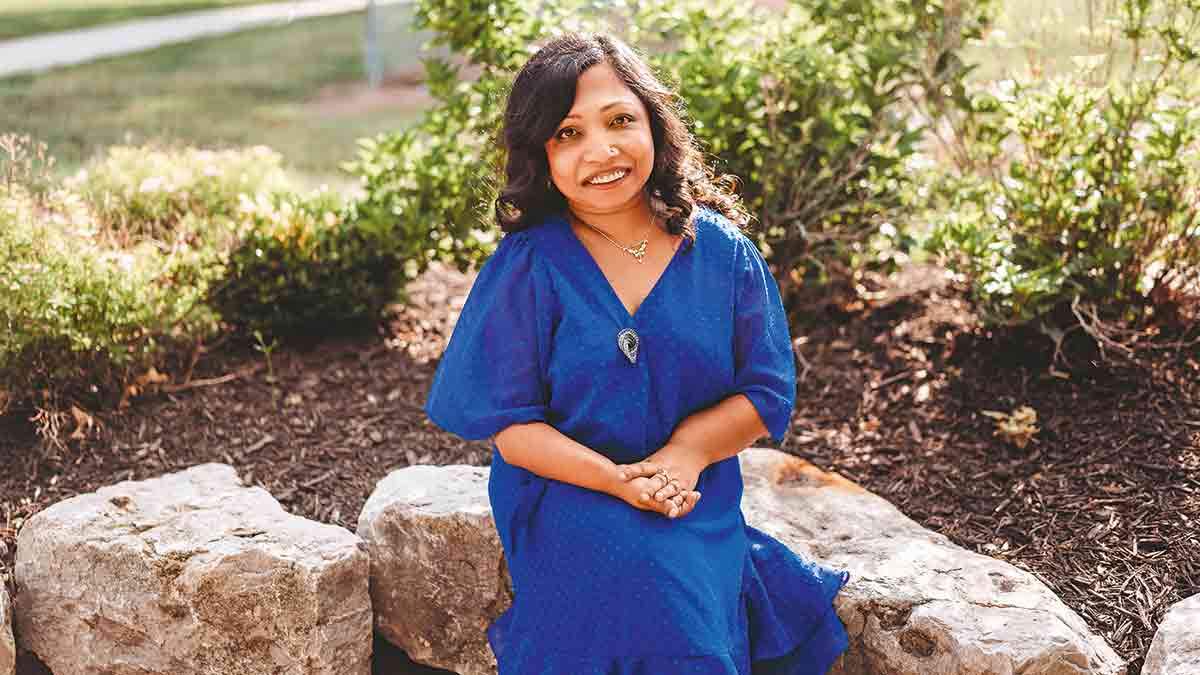
Around 16 years ago, while pregnant with her second son, Neena Nizar, a 32-year-old Indian expatriate in Dubai, began to suspect that the unanswered medical mystery she had lived with all her life might also be affecting her children. Her older son, Arshaan, was about two-and-a-half years old then and had shown no signs of ill health. At birth, he was a healthy nine-pound baby. And, he had met all his developmental milestones, and walked and ran normally.
During a routine ultrasound in Neena’s fourth month of pregnancy, doctors noted that the foetal femurs were measuring approximately two weeks behind expected development. They reassured her that the discrepancy would likely resolve on its own. However, by the six-month followup scan, the gap had not improved, and Neena began to feel that something was off.
Around that time, Arshaan developed a slight swelling around his ankles. Though the swelling did not appear concerning, Neena sought medical advice. She was initially told there was nothing to worry, but soon blood tests revealed that Arshaan had elevated calcium levels. Given her history of unexplained skeletal abnormalities, severe short stature and numerous childhood surgeries without a definitive diagnosis, the findings raised concerns.
“That was when I began to worry that something was wrong with both my children,” recalls Neena. “For the first time, I started wondering whether whatever I had lived with my entire life could be affecting them, too.”

Determined to find answers, Neena turned to her medical records. Many of her childhood records were incomplete, and no historical X-rays were available for comparison. Frustrated but increasingly convinced that there was a connection, she spent countless hours searching for information on skeletal dysplasias—rare genetic disorders that cause very short height and other growth issues—that might explain both her condition and the emerging signs she was seeing in her children.
“I was trying to piece together my story through my children,” says Neena. “It felt as though they were giving me puzzle pieces that I had never been given as a child. For the first time, I felt that there might be a way to understand what was happening to all of us.”
Neena began sending Arshaan’s X-rays to skeletal dysplasia experts around the world, hoping someone could identify the condition. But no one had an answer. Just as she was beginning to lose hope, the answer came from the most unexpected place—her home state of Kerala. The answer: she and her children have a rarest of rare condition called Jansen’s metaphyseal chondrodysplasia, or simply Jansen’s disease. That diagnosis by Dr Sheela Nampoothiri, clinical professor and head of paediatric genetics at Amrita hospital, Kochi, set Neena, now based in the US, on a journey to find people around the world with similar conditions. That journey has eventually culminated in the development of a drug of which Neena is now the first recipient. She is currently undergoing a brave human trial that could help not only those with the same rare condition, but also people with some less rare hormonal disorders.
Life in an old world
Neena was born in 1978, the middle child of a Dubai-based engineer father, Abdul Karim Nizar, and homemaker mother Sunaitha Nizar. As an infant, she was underweight and weak, missed developmental milestones and by two and a half years had developed bowed legs and a waddling gait. “People thought I had polio,” she recalls. “I had received all my vaccinations, so that was confusing. My parents took me home and tried physiotherapy, food supplements, different types of milk and other treatments. But I wasn’t gaining weight or growing properly. My head was very big, and I had big eyes. So, we were given different diagnoses.” By the age of five, her forearms also started bowing. Notably, her two siblings didn’t face any such issues.
When she was three, her parents took her to London for surgery to straighten her legs. Little did they know that this would be the first of many surgeries she would undergo during childhood and adolescence. The surgeries were difficult, and Neena did not enjoy being in hospital. But her parents never allowed the surgeries to define her childhood. “Every time we went for surgery, my father would plan a trip around it. We would go to Disneyland or visit different places, and he really helped take my mind off it. So, my memories of those trips are more about the places we went to and the things we enjoyed,” she says.
Today, Neena, 48, is a US-based global advocacy leader for rare diseases. She holds a master’s and an MPhil in English, as well as a doctorate in interdisciplinary leadership from Creighton University in Omaha, Nebraska. She attributes all of this to the way her parents raised her—they never focused on things she couldn’t do. “It was always about the things I could do, or figuring out ways in which I could do them,” she says. “For instance, my father would make special shoes for me because I could never find shoes that I could wear over my AFOs (ankle-foot orthoses) and other supports. He would make shoes for me and adjust my clothes. He would tailor them. Even today, when I go back to India, he stitches my clothes and adjusts them for me.”
Though her parents created a supportive environment at home, Neena’s school years in Dubai in the 1980s exposed her to the challenges of navigating an ableist world. Her school was not designed to accommodate students with disabilities. “There was no elevator, so you had to take your time climbing stairs while everybody rushed past you,” she says. After surgeries, when she could not use the stairs, her younger brother would carry her school bag to her classroom and often be reprimanded for entering the school’s girls section. And, if she missed school, then the onus was on her to catch up on the syllabus. But she does not begrudge her teachers or the school. “Now when I think about it, I am like, ‘how stupid that was.’ But at that time, you don’t know that these are things that are not set up properly,” she says.
Her experience had taught her enough about accessibility and disability and she began writing about it at 15, even winning a prize for her first article. “So, I had some kind of advocacy in me early on, but I never really recognised it or understood that it was connected to who I am today,” she says.
After class 12, Neena received a scholarship to pursue higher studies in the US. But the condition of her legs required further surgeries, prompting her family to relocate to Kerala. Here, they found Dr Cherian Kovoor, a Kochi-based specialist in Ilizarov treatment, a surgical technique that uses an external device to gradually reshape, lengthen or repair bone. “My father was always looking for newer treatments or anything that could help me,” she recalls. “So, he said, ‘You study in Kerala, because then you can also access this treatment.’ That’s how we came back home.”
Neena underwent Ilizarov treatment on both legs, followed by several more surgeries. Meanwhile, she took admission in All Saints’ College in Thiruvananthapuram. Despite the college’s old and inaccessible building, the teachers and administration went out of their way to support her through her surgeries and studies.
India still has a long way to go on accessibility, says Neena. “Even now, when I come to Kerala, I cannot move freely,” she says. “The roads and floors are so uneven.” During a recent visit, she could not bring either her or her children’s wheelchairs, severely limiting where they could go. A building, she says, may be accessible but the road leading to it may not be. “Here [in the US], my children can go everywhere. My son drives, and they are able to move around using their power wheelchairs,” she says. “That is one of the reasons we stayed here and weren’t able to continue staying in India, because it is simply not possible for them to have the same quality of life.”
Highs and lows
After college, Neena worked for a while at Technopark in Thiruvananthapuram before deciding to return to Dubai on her own. “My mother was very upset and worried. But my father said, ‘Let her go and see what she can do,’” she recalls.
In Dubai, she joined her alma mater, St. Mary’s Catholic High School, as an English teacher and became increasingly involved in disability advocacy. She joined a special families support group that organised activities and events for children with disabilities, and started a Best Buddies programme at her school, pairing students with and without disabilities. “I got involved because it was something I was passionate about,” she says. She soon noticed that children with disabilities had few social activities, prompting her to organise and lead summer camps for them.
Around that time, she met her future husband, Adam J. Timms, online. He was interested in her work with the disability community and travelled from the US to Dubai to meet her. They soon decided to get married. “I called my parents and told them, ‘There’s someone from America who wants to marry me.’ They were very excited because my mother wanted me to get married and settle down.” Her parents had always worried about whether she would marry and what would happen to her after they were gone. “I think that’s something disability has created in Indian society—it becomes a big concern,” she says.
Her take on marriage though is different. “Whether people with disabilities marry or not isn’t the measure of a fulfilling life,” she says. “People can be happy either way. I have met many individuals who are unmarried and living rich, meaningful lives. But at that time, marriage was one of my parents’ biggest concerns.”
Neena and Adam got married in 2006. When they began thinking about having children, doctors initially told Neena that she would not be able to conceive. “We thought, ‘Okay, maybe that’s true.’ We started planning to adopt and were getting the paperwork ready when I became pregnant in 2008. Then they told us, ‘Don’t go ahead with the pregnancy because you will die,’” she recalls.
The couple consulted several doctors, who warned that Neena would not be able to carry the pregnancy to term and that the baby would not grow or survive. But there was no indication that anything was wrong. “The baby was developing perfectly normally,” she says. “Every checkup was fine, and I didn’t have any problems.”
And, Arshaan came into their lives. He was born healthy and for two years or so his parents had nothing to worry about. But then they saw something unusual happening to his body.
Light at the end of the tunnel
Nampoothiri spent the first decade of her career as a paediatrician and the next two as a geneticist. “As a doctor, I always pray that whatever we do should ultimately help patients, and that I should have the wisdom to do the right thing at the right time,” she says.
In her career, Nampoothiri has diagnosed and treated thousands of patients with genetic disorders, but she recalls diagnosing Neena and her children as one of the “serendipitous moments” of her professional life. “Discovering such a rare disorder in a patient, seeing a drug being developed for it, and then seeing that drug reach the same patient—I feel that is something that may happen only once in a doctor’s entire career, if at all,” she says.
It was at her father’s insistence that Neena went to see Nampoothiri in Kochi. “My father saw Nampoothiri on television. As I told you, he is always looking out for these things,” she says. “He called me and said, ‘We should go and see her.’”
In October 2010, Jahan was born. More than a month later, Neena took Arshaan to Nampoothiri for a consultation. Nampoothiri examined X-rays of Neena and Arshaan. Neena recalls her saying, “I think I know what you have!”
Nampoothiri had undergone training in skeletal dysplasias under Prof Andrea Superti Furga in Germany, but she says the diagnosis was not something she could announce the moment she met Neena and her children. “We are not superhuman, especially when dealing with a condition this rare,” she says.
The X-rays and clinical features pointed to metaphyseal dysplasia, a group of skeletal disorders affecting the growing ends of long bones. Three possibilities were considered: Schmid metaphyseal dysplasia, cartilage-hair hypoplasia and Jansen metaphyseal dysplasia. All three can cause short stature, bowed legs, abnormal metaphyses and a waddling gait. But hypercalcaemia is a key clue to Jansen’s disease.
“I knew it wasn’t Schmid or cartilage-hair hypoplasia, so I started wondering whether it could be Jansen’s disease,” says Nampoothiri. After consulting reference books on rare skeletal disorders, she was able to make the diagnosis the same day.
Initial tests at the hospital included measurements of calcium and parathyroid hormone (PTH). In Jansen’s disease, calcium levels can be elevated despite low or normal PTH levels. Incidentally, Nampoothiri asked Neena to bring Jahan for a consultation two days after diagnosing Jansen’s disease in her and Arshaan.
“They did not know that the younger child also had the condition because there had been no genetic diagnosis,” recalls Nampoothiri. Jahan was also diagnosed with the disease based on radiography results.
Jansen’s disease is an autosomal dominant disorder, meaning an affected person has a 50 per cent chance of passing the condition to each child, explains Nampoothiri. It became clear that Neena had passed it on to both her children. The disease is caused by activating mutations in PTH1R, the gene encoding the parathyroid hormone 1 receptor protein, which plays an important role in regulating bone growth and calcium and phosphate metabolism. In Neena and her children, the mutation was H223R, wherein histidine, an amino acid, is swapped for arginine at position 223 of the receptor. The mutation causes PTH1R to remain abnormally active, which could result in PTH-independent hypercalcaemia and hypercalciuria (too much calcium in blood and urine, respectively). However, overt hypercalcaemia is not present in every person with Jansen’s disease. It was later found that Neena did not have overt hypercalcaemia, while both her sons did.
The disorder can also affect the kidneys. Hypercalciuria can lead to nephrocalcinosis, in which calcium deposits accumulate in the kidneys, as well as kidney stones and, in some cases, impaired renal function.
After the diagnosis, Nampoothiri came across the work of Dr Harald Jüppner, a paediatric endocrinologist at Harvard Medical School in Boston, who had spent decades studying calcium and phosphate regulation. Jüppner was exploring a potential way to treat the underlying problem: an inverse agonist, a drug designed to reduce the receptor’s abnormal activity. Nampoothiri contacted Jüppner and arranged genetic testing for Neena and her children, which confirmed the diagnosis. The three blood samples had been de-identified, so Jüppner initially knew only that they came from three patients with Jansen’s disease somewhere in India or the Middle East. Nampoothiri and Jüppner jointly published a study that assessed the condition in Neena and her children.
“When we received the diagnosis from Dr Sheela, I searched online for information about the condition but found almost nothing. The only paper I could find was written by Dr Jüppner,” says Neena. “In it, he mentioned the possibility of turning off the overactive PTH receptor with an inverse agonist. That single idea gave me hope. When I returned to Dubai, I contacted him. He was surprised to hear from me! I told him I was interested in the concept of an inverse agonist and asked if we could meet. By then, I had already decided that if there was any chance of a treatment, I would need to move to the United States to pursue it.”
Though Neena and Jüppner agreed to meet, it took years for that to actually happen. Neena was diagnosed in 2010, but immigration restrictions meant she could not move to the US until 2015. Adam, now 52, went before her, in 2013, to set up a home, while Neena remained in Dubai with their children.
Soon after arriving in the US, the family returned to hospital care as the children needed surgery. Watching her sons undergo repeated surgeries has been harder for Neena than dealing with her own condition. Both have undergone multiple orthopaedic surgeries to correct leg deformities and spinal fusion surgeries to address spinal complications, and require extensive rehabilitation. “The hardest part as a mother is seeing them really struggle with it,” she says. Yet having the same condition helps her understand what they need and improve their quality of life. “They are very smart boys, very fun-loving, and they love life,” she says. “They have good friends, they do well in school, and they are very well supported.”
In that sense, she has been able to give them things she did not have as a child. “It’s a much better life for them because they have access to so many things,” says Neena, For instance, Arshaan got his driving licence at 17. “I didn’t get my licence until I was 28,” she recalls.
Neena finally met Jüppner in person in 2016, at the National Institutes of Health’s (NIH) Rare Disease Day event in Washington, D.C. Although Jüppner had studied conditions that could lead to Jansen’s disease, this was the first time he had met a person living with the condition. Notably, in 1996, Jüppner’s colleague Dr Thomas J. Gardella had discovered a potential peptide that could turn off a defective PTH1R gene. And that wild potential of creating a drug became Neena’s and Jüppner’s core conversation topic. “When we met,” says Neena, “I asked him, ‘What can we do to make this drug happen?’”
Jüppner told her they needed massive funding. Determined to help move the science forward, Neena founded The Jansen’s Foundation in 2017, a nonprofit. Neena’s advocacy helped Jüppner and his team at Harvard secure an R01 research project grant from the NIH. That seed funding supported preclinical research. Since then, the foundation has broadened its fundraising efforts and provided resources and support to patients around the world.
Neena recalls that when she first started, she was told it could take two decades to develop the drug and cost around $20 million. “That is very discouraging for anyone in the rare disease space,” she says. “How does somebody who has no connection to the drug development world figure out how to raise that kind of money, find an investor or find people who can help?”
With no established network in the US, Neena had to learn the intricacies of drug development herself. “I just went and figured out who I needed to talk to, what I needed to do,” she says. “I didn’t even know that you have to develop a mouse model to test something, and then you need a toxicity study. Then you need to figure out whether you will get approval from the regulators to actually test it in human beings. I didn’t go to school for any of this. But you become the professional in the room. You have to. There was no other option.”
Neena discovered the NIH’s National Center for Advancing Translational Sciences (NCATS), which helps move promising discoveries from the laboratory into treatments for patients, particularly for rare diseases that have been largely overlooked by industry. Recognising the potential of an inverse agonist to treat Jansen’s disease, Neena partnered Jüppner and his team. And, they successfully secured an NCATS grant, enabling the research to advance from promising mouse studies towards human clinical trials. For the first time, a potential therapy for Jansen’s disease was on a path from scientific concept to patient treatment. By around 2018-2019, researchers had developed a mouse model to test the drug using Neena’s cells. But Covid-19 delayed the research and its progression towards human trials.
Neena’s initiatives, meanwhile, also made her an international voice for rare disease patients and their families. “I have given talks in many countries and at many venues. I have talked about drug development, rare diseases and the diagnostic pathway, and how we can improve it,” says Neena, who has been invited to participate in a side event on rare diseases held alongside the UN General Assembly in New York City on September 23.
Moreover, the Jansen’s Foundation worked with clinicians, families and research networks, and identified and connected approximately 30 patients with Jansen’s disease. “We created a website and shared images and information about the diagnostic journey,” says Neena. “Now, when people find out they have some kind of bone condition, or that they have Jansen’s disease or something similar, they immediately find our foundation through an online search. And then they contact us. We’ve had doctors reach out to us asking, ‘Could this be Jansen’s disease?’”
With such a small patient population, pharmaceutical companies have little financial incentive to invest. But Neena believes the value of studying ultra-rare diseases extends far beyond the patients affected. “The mechanisms we study in these populations can give us answers to much larger diseases,” she says. Researchers note that study into Jansen’s disease could also offer insights into other disorders involving the parathyroid hormone receptor. In time, the drug could potentially help patients with hyperparathyroidism, they say. Currently, these patients require surgery to remove their parathyroid glands. “Now that we have achieved the clinical trial stage, we are getting people interested in us because our drug can potentially be used for other conditions as well,” says Neena.
As part of the human trial, Neena has so far received the drug to assess its safety and tolerability. Subsequent stages will help determine the optimal dose. Once efficacy is established, her children may also join the trial. The injections are currently administered by the clinical team, but Neena expects to eventually self-inject at home.
The drug cannot undo the damage Jansen’s disease has already caused. Yet, Neena is taking the risk so her children—and others with the disease—might have a better future. The trial involves intensive monitoring. Blood tests are conducted at several points each day to check for toxicity, liver problems and other potential side effects. The team also closely monitors her temperature, heart rate, blood pressure, weight and liver function.
Being the first patient to receive a drug that has never before been tested in humans is, in some ways, like “stepping on the moon for the first time”, says Neena. “But when you get there, you realise, ‘Oh, now I have to build a house on the moon. Now I have to think about how to live on the moon.’” She had to spend 10 weeks away from her family and work. “But I was very fortunate. My whole community and the rare disease community were sending me cards, gifts and flowers, and FaceTiming me. So, that helped the time pass,” she says. “And the clinical staff there were excellent. The nurses really hold you in such high regard because you are selflessly doing this for a larger community. So, they were always very supportive.”
Neena will now undergo further testing to determine the right dosage. She says she did not initially recognise the significance of what she had achieved. “When global media started recognising it, and people started messaging me, it was only then that it really dawned on me what an incredible thing it was,” she says. “You just do it because, as a mother, you do your best for your children. And so, that is exactly what I did.”
