



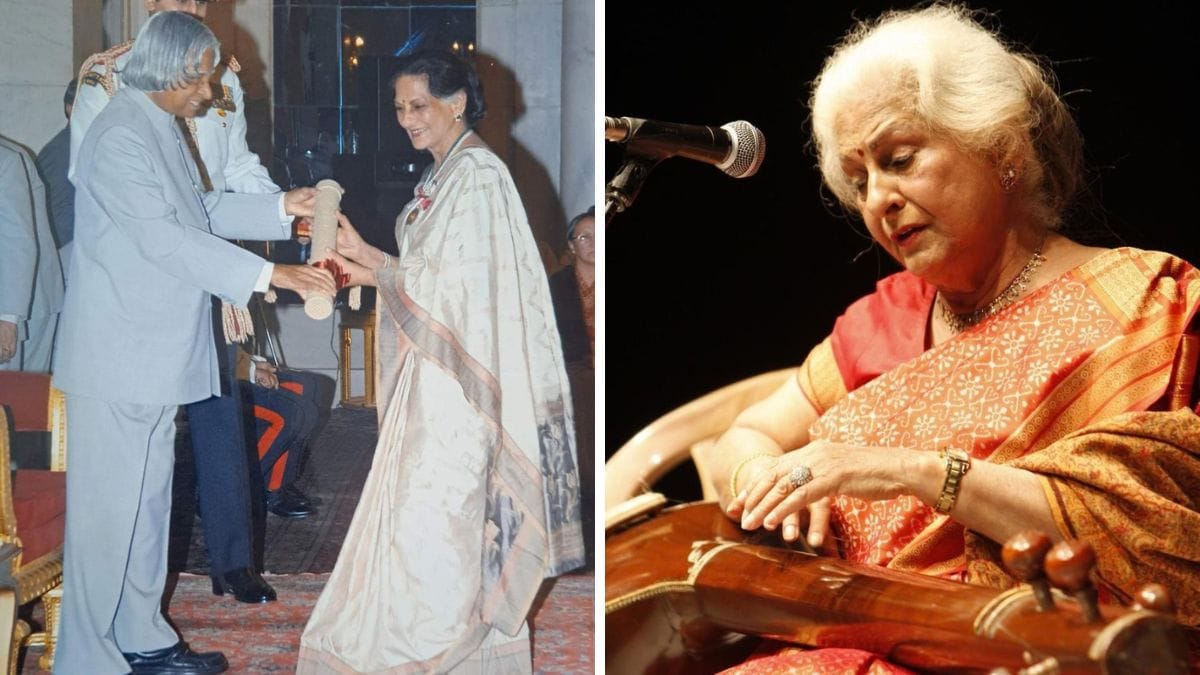
At an age when most people look back on life, Vidushi Shanno Khurana continues to look ahead.
At 98, she still practises her music every day. No ceremony, no award and no milestone has persuaded her to believe that she has learnt enough. Ask her about her musical journey and she responds with disarming simplicity: “There is still so much to learn.”
Perhaps that is the most revealing sentence about a musician who has spent more than eight decades immersed in Hindustani classical music.
A distinguished exponent of the Rampur-Sahaswan tradition, Khurana is a vocalist, researcher, teacher, theatre artiste and innovator. She has explored the great gharanas of Hindustani music, researched Rajasthan’s folk traditions, and brought classical ragas to the theatre through ambitious musical productions. Yet, despite the honours and recognition that have come her way, she continues to see herself not as a finished artist but as a student.
For Khurana, music is not merely something she performs. It is the atmosphere in which she has lived.
The child who listened to the radio
Born on December 23, 1927, in the princely state of Jodhpur, then part of British India, Shanno was one of eight children of Chaman Lal Kumar, a railway engineer, and Jamuna Bai. She was originally named Raj Kumari. Her name was later changed to Shanno, after a woman from Jalandhar who had come to Jodhpur to raise funds for a social cause.
Her childhood was marked by an early personal tragedy. She lost her mother in a railway accident when she was only four.
Music, however, entered her life almost instinctively.
She would sit beside the radio and listen intently to the great voices of Roshan Ara Begum, Hirabai Barodekar and Narayanrao Vyas. Then she would try to reproduce what she had heard. There was already something unusually attentive in the way she listened—a quality that would later become central to her musical personality.
A wandering ascetic once visited the family home and, looking at the little girl, told her father that she was destined to perform on stage.
The prediction stayed with her.
But becoming a professional musician was hardly considered a respectable career for a girl from a conventional family in those days. Women performers were burdened with social prejudices, and classical music was still associated, in the public imagination, with courtly and hereditary traditions. Her father therefore did not want his daughter to take up music professionally.
Shanno persisted.
Eventually, her determination prevailed, and she began training under Pandit Raghunath Rao Musalgaonkar, a respected musician associated with the Gwalior tradition.
Decades later, she would remember her first guru with affection and admiration. He was, she recalled, so dignified and modest that he would scarcely raise his eyes while teaching.
A question that changed her life
The defining moment of Khurana’s early musical life came in Lahore.
After her marriage to Dr Parmeshwar Lal Khurana, she moved to Lahore. Her husband was deeply supportive of her musical aspirations. He understood that music was not a pastime for her; it was an essential part of who she was.
In 1945, the young Shanno received an invitation that would alter the course of her life.
Jeevan Lal Mattu, a senior figure associated with All India Radio’s Lahore station, had already noticed her talent. Mattu was a perceptive talent scout who had earlier recognised the promise of another young Punjabi singer—Mohammed Rafi.
He asked Shanno a deceptively simple question:
“Would you like to sing on the radio?”
She readily agreed.
At the Lahore studio of All India Radio, she sang Raga Multani. She was paid ₹25 for the broadcast—an exciting reward for a young singer.
But the real lesson came immediately afterwards.
As she was leaving, Mattu stopped her and asked her to explain the difference between the treatment of certain notes in Todi and Multani.
She had no answer.
The excitement of her first radio appearance disappeared instantly.
Yet that embarrassment became a blessing in disguise.
Instead of being discouraged, she made a resolution: she would understand Hindustani music in its depth—not merely sing it, but study its grammar, aesthetics, history and subtle distinctions.
That moment of realisation stayed with her for the rest of her life.
Partition and a new beginning
The years that followed were turbulent. Communal tensions were rising, and the subcontinent was heading towards Partition.
In 1947, Shanno and her husband left Lahore for Delhi.
The move meant beginning again in unfamiliar surroundings. But her husband’s support remained unwavering. On one occasion, he told her with unusual seriousness:
“If you do not find time to practise, you will lose everything.”
The words were prophetic.
All India Radio became an important part of her musical life in Delhi. The eminent tabla player Pandit Chatur Lal would come to her home and accompany her practice. Radio broadcasts and her association with Sangeet Bharati further strengthened her musicianship.
She was no longer simply a promising singer. She was becoming a serious student of music.
The scholar behind the singer
Musicologist Thakur Jaidev Singh recognised the depth of her potential and encouraged her to pursue advanced studies at Indira Kala Sangeet Vishwavidyalaya in Khairagarh.
The decision was not easy.
Shanno was reluctant to leave her family merely to pursue her own ambitions. Her husband, however, encouraged her to go.
At Khairagarh, she received the affection and intellectual support of Vice-Chancellor Pandit S. N. Ratanjankar. She immersed herself in the academic study of music and eventually became the first woman to earn a doctorate in music from the university.
The experience broadened her horizons.
For Khurana, performance and scholarship were never separate worlds. A raga had to be experienced emotionally, but it also had to be understood intellectually.
Her subsequent research included a comparative study of the distinctive features of eight major Hindustani gharanas, as well as extensive work on the folk music of Rajasthan. Both areas of research eventually appeared in book form.
The demanding guru
Back in Delhi, another decisive chapter unfolded when she came under the tutelage of Ustad Mushtaq Hussain Khan, one of the towering figures of the Rampur-Sahaswan gharana.
The maestro did not accept disciples casually.
Shanno had to demonstrate not merely talent but discipline, patience and complete commitment. Eventually, he accepted her as a ganda-bandh disciple.
The relationship profoundly shaped her musical identity.
When Ustad Mushtaq Hussain Khan died in 1964, she was devastated. But one of his teachings remained permanently etched in her consciousness:
“Can a musical note ever be Hindu or Muslim?”
For an artist who had lived through Partition, the statement had a significance far beyond music. It was a philosophy of art—and of humanity.
A voice beyond gharanas
Although firmly rooted in the Rampur-Sahaswan tradition, Khurana’s music has never been confined by the boundaries of a single gharana.
The precision and openness associated with Gwalior can be heard alongside elements of Agra’s robust musical architecture. Her deep study of different traditions gave her a rare ability to understand music comparatively rather than competitively.
She became equally accomplished in khayal and in forms such as thumri, tappa, maand, hori, kajri and chaiti. That breadth was one of the distinguishing features of her artistry.
She did not see classical music as an isolated elite tradition. For her, it was part of a much larger cultural continuum in which folk music, theatre, poetry and classical forms could speak to one another.
When Shanno became Heer
Khurana’s artistic curiosity did not stop at music.
In 1956, she accepted theatre director Sheila Bhatia’s invitation to appear in the musical production Heer Ranjha. At 29, she was relatively unknown to Delhi’s theatre-going public.
Her performance changed that.
As Heer, she combined a commanding voice with striking dramatic presence. Audiences were captivated.
After one performance, Jawaharlal Nehru is said to have embraced her and exclaimed: “Wonderful, my girl!”
The role made her widely known in Delhi’s cultural circles and revealed another dimension of her artistic personality.
She subsequently turned to Sohni Mahiwal, another tragic Punjabi love story. In her musical interpretation, nearly 40 ragas were woven into the narrative.
It was an ambitious experiment—not a Western-style opera, but an Indian musical theatre form rooted in the grammar of Hindustani music.
During the 1960s and 1970s, she went on to create other musical productions, including Jahanara, Chitralekha and Sundari.
Her purpose was clear: to take classical music beyond the traditional concert hall.
As she explained her philosophy: “I thought, why shouldn’t classical ragas reach the common man?” That question perhaps explains much of her career.
A lifetime of honours—and no sense of arrival
Khurana’s contribution to Indian music has been recognised with some of the country’s most prestigious honours.
She was awarded the Padma Shri and later the Padma Bhushan. She became a Fellow of the Sangeet Natak Akademi, its highest distinction, and has received several other major cultural honours.
But awards have never defined her.
What defines her is the discipline with which she has approached music for more than eight decades.
Her life has unfolded through some of the most dramatic chapters of modern Indian history—colonial India, Partition, the rebuilding of independent India, the evolution of All India Radio, the expansion of the modern concert circuit and the changing relationship between classical music and the wider public.
As December 23, 2026 approaches, Shanno Khurana is poised to enter her birth centenary year. She will complete 99 years on that day and begin the 100th year of a life devoted almost entirely to music. Her 100th birth anniversary will fall on December 23, 2027.
At 98, she remains remarkably alert, intellectually curious and faithful to her daily riyaz. She continues to listen, reflect, practise and learn. There is no sense of having arrived, no complacency born of a lifetime of achievement.
That is perhaps what makes her story so extraordinary.
She has lived through some of the most turbulent and transformative decades of the Indian subcontinent—colonial rule, Partition, migration, the birth of independent India and the changing landscape of Hindustani classical music. She has been a performer, scholar, teacher, researcher, actor and innovator. She has received some of the country’s highest honours and left an enduring imprint on India’s musical and theatrical traditions.
Yet, after more than eight decades of sadhana, she remains a student.
“There is still so much to learn,” she says.
Those words perhaps capture the essence of Shanno Khurana better than any award or title ever could. For her, music has never been a destination to be reached; it has been an endless journey of discovery.
As she enters her birth centenary year in December 2026, the remarkable story of Shanno Khurana is therefore not one of an artist looking back at a completed journey. It is the story of a lifelong seeker who continues to walk towards the next note, the next raga, the next revelation.
At an age when most people count the years behind them, Shanno Khurana continues to listen for the music that lies ahead.
The author is a retired state tax officer with Uttar Pradesh state tax department
