



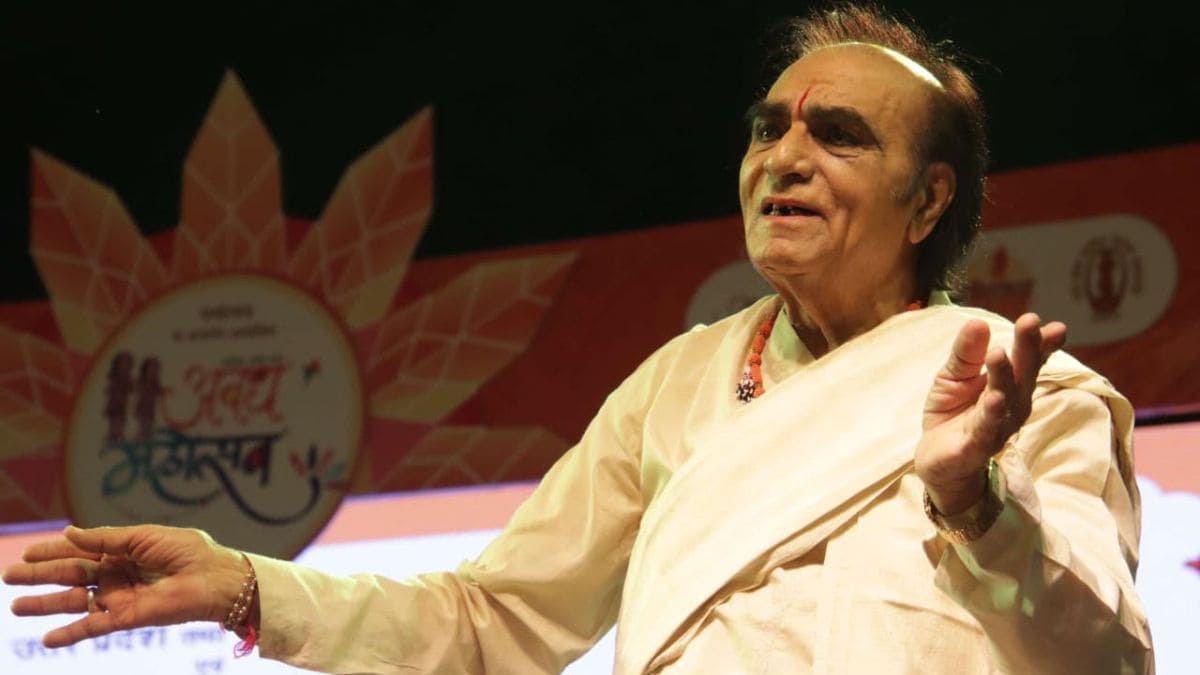
There are many who see Kathak merely through the jingle of ghungroos, the rhythmic stamping of feet, the whirling movements and expressive gestures. But those who have kept alive within themselves a restless curiosity to explore the history, shastra and the aesthetic sensibility concealed behind these elements are rare.
Dr Puru Dadheech belongs to this rare tradition. For him, Kathak has never been merely a dance form; it has been a discipline of study, research and teaching, an exercise in creative reconstruction and, above all, a means of understanding India’s cultural memory.
On August 13, 2026, at Vigyan Bhavan in New Delhi, President Droupadi Murmu conferred upon him the Sangeet Natak Akademi Fellowship, Akademi Ratna. The Fellowship is the Akademi’s highest honour.
But Dadheech’s story does not begin with an award. To understand him, one must return to the young man who decided not merely to learn Kathak, but to understand the vast world of knowledge and tradition that lay behind it.
Born in Ujjain on July 17, 1939, Puru Dadheech trained in the Jaipur gharana tradition of Kathak under such eminent gurus as Pandit Durgaprasad, Pandit Narayan Prasad, and Pandit Sunder Prasad. He studied the Natyashastra under Babulal Shastri and literature under Shivmangal Singh Suman and Acharya Srinivas Rath. This confluence of dance, dramaturgy, and literature gave birth to both the artist and the scholar within him.
Perhaps the most significant aspect of Dadheech’s personality is his determination to take Kathak into the serious academic world of the university. According to the official biography of the Sangeet Natak Akademi, he was the first scholar in Kathak to receive the degree of Sangeetacharya, then known as D.Music. His research focused on 'The Origin and Development of Kathak Dance'. His subsequent extensive research into the Sanskrit theatrical tradition culminated in a Ph.D.
Here, Dadheech’s journey takes an intriguing turn. At a time when, for many, Kathak began and ended on the stage, Dadheech was venturing into texts and manuscripts in search of its history. His research also examined the desi dance forms and elements of dance described in mediaeval treatises. Documents relating to the Government of India’s Tagore National Fellowship likewise record his research interest as an analysis of desi dance forms and dance elements described in mediaeval texts. For him, therefore, the history of Kathak was never a closed chapter. It was a continually unfolding book.
This quest eventually led him to questions that challenged some of the prevailing assumptions about the origins and evolution of Kathak. His scholarship brought the Natyashastra, Sanskrit literature, mediaeval sources, and later Kathak traditions into dialogue with one another.
Rather than viewing Kathak merely as a product of a particular courtly period, he sought to understand its relationship with India’s much older and wider tradition of dance.
As profound as his scholarship has been, his creative world has been equally imaginative. Dadheech also approached the figure of Rama from an unusual perspective. His question was: despite the vast body of literature on Rama, how much of it has found expression in Kathak—particularly in relation to the inner emotions of the nayaka, the male protagonist?
In Kathak, the nayaka has often been viewed through the eyes of the nayika, the female protagonist. But what does the nayaka himself feel? What is the nature of his inner emotional world? This aspect has received comparatively little attention. It was this thought that inspired Dadheech to create a work centred on Rama as the dheera-udatta nayaka—the dignified, noble and heroic protagonist.
As Rama leaves Ayodhya, renouncing his royal attire, meeting his family and friends, offering them solace and restraining the grief within himself, Dadheech’s Kathak brings to the fore precisely this deeply human dimension of Rama. Here, Dadheech ceases to be merely a storyteller; he becomes an artist who enters the inner world of his character.
Another distinctive creation of Dadheech is Kali Stavan, which he conceived especially for Kathak in the Dhrupad idiom. In the 1970s, he made a pioneering effort to revive Dhrupad-nartan within Kathak, while also giving a place in his compositions to his fascination with rare and largely forgotten rhythmic cycles. Kali Stavan, for instance, is set to the 13-beat tala known as Manthika, an uncommon rhythmic cycle.
This detail reveals something fundamental about his aesthetic vision. Dadheech never allowed Kathak to be confined to familiar or popular musical conventions. He sought to rediscover within it the gravitas of Dhrupad, the intricate architecture of rare talas, and a spiritual undercurrent capable of carrying dance beyond entertainment towards sadhana—a disciplined pursuit of artistic and inner refinement.
Another word of profound significance in Dadheech’s understanding of Kathak is thehraav—stillness. Writing about the dancing of the celebrated Kathak exponent Roshan Kumari, he drew attention not only to her extraordinary footwork but also to the remarkable stillness that gave her dancing its distinctive character. The observation reveals the depth of his artistic perception: dance, for him, is not simply movement. At times, a dancer’s pause can be as eloquent and meaningful as a whirl.
This, perhaps, is the essence of Dadheech’s artistic vision: he looks for the invisible within the visible.
His contribution as a teacher has been equally exceptional. He taught and held academic responsibilities at institutions including Madhav Sangeet Mahavidyalaya, Ujjain; the Bhatkhande Hindustani Music College, Lucknow; and the Indira Kala Sangeet Vishwavidyalaya, Khairagarh. He has also served as the director of a research centre devoted to Kathak at Sri Sri University, Cuttack, where, under his guidance, numerous research scholars have earned PhD degrees. In doing so, he forged a meaningful bridge between the oral tradition of the guru-shishya parampara and the structures of modern academic scholarship.
The breadth of his literary and scholarly output is another testament to this expansive vision. His books on Kathak, abhinaya, the Natyashastra, and the theory and history of Indian dance—including the two-volume Kathak Nritya Shiksha—have served as important reference works for students, teachers and researchers. His Kathak Nritya Shiksha has also found a place in contemporary academic curricula.
There is an important truth here: the true measure of a great guru lies not merely in the performances he gives on stage, but in what survives through the generations he shapes. Dadheech has not simply trained dancers; he has nurtured students who understand the traditions, texts and cultural memory embedded in the dance they perform.
His life can therefore be distilled into three words: sadhana, shodh and sanskar—discipline, scholarship and cultural grounding. Sadhana made him an artist; shodh made him a scholar; and sanskar made him a guru.
Dr Puru Dadheech has received numerous honours, including the Padma Shri. Yet, the Akademi Ratna conferred upon him on August 13, 2026, carries a significance beyond the honour itself. It is not merely recognition of a distinguished exponent of Kathak; it is national acknowledgement of a larger principle—that the performing arts cannot be understood in isolation from shastra, history, scholarship and education. The Sangeet Natak Akademi regards its Fellowship as a recognition of sustained and outstanding contribution to the performing arts.
At a time when the artistic world is increasingly shaped by instant popularity, spectacle, and visual impact, Puru Dadheech’s journey reminds us of another path: slower, deeper, and far more demanding. It is a path in which the artist opens a text before stepping onto the stage; in which the dancer turns the pages of a manuscript; and in which the guru teaches the disciple not merely how to dance, but why to dance.
Perhaps that is the enduring significance of Puru Dadheech. Amid the incessant sound of ghungroos, he has taught us to listen for the silence of the shastra.
The author is a retired State Tax Officer, GST Department.
