



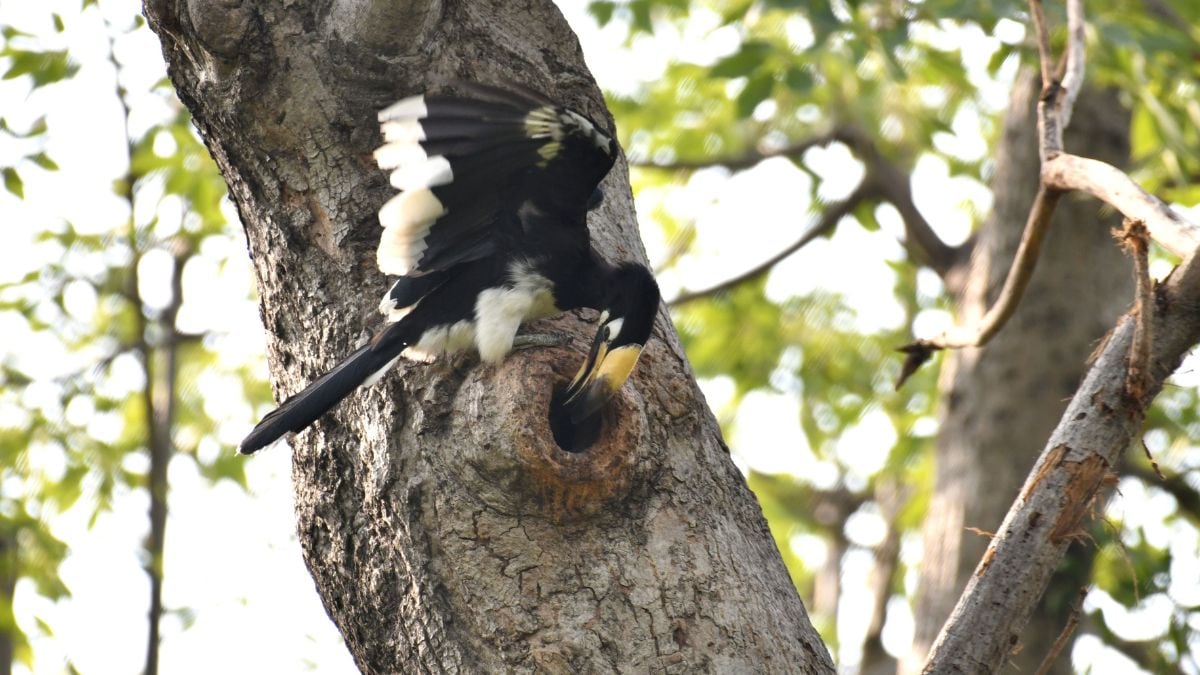
A rare and fascinating wildlife phenomenon unfolding in the heart of Delhi is drawing the attention of birdwatchers, photographers, and morning walkers alike.
At Lodhi Garden, one of the capital's most cherished green spaces, a female Pied Hornbill has been observed feeding chicks in the nest of an Indian Grey Hornbill—an unusual behaviour that has intrigued bird enthusiasts and experts.
Known as a green oasis where history and nature coexist, Lodhi Garden has become the centre of attention for bird lovers over the past few weeks.
The activity is taking place in a nest cavity located in a Semal tree, where Grey Hornbill chicks are being raised.

While the Indian Grey Hornbill is a common resident of the Delhi-NCR region, the Pied Hornbill is not. Yet, one Pied Hornbill appears to have remained in the city, and is now regularly participating in feeding the Grey Hornbill chicks.
According to eBird, the Pied Hornbill is a striking black-and-white bird with a pale yellow bill and a casque, or "helmet". It is also visibly larger than the Indian Grey Hornbill.
Hornbills are renowned for their unique nesting behaviour. Before laying eggs, the female seals herself inside a natural tree cavity using mud, fruit pulp and droppings, leaving only a narrow slit through which the male delivers food. Once the chicks grow, the female emerges and both parents continue feeding the young until they are ready to fledge.
At the Lodhi Garden nest, both the male and female Grey Hornbills have been taking turns feeding the chicks. What has surprised observers is the regular appearance of the female Pied Hornbill as well, which has also been bringing food to the nest. Birdwatchers report that this behaviour has continued for more than two weeks.
The development has generated considerable excitement among photographers and birding groups. Interestingly, social media communities that normally discourage the sharing of active nest photographs have also been posting images and videos of the event. Some regular visitors have even given the birds affectionate nicknames based on their colours and appearance.
Birdwatchers are now eagerly hoping that the chicks continue to thrive and safely fledge from the nest cavity.
Dr. Surya Prakash, a retired academic from Jawaharlal Nehru University and a member of the Indian Bird Conservation Network (IBCN), the Bombay Natural History Society (BNHS) and WWF's Education Department, said he is closely following the development.
"I am still studying the ethno-biological behaviour associated with this Pied Hornbill phenomenon at Lodhi Garden," he said.
Meanwhile, WWF's Delhi office, located adjacent to Lodhi Garden, is planning weekend surveys to assess Grey Hornbill nesting activity and recruit volunteers to monitor nests.
The unusual interaction between the two hornbill species has sparked widespread interest, both online and offline.
For now, however, the real attraction remains high in the trees of Lodhi Garden, where a remarkable example of avian behaviour continues to unfold before the eyes of Delhi's birding community.
