



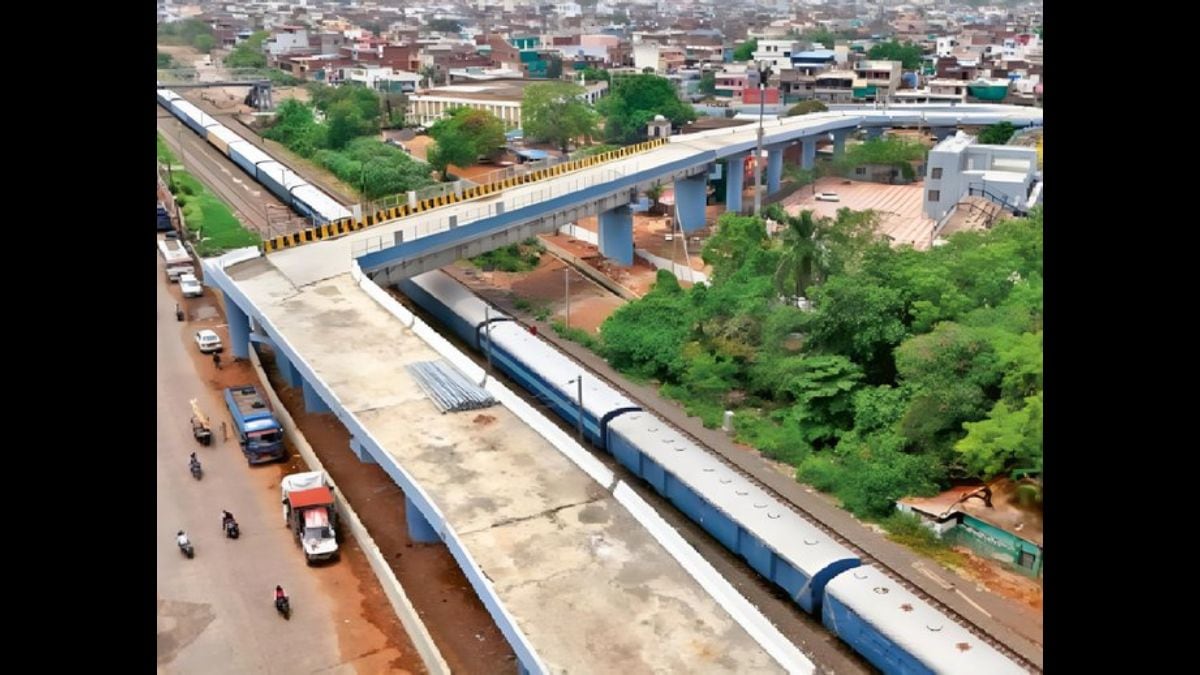
Earlier this week, the latest innovation in bridge design was unveiled at Mira-Bhayandar, a far-flung, fast-growing suburb of Mumbai. A new four-lane highway coursing along without a care in the world suddenly came to a stop. A low concrete wall stood in its way, and four lanes became two.
Now, road-shedding is contagious in Mumbai and other cities around the country. It happens all the time, as hawkers take up permanent residence and spread their wares expansively on public thoroughfares.
But the process is usually evolutionary. It takes months to starve a new highway and reduce it to a gully. But here, forward-thinking MMRDA engineers, anticipating the eventual outcome, incorporated changes right at the design stage and proved conclusively that innovation in bridge design is alive and well.
Bridge building has for long been the cradle of change. In Mumbai’s busiest suburb, Andheri, they had spent nearly a decade rebuilding the Gokhale Bridge. Finally, in an impressive feat of daring, they finished construction of the bridge but did not complete it. Two arms of the bridge were suspended metres apart like unconsummated lovers. Undeterred by the symbol of ill-fated romance, the inauguration went ahead anyway. We take these things in our stride.
Amid bridges being made, unmade and re-made, Bhopal came up with a turn for the better. Believing that curves are reserved for the better things in life, design engineers gave the Aish Bagh bridge a breath-taking 90-degree turn. Euclid would have applauded, but motorists are appalled. Another example of innovation is the seasonal bridge. Like mangoes, a 6-foot long, 10-ft wide structure on the Kari Kosi river comes out only when it’s in season. For the rest of the time, i.e., the flood season, it stays submerged.
There’s a price to be paid, of course, for all such innovations. For bold new designs to come up, the old bridges must fall, the quicker the better. Last year’s monsoon accounted for the collapse of 12 bridges in the space of 20 days, a stunning record of a bridge collapsing roughly every 30 hours.
And what happens to the bridges that stand through it all? They become too well-known and pay the price of popularity, the target of big game souvenir hunters. A 60-foot-long, 30-tonne iron bridge in Chhattisgarh vanished overnight. Other stolen bridges included a 500-tonne bridge in Rohtas district in Bihar where bridge robbers added a filmi touch to the proceedings by posing as irrigation officials executing a state government firman - yeh bridge mujhe deydey thakur.
Now experts tell us that a bridge should be seen as more than a structure that links A to B over C. It’s a must-see tourist attraction. The crowds who used to visit the Howrah Bridge are soon jaded, experiencing deja vu. They’ve seen it all a hundred times before - in movies, on video and photographs. But a couple of years ago, wide-eyed droves came from across the country to Mumbai, curious to glimpse the bridge with the hole. Surely, many more will now make their way to Bhayandar to see the shrinking of the Setu, probably humming the song from Lakhan - ‘four two ka one, one two ka four’.
Also, mind gurus say that some bridges are the latest psychological test. It’s a trendy variant of the traditional question - is the glass half-full or half-empty? If you see a four-lane bridge suddenly becoming two-lane, and think of the traffic trauma caused, you are a pessimist. On the other hand, if you look at the problem from the opposite angle, and see a two-lane bridge expanding into four lanes, you are a sunny optimist.
You will agree there’s more to a bridge than meets the eye. Perhaps Lata Mangeshkar and S.P. Balasubramaniam summed up the teeming sentiments best years ago when they gave us tere mere bridge main…
