



The noughties were a time of disruption when the old rules were giving way to new ones. Geopolitically, the Berlin Wall had just fallen in 1989 and the Soviet Union dissolved in 1991. Its cultural ramifications were many. The excess and glamour of the 1980s gave way to a more grunge and rebellious aesthetic, best defined by Nirvana’s ‘Smells Like Teen Spirit’ which became a youth anthem. Hip-hop became mainstream, with Snoop Dogg, Tupac Shakur and many others dominating the cultural zeitgeist. MTV was not just about music, but also fashion, hairstyles, slang and dance. The 1990s were also the age of blockbusters, sitcoms and boy bands.
Into this mix came the supermodels who straddled all these sub-cultures. Cindy Crawford, Naomi Campbell, Linda Evangelista, Christy Turlington, Claudia Schiffer and Kate Moss were as much a product of their times as celebrities in their own right. They sat at the intersection of fashion, music, TV, advertising, magazines, nightlife and celebrity culture at a time when the media was still unfragmented. It was the last era of everyone watching the same things, reading the same magazines, attending the same events. Soon the internet, which was already moving out of universities and computer labs, would splinter youth culture forever and the media would never again be a monolith.
Many of the supermodels and fashion stars of the 1990s and 2000s were discovered through the Elite Model Look, like Crawford, Gisele Bundchen, Stephanie Seymour and Lara Stone. Originally called The Look of the Year, the Elite Model Look—a modelling competition to discover unknown faces—was founded in 1983 by John Casablancas, the founder of Elite Model Management. “I knew the day I won the Elite Model Look contest my life would change forever and never be the same. I was right. Everything went so fast,” said French model Charlotte Di Calypso, who won the contest in 2005. This year, it took place in Rome with 50 finalists from all over the world. Before the event, the contestants underwent a three-day training session at Villa Cornetto-Bourlot in Tivoli.
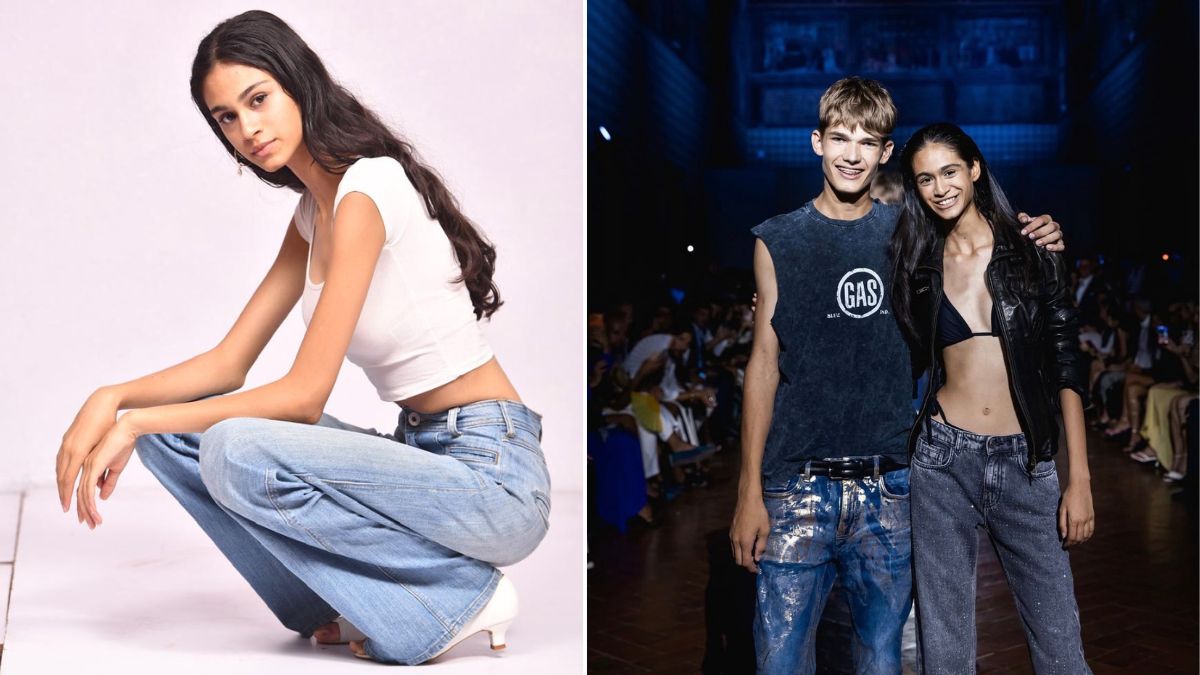
Like many of the previous winners, it seems like 19-year-old Keira Ann Alvares Ganapathy—who won this year’s competition along with Otto Vadskaer from Denmark—was born to model. Her mother being a director of Broadway musicals, she is used to the limelight. She used to perform onstage in minor roles when she was young. Recently, she has taken up dance seriously, being a dance choreographer on the shows for the past three years. She’s never had stage fright and knows how to remain calm under pressure, a skill especially useful before going on the ramp. Not to mention that she has the look for it. In Coorg where she grew up, she says she has often been called too “skinny and malnourished” but when it comes to modelling, her body is perfect.
When I speak with her over Zoom, she is dressed in a striped T-shirt and sweatpants, and seems like your everyday teenager; her style icons are Bella Hadid and Audrey Hepburn, she loves listening to Michael Jackson’s ‘The Way You Make Me Feel’, and has just finished reading The Forty Rules of Love by Elif Shafak. But when she gets ready to walk the ramp, she transforms into a different person. “Once you are dressed, your hair and makeup are done and you’re waiting backstage, something just clicks,” she says. “I feel more focused, confident and a lot more put together.”
One of the things they were taught during the training in Italy was how to handle social media. It is an important lesson that signifies how much the industry has changed since the age of the supermodels. Once upon a time, the model was the celebrity, until the celebrity became the model, when brands chose those with an established following to model their products. A model need no longer have a casting agent or fashion house to back her; she can create her own image and aesthetic. Also, with the internet causing a mushrooming of sub-cultures—like luxury, Tik-Tok fashion, K-pop, beauty influencers and sneaker culture—brands need not have one face representing their products, they can have 10 faces for 10 different audiences.
Still, Keira says that when it comes to runway modelling, the influence of social media is not all-encompassing. “The kind of modelling I want to do—ramp modelling for shows like the Paris Fashion Week—I don’t think I can get there through social media,” she says. “Because with social media, anyone can model. For runway modelling, you need a particular body type and face.”
She does, however, feel models today are mostly of the “cookie-cutter” variety. “In the 1990s, there was a lot more flair to modelling,” she says. “Today, at least initially, everyone has to walk the same, look the same. When you start out, you have to follow everyone else. But how you carry yourself after that, once you’ve established yourself and got your foot in the door—that will make all the difference.”
She has given a lot of thought to what kind of legacy she wants to leave. Sometimes it stresses her out, because she does not yet know how she will make her mark. “I don’t want to be just another name,” she says. In an age when people are turning into brands—their value fixed by engagement, likes and followers—holding on to her humanity might be the first step.
