



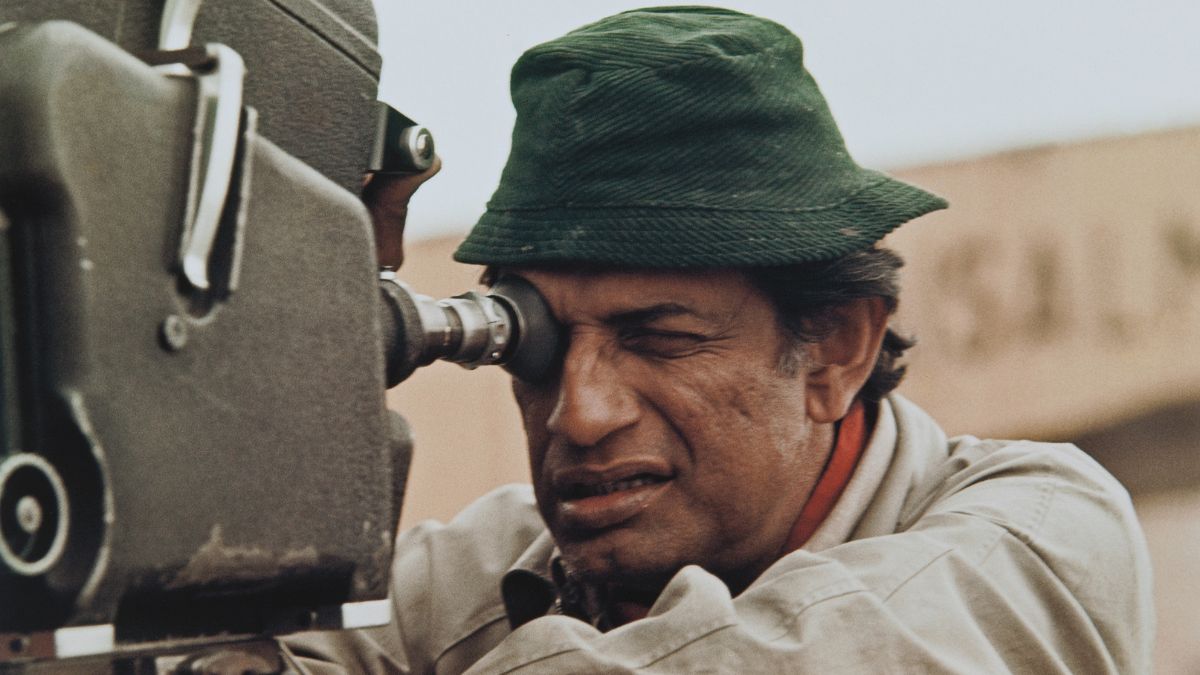
Nemai Ghosh first met Satyajit Ray in 1968 in the small town of Rampurhat in West Bengal. They clicked instantly.
Ray was there shooting Goopy Gyne Bagha Byne (The Adventures of Goopy and Bagha). It was the beginning of a lifelong association between the Indian auteur and the photographer who would shadow him everywhere—from film sets to his home—capturing him in black-and-white and colour, eventually being referred to as Ray’s ‘photo-biographer’ by none other than Henri Cartier-Bresson.
“Everything about him intrigued me,” writes Nemai Ghosh in the preface to Faces and Facets: Satyajit Ray in Colour, a publication featuring rare colour photographs of Ray taken by Ghosh between 1969 and 1991.
The book is part of a month-long exhibition at DAG, which opened in New Delhi on May 8.
The book opens with a picture of Ray in his study, working; a pipe in his mouth, papers and books all around.

“I don’t feel very creative when I’m abroad somehow. I need to be in my chair in Calcutta,” Ray had said.
The image captures the master filmmaker in a space that feels both personal and professional. That is the larger frame the book adopts—showing Ray on the sets of several films as well as in the intimate confines of his home, alongside his wife Bijoya, son Sandip, daughter-in-law Lalita, and grandson Souradeep.
Ghosh captured him, in action, on the set of his many films—Sakha Prasakha, Agantuk, Ghare Baire, Sonar Kella, among others.
In one, from the sets of Sadgati (1981), he is seen being photographed by actress Smita Patil. In another one, he is being interviewed by filmmaker Shyam Benegal for a documentary, with Govind Nihlani on the side.
While the book and the exhibition capture Ray vividly, they also showcase a rich artistic exchange that continues to influence filmmaking to this day.
Ray was a genius, in the sense also that he wrote his scripts, designed the sets and costumes, operated camera, composed music, and even drew posters for most of his films.
In one photograph, Ghosh captures Ray sketching for his popular detective Feluda in 1986. In another particularly striking image, he photographs him designing Wajid Ali Shah’s crown for Shatranj Ke Khilari. Elsewhere, Ray is seen at the keyboard, composing music, sketching, directing: moments Ghosh records to reveal a man immersed in his many crafts.
The book also captures Ray in transition, particularly after he suffered a major heart attack in 1984.
In one simple yet intimate photograph, Ghosh shows him pacing the verandah of his home during recovery. Behind him hangs a portrait of his mother, Suprabha Ray, who died in 1960.
In another image, taken on the sets of Shakha Proshakha, Ray briefs Soumitra Chatterjee, surrounded by members of his unit in Calcutta in 1990, while his doctor looks on.
“I visited his house as often as I liked, at any hour. If I did not turn up for a day or two, there would be a phone call asking why I was absent,” Ghosh writes.
Ray passed away in 1992, but continues to have a deep influence.
“Today his spell is still upon me, even though he is no more,” Ghosh writes about Ray; his Manik Da, as he was referred to.
“Nemai is like a bug on my windowsill,” Ray used to say.
