



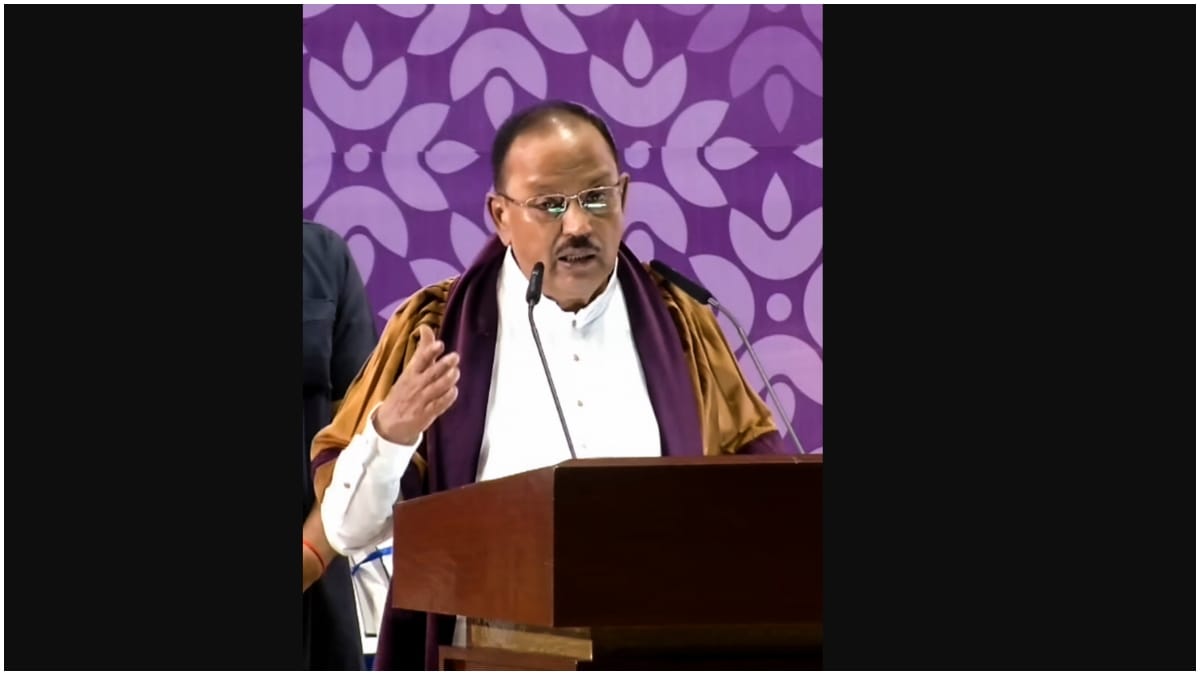
India’s top national security leadership converged at IIT Roorkee on Saturday as National Security Advisor Ajit Doval and Chief of Defence Staff Gen N.S. Raja Subramani urged graduating engineers to lead in a world being reshaped by technology, geopolitical realignment, and the race for strategic self-reliance.
Doval, who attended the institute’s 2026 convocation as Chief Guest and was awarded an Honorary degree, told students that leadership would increasingly depend on the ability to make decisions independently and develop one’s own doctrine.
“Decision-making and building your own doctrine is critical to becoming a leader,” Doval said.
Describing the current generation as particularly fortunate, the NSA said young people today have access to opportunities that previous generations could not have imagined.
“The current generation is the luckiest with abundant opportunities, unlike past struggles. This is the age of technology, engineering, and innovation which drives societal growth, with youth having decades for progress,” he said.
Doval also drew on an episode from his early career as a young intelligence officer posted in Sikkim. He recalled being responsible for monitoring border areas and gathering intelligence on the movement and activities of the Chinese military when an intelligence team sent on a border mission failed to return.
“Five days passed, ten days passed. Then ten more days passed,” Doval recalled.
He was subsequently informed that the team had been taken into Chinese custody. After negotiations, the personnel were released and returned. Doval said he initially believed the incident had ended his career, although an inquiry later found no fault on his part.
An old Tibetan Sherpa colleague in the Intelligence Bureau, however, offered him a perspective that stayed with him: “Life is only a question. Some people get their mapping right; others get it wrong.”
Gen N.S. Raja Subramani, Guest of Honour, asked the graduates to prepare for a world marked by what he termed “DHAARA”: disruption, hyper-connectedness, asymmetry, realignment, and autonomy.
“The world is undergoing enormous disruption; technology is changing faster than we can catch up,” the CDS said. “You as graduates will have to learn, unlearn, relearn, and adapt and be curious throughout if you want to keep up with the changing world.”
He cautioned that hyper-connectivity, extending beyond social media to financial systems, airlines, energy networks, and other critical infrastructure, also creates vulnerabilities. Future engineers and technologists, he said, would have to build systems with resilience at their core.
Subramani also spelt out his message on “Bharat”, with B standing for build, H for harness, A for adaptability, R for research, the second A for atmanirbharta, and the final A for taking responsibility for one’s actions.
“Atmanirbharta doesn't mean isolation. It means having the strategic capability to stand on our own feet, to secure our interests,” he said.
Senior Advocate Harish Salve, a member of IIT Roorkee’s Board of Governors, told students that they were entering a world undergoing a fundamental transformation.
“You are a first generation which is entering a world that is desperately trying to reinvent itself,” Salve said, noting that the rules-based international order that earlier generations had taken for granted was no longer sacrosanct.
“Do not ever take your blessings of freedom and democracy for granted,” he said, adding that technology would be at the core of the emerging world order.
“Never stop dreaming and never stop questioning,” Salve told the graduates.
He also said the world was fascinated by India’s disruptive technology and was anticipating that India would soon lead the race.
IIT Roorkee Director Professor K.K. Pant highlighted the institute’s growing focus on research, entrepreneurship, and strategic technologies. The institute has invested around Rs 400 crore in research and is working closely with the Indian Army, including training 250 Army personnel in artificial intelligence and drone technology.
Pant also highlighted the institute’s hardware technology laboratory and stressed the importance of entrepreneurship to the institute’s future.
“Entrepreneurship is very crucial for our institute,” Pant said, while underlining the need to translate research and innovation into real-world solutions.
The convocation also highlighted the growing participation of female students. A total of 2,071 graduates received degrees, including 702 male and 202 female postgraduates. The institute said the 2026 convocation saw an increase in the number of female students.
Among the students recognised for their achievements were BS-MS Chemical Sciences student Srivardan Balaji, who received the President’s Gold Medal, and Computer Science student Komal Tiwari, who was recognised for cultural excellence.
Salve congratulated the parents of the graduating students, acknowledging the sacrifices made by families to support their children’s education.
“India should be thankful to all of you who have faced hardships for your child’s future. Your tapasya has paid dividends,” he said.
He also reminded the graduates that engineering was ultimately about serving society.
“Engineering is for people,” Salve said, urging the students to act as a bridge for building trust as they enter a world where technology, innovation, and national security are becoming increasingly intertwined.
