



LAST YEAR, The New Yorker ran an article titled ‘The Family Fallout of DNA Surprises’. The strapline spelled out the story: “Through genetic testing, millions of Americans are estimated to have discovered that their parents aren’t who they thought. The news has upended relationships and created a community looking for answers.”
With websites like Ancestry.com and FamilySearch.org becoming popular, more and more families in the west are digging into their roots and discovering surprises.
The big upset came a decade ago when the then Archbishop of Canterbury Justin Welby found out that his father was not Gavin Welby, a whisky salesman, but Sir Anthony Montague Browne, prime minister Sir Winston Churchill’s last private secretary. Welby took the DNA test willingly after The Telegraph approached him with research it had carried out into his family background.
If Indian families go mainstream on DNA sites, we might end up with enough storylines for a few movies, series and books, I guess. What with Indian migration going on for centuries now, imagine the layers that could be added to these plots.
For example, wouldn’t this make for a fantastic storyline: a Georgian Orthodox Christian queen was widowed, and then taken captive by a shah when he invaded her kingdom in 1614. In 1624, he executed her after she refused to convert. He then married two of her daughters.
An Augustinian monk secretly exhumed the queen’s remains and carried them to a country across the seas. There, he buried her in a black stone casket in one of the great cathedrals of the Augustinian order. In the 1800s, the cathedral was abandoned and fell into ruin. In the 21st century, archaeologists found three skeletal remains in a ruined cathedral and handed them over to DNA scientists. One of them was the queen.
Senior Assistant Editor Pratul Sharma’s gripping cover article begins with the facts of this fairytale. The queen was Ketevan of Khaketi in modern Georgia. The shah was Shah Abbas I of Persia. The princesses married in captivity were Marta and Helen. The Augustinian monk reburied the queen in the Church of St Augustine, Old Goa, in 1627.
The Archaeological Survey of India found the remains in 2005, and the scientists at the Centre for Cellular and Molecular Biology, Hyderabad, identified the queen. In 2017, the queen’s remains were sent to Georgia for veneration and returned in 2018.
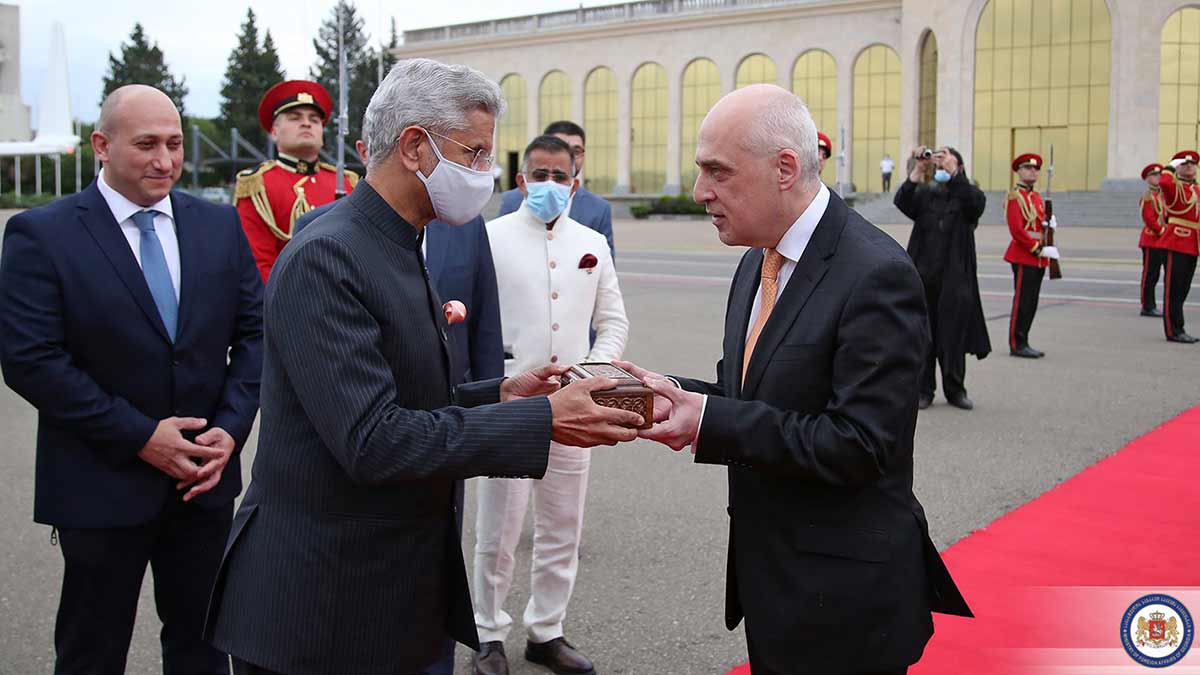
In July 2021, Minister of External Affairs S. Jaishankar accompanied the queen on her final visit back to her homeland after 400 years. The minister was received by then Foreign Minister David Zalkaliani. The relics were carried off an Indian Air Force flight by a ceremonial detachment of the Georgian army, and accorded a guard of honour. After all, she was a queen returning home. In the years that she had been away, the Georgian Orthodox church had declared her a saint.
Later in the visit, Jaishankar handed over part of the relics to Georgia in perpetuity as a gift from the people of India. The importance of the moment was underscored by those who received it on behalf of Georgia—His Beatitude Ilia II, Catholicos-Patriarch of All Georgia, and then Prime Minister Irakli Garibashvili.
The queen today sleeps in two homes across the seas—in her own homeland and in a country that guarded her rest for four centuries.
The entire point of Pratul’s article and this cover is that Indian archaeologists and scientists are using ancient DNA to uncover forgotten migrations, debunk myths, and enrich India’s history and diplomacy. Queen Ketevan is just one chapter of the story. I am certain that you will enjoy the other chapters as much as I did, dear reader.
