


Charles Correa was discussing life with Mary Roy recently when she quoted her son to exemplify a point. Then the architect asked: "Does your son talk?" He went by the novel, which described Estha as having become very silent.
But Lalit Kumar Christopher Roy—sister Arundhati refers to him as LKC in her line of dedication—takes pains to explain that the novel is not that autobiographical. "Everybody now thinks I am Estha. Maybe the character has 25 per cent of me but 75 per cent is somebody else," he says. "Of course, it has experiences and incidents that happened during our childhood."
Arundhati's tale of twins gives the age difference between the kids as 18 minutes. Actually, Lalit is elder to her by 18 months! In the book, Estha wears beige, pointed shoes and sports an Elvis Presley puff. "That was the prevailing fashion of the day and I used to follow that," says Lalit, who is the vice-president of the Frozen Foods Division of the Kochi-based Amalgam group. He, like his celebrity-sister, left home and came up the hard way.
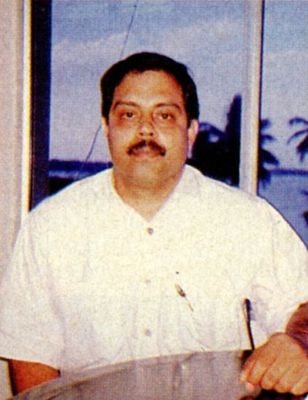 Shades of Estha: Arundhati's brother Lalit Roy
"I made it," Arundhati told him over the phone from London soon after she received the Booker. "Absolutely fantastic. Congratulations," he replied. Ever since she was nominated, he was certain that she will. In fact, he jotted it down somewhere, much before the announcement came, 'Arundhati Roy, winner of Booker Prize, 1997'.
Confessing he has none of her sister's vivid memory, he remembers that Arundhati always had a knack for story-telling. "She would add a lot of spice," he says. The children had their early education in Ooty's Breeks School and Lawrence School before they became the first students of their mother's own school in Kottayam.
"She was a very good student, athlete, orator and a voracious reader. She probably took an interest in writing after she left school," says Lalit. Mary Roy encouraged them to do a lot of reading and writing. As they spent their childhood outside Kerala, they spoke very little Malayalam at home and conversed either in Hindi or English. Both could just manage to read and write in their mother tongue. He remembers that Arundhati used to pester their uncle George Issac, a scholar, with questions about creative writing even in those days.
"Uncle used to take us to the river which she talks a lot about in the book. We learned to swim in that river and developed a great affinity towards it," he says. In the novel, Issac is reborn as Chako and Lalit admits that the character conforms greatly with the original. "But I wouldn't say the same about Rahel or Ammu. I see some traits of my mother in Ammu but some that are not hers," he says.
What about the scene involving the Plymouth car journey about which critics raved? "We fell in love with the film Sound of Music and travelled in a car from Kottayam to Kochi at least five times to see it," he says. "My grand-uncle had a Plymouth car and my uncle owned a blue Vanguard. She combined both to create a blue Plymouth."
He says it is hard to tell whether she will go on to write her second book. "She is somebody who moves about as if a spirit guides her," he explains.
What about the rebellious streak in her character? "My mother is a powerful personality and she brought us up to be very independent. But Arundhati is a very lovable and soft person with a hard exterior," he says.
(Reproduced from issue dated October 26, 1997)